텍스트 → 이미지공간 · 건축스타일 가이드
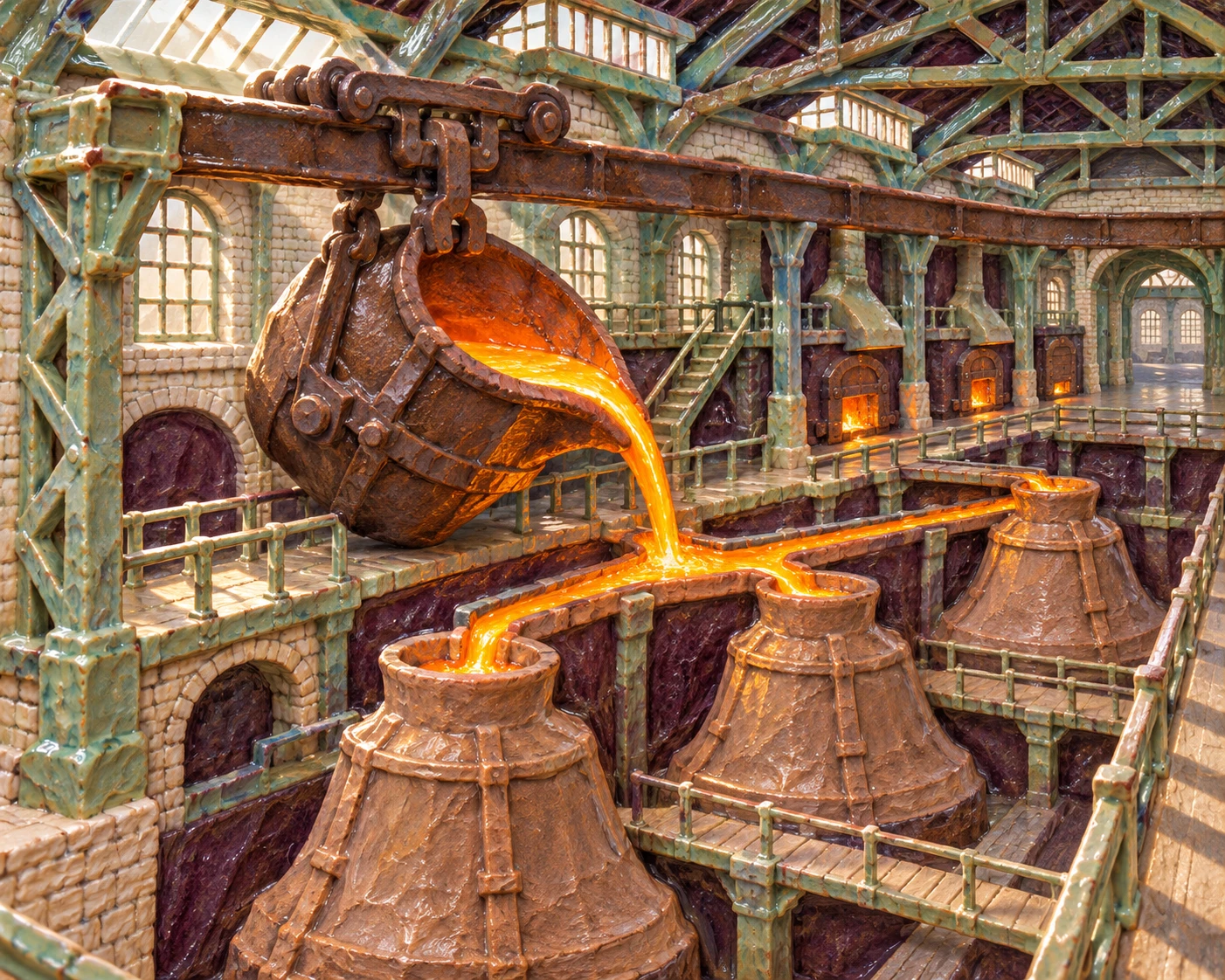
종 주형으로 쇳물이 흐르는 주조장
쇳물 통로와 종 주형, 가대가 겹치는 주조장 내부를 손으로 빚은 도자 부조와 고인 유약으로 표현한다.
이 이미지로 조합하기종 주형으로 쇳물이 흐르는 주조장
- 형태 언어
- 형태를 손으로 눌러 빚은 도자 부조로 바꾸고, 넓고 얕은 면과 둥글게 솟은 덩어리에 작은 수작업의 불균일함을 남긴다.
- 윤곽선
- 말아 올린 점토 테두리와 얕게 새긴 홈으로 경계를 만든다. 균일한 외곽선을 더하지 않고 경계의 부드러움을 달리한다.
- 붓질·입자
- 넓은 조형 도구 자국과 간간이 남은 엄지 눌림이 보이게 하고, 덜 분절된 부분에는 더 느슨한 흔적을 둔다.
- 표면 표현
- 오목한 곳에는 유약을 고이게 하고 능선에는 얇은 반투명 유약을 입히며 일부 점토를 드러낸다. 유약 두께의 차이로 명암을 전이한다.
우선순위
빚어 만든 부조 깊이와 불규칙하게 고인 유약이 도자 일러스트의 특징을 분명히 드러내게 한다.
피할 표현과 결과 확인
이 예시의 실제 생성 프롬프트
MODULE OWNERSHIP
subject: Subject count, type, stable proportions and landmarks, resting face geometry, hair shape, physical materials, garment construction and permanent marks. No emotion, movement, color assignment or rendering recipe.
expression: Facial soft-tissue displacement and pupil direction, muscle coordination, regional intensity, asymmetry and onset/peak/release. No head/body pose, stable appearance, skin color or rendering.
gesture: Head/neck/body/limb orientation, joint movement, support, contact and pose-caused occlusion using existing anatomy. No eye/pupil movement, emotion, identity, props inventory or camera.
props: Prop count, type, construction, physical material and scale relative to the subject. Holding/contact belongs to gesture, position to composition, color to palette.
scene: Environment elements, terrain, backdrop/floor presence and structural detail. No canvas positions, camera, lighting, assigned colors or render texture.
camera: Projection, focal-length impression, camera elevation/yaw/roll, viewing distance and crop. No actor pose, world placement, lighting or canvas aspect ratio.
composition: Normalized 0-100% canvas positions, scale in frame, depth/overlap, focal hierarchy and margins. No joint pose, camera projection, rendering, subject/prop inventory or emotion.
palette: Color anchors, hue/saturation/value ranges, colors assigned to parts and approximate color coverage. No illumination direction, shading algorithm, physical material or layout.
lighting: Light-source direction/softness/intensity, ambient illumination, physical shadow direction/length and highlight position. Absence of directional illumination is allowed. No shading technique, palette or material changes.
style: Reusable form abstraction, contour weight/taper/edge quality, medium and mark scale/density/direction, surface rendering and tonal transition technique. No fixed subject proportions, anatomy, identity, expression, pose, palette, light-source direction, camera or layout.
output: Image count, aspect ratio, size, file/alpha requirements and global lettering/logo/watermark restrictions. No background scenery, crop, style, identity or pose.

SUBJECT
inventory: No character subjects.
geometry: No character proportions or anatomical landmarks apply.
resting-face: No faces or facial geometry apply.
appearance: No character appearance or garments apply.

PRIORITY


AVOID


CHECK


PROPS
inventory: One industrial crucible and three large bell casting molds, substantial enough to require a gantry.
construction: The iron crucible has a broad pouring lip; refractory clay molds have flared bell bodies and open funnel necks.

PRIORITY


AVOID


CHECK


SCENE
inventory: A brick foundry hall contains a casting trench, raised walkways, an upper access gallery, a spanning gantry, furnace bays and roof monitors.
structure: Molten metal pours into branching casting channels; narrow walkway bridges connect the work bays across the trench.

PRIORITY


AVOID


CHECK


CAMERA
projection: Use gently compressed architectural perspective with a normal-lens impression.
viewpoint: Look diagonally downward from an elevated viewpoint, with no camera roll.
crop: Frame a substantial interior section, cropping the nearest beam and floor edge while retaining the roof structure.

PRIORITY


AVOID


CHECK


COMPOSITION
placement: Place the pouring junction near 60% width and 60% height; the crucible occupies the upper left and molds stagger below.
depth: The pour is the focal point; overlapping gantry, crucible rim and mold shoulders lead into successive furnace bays.
spacing: Alternate dense equipment overlaps with open trench intervals; retain a clear glimpse through the farthest bay.

PRIORITY


AVOID


CHECK


PALETTE
colors: Use celadon, iron brown, warm ivory and deep aubergine, with concentrated orange-yellow accents.
assignment: Architecture is celadon and ivory; equipment is iron brown; recesses are aubergine; molten passages are orange-yellow.
balance: Restrained architectural colors occupy most of the image; vivid accents remain concentrated in the casting network.

PRIORITY


AVOID


CHECK


LIGHTING
sources: Soft daylight descends from upper-left roof openings, supplemented by stronger local illumination from the molten metal.
shadows: Broad architectural shadows fall toward the lower right; close overlaps cast short, distinct contact shadows.
highlights: Highlights catch upper-left relief ridges and lower edges facing the molten channels.

PRIORITY


AVOID


CHECK


STYLE GUIDE
form-language: Translate forms into hand-pressed ceramic relief, using broad shallow planes and rounded raised masses with slight handmade irregularity.
contour: Define boundaries with rolled clay lips and shallow incised grooves; vary their softness instead of adding uniform drawn outlines.
mark-making: Let broad modeling-tool sweeps and occasional thumb impressions remain legible, with looser marks across less articulated passages.
surface-rendering: Use pooled glaze in recesses, thin translucent washes over ridges and occasional exposed clay; tonal changes follow uneven glaze depth.

PRIORITY
Make modeled relief depth and irregular glaze pooling visibly define the ceramic illustration.

AVOID


CHECK


OUTPUT
format: One finished image.
restrictions: One finished image, 5:4 aspect ratio, 2500 × 2000 pixels, opaque PNG; no lettering, logos or watermarks.

PRIORITY


AVOID


CHECK
모델명은 이미지 출처 정보 기준입니다. 같은 프롬프트를 사용해도 결과는 달라질 수 있습니다.