텍스트 → 이미지캐릭터스타일 가이드
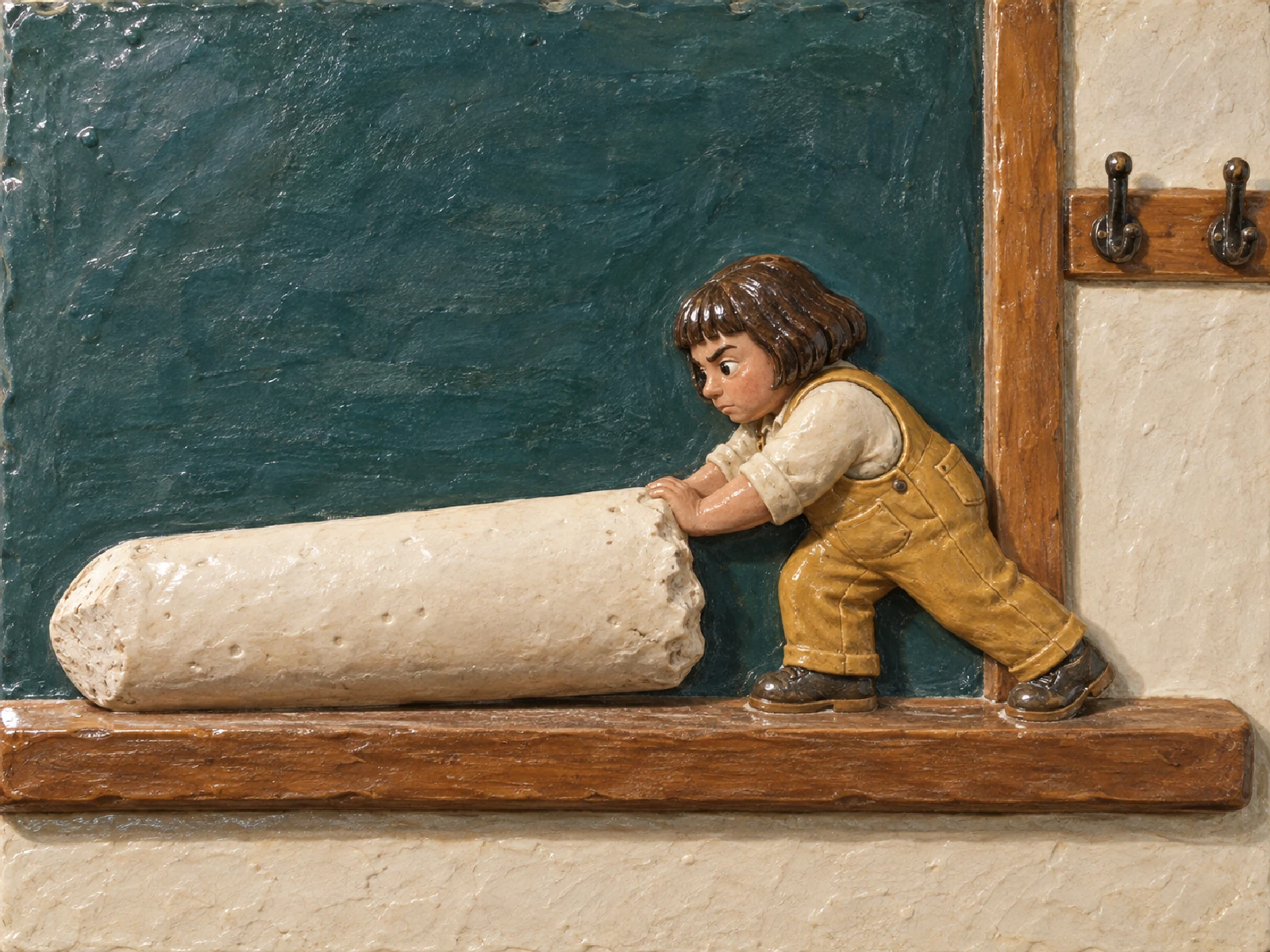
칠판 턱의 작은 관리인
작은 관리인이 자기 몸통만 한 분필을 밀어 옮기는 교실 풍경. 손으로 빚은 듯한 도자기 부조와 오목한 곳에 고인 유약이 익숙한 공간의 뜻밖의 크기를 드러낸다.
이 이미지로 조합하기칠판 턱의 작은 관리인
- 형태 언어
- 형태를 둥근 모서리와 손으로 누른 듯 불균일한 연결부를 가진 얕은 조형 덩어리로 옮긴다.
- 윤곽선
- 부드럽게 솟고 조금 흔들리는 가장자리를 사용하며, 일부 윤곽선은 파인 홈으로 대신한다.
- 붓질·입자
- 불규칙한 도구 자국과 짧은 새김을 일부 남기고 간격과 압력이 자연스럽게 달라지도록 한다.
- 표면 표현
- 도자기 유약은 오목한 곳에 반투명하게 고이고 돌출부에는 얇게 흐르며, 연결부는 완만하게 물결치도록 표현한다.
우선순위
유약 표면의 입체감을 살린 도자기 부조 일러스트레이션.
피할 표현과 결과 확인
이 예시의 실제 생성 프롬프트
MODULE OWNERSHIP
subject: Subject count, type, stable proportions and landmarks, resting face geometry, hair shape, physical materials, garment construction and permanent marks. No emotion, movement, color assignment or rendering recipe.
expression: Facial soft-tissue displacement and pupil direction, muscle coordination, regional intensity, asymmetry and onset/peak/release. No head/body pose, stable appearance, skin color or rendering.
gesture: Head/neck/body/limb orientation, joint movement, support, contact and pose-caused occlusion using existing anatomy. No eye/pupil movement, emotion, identity, props inventory or camera.
props: Prop count, type, construction, physical material and scale relative to the subject. Holding/contact belongs to gesture, position to composition, color to palette.
scene: Environment elements, terrain, backdrop/floor presence and structural detail. No canvas positions, camera, lighting, assigned colors or render texture.
camera: Projection, focal-length impression, camera elevation/yaw/roll, viewing distance and crop. No actor pose, world placement, lighting or canvas aspect ratio.
composition: Normalized 0-100% canvas positions, scale in frame, depth/overlap, focal hierarchy and margins. No joint pose, camera projection, rendering, subject/prop inventory or emotion.
palette: Color anchors, hue/saturation/value ranges, colors assigned to parts and approximate color coverage. No illumination direction, shading algorithm, physical material or layout.
lighting: Light-source direction/softness/intensity, ambient illumination, physical shadow direction/length and highlight position. Absence of directional illumination is allowed. No shading technique, palette or material changes.
style: Reusable form abstraction, contour weight/taper/edge quality, medium and mark scale/density/direction, surface rendering and tonal transition technique. No fixed subject proportions, anatomy, identity, expression, pose, palette, light-source direction, camera or layout.
output: Image count, aspect ratio, size, file/alpha requirements and global lettering/logo/watermark restrictions. No background scenery, crop, style, identity or pose.

SUBJECT
inventory: One original adult human caretaker, A, miniature relative to ordinary classroom fittings.
geometry: A has a compact, stocky build, broad hands, a rounded head and a short neck.
resting-face: Broad straight brows, oval eye openings, a blunt nose and a wide mouth define the resting face.
appearance: A wears canvas coveralls over a jersey shirt and soft work shoes; hair forms a blunt ear-length bob.

PRIORITY


AVOID


CHECK


EXPRESSION — ACTOR A
brows: Inner brows draw slightly together without a deep scowl.
lids: Upper lids lower slightly; lower lids firm without closing the eyes.
cheeks: Cheeks remain mostly relaxed, with slight tension beside the mouth.
nose: Nostrils stay relaxed; the nose bridge remains unwrinkled.
mouth: Lips meet with gentle pressure; one corner presses inward slightly more.
jaw: The jaw firms lightly without clenching or projecting forward.
gaze: Both pupils aim toward the chalk's leading end.
coordination: Brow convergence and lid tension carry the effort; the mouth stays quieter.
timing: Capture a sustained apex of concentration, before the face releases.

PRIORITY


AVOID


CHECK


GESTURE
head: A's neck extends forward slightly, with the chin lowered toward the working hands.
torso: The torso leans into the push, with the back forming a broad, continuous curve.
limbs: One foot advances and the other braces behind; bent elbows connect the shoulders to both palms.
contact: Both palms press the chalk's trailing end; both soles bear on the ledge, with the far palm partly hidden.

PRIORITY


AVOID


CHECK


PROPS
inventory: One oversized chalk stub, approximately as long as A's torso and much thicker than A's forearm.
construction: The chalk is a solid pressed mineral cylinder with one worn end and one irregular broken end.

PRIORITY


AVOID


CHECK


SCENE
inventory: An ordinary classroom blackboard, its projecting chalk ledge, a plaster wall and a short row of coat hooks.
structure: The board has a substantial wooden frame; the ledge forms a narrow shelf. The room floor is not visible.

PRIORITY


AVOID


CHECK


CAMERA
projection: Use a near-orthographic view with restrained depth compression.
viewpoint: View nearly square to the board, slightly above ledge height, with no roll.
crop: Show A's full figure and the complete chalk stub; crop the classroom fittings beyond this encounter.

PRIORITY


AVOID


CHECK


COMPOSITION
placement: Place A near 66% canvas width, occupying about half the height; the chalk extends into the left half.
depth: A and the chalk overlap the board; the frame and distant hooks establish successive background layers.
spacing: Make A the first read and the scale contrast the second; leave ample board space above and room ahead of the chalk.

PRIORITY


AVOID


CHECK


PALETTE
colors: Use deep slate teal, butter ochre, warm ivory and muted peach, with restrained saturation.
assignment: Assign teal to the board, ochre to coveralls, ivory to chalk and wall, and peach to exposed skin.
balance: Teal dominates the field; ivory provides a broad counterweight, with ochre and peach as smaller accents.

PRIORITY


AVOID


CHECK


LIGHTING
sources: A broad upper-left source gives gentle directional light, supported by moderate ambient illumination.
shadows: Short shadows fall to the lower right, with soft edges and small contact shadows beneath feet and chalk.
highlights: Broad highlights sit on upper-left-facing curves, with narrow glints along the most projecting edges.

PRIORITY


AVOID


CHECK


STYLE GUIDE
form-language: Translate forms into shallow sculpted volumes with rounded bevels and uneven, hand-pressed transitions.
contour: Use softly raised, slightly wavering edges; occasional incised grooves replace drawn outlines.
mark-making: Keep a few irregular tool dents and short incisions; allow their spacing and pressure to vary naturally.
surface-rendering: Model ceramic glaze as translucent pools in recesses and thinner passages over crests, with gently rippled transitions.

PRIORITY
Ceramic relief illustration with modeled glaze surfaces.

AVOID


CHECK


OUTPUT
format: One finished image, 4:3 aspect ratio, 1600 × 1200 pixels, opaque PNG.
restrictions: No lettering, logos, signatures or watermarks.

PRIORITY


AVOID


CHECK


FINAL INTEGRATION
expression + style: Let the sculpted treatment preserve the small facial displacements that distinguish focused effort.
모델명은 이미지 출처 정보 기준입니다. 같은 프롬프트를 사용해도 결과는 달라질 수 있습니다.