텍스트 → 이미지캐릭터스타일 가이드
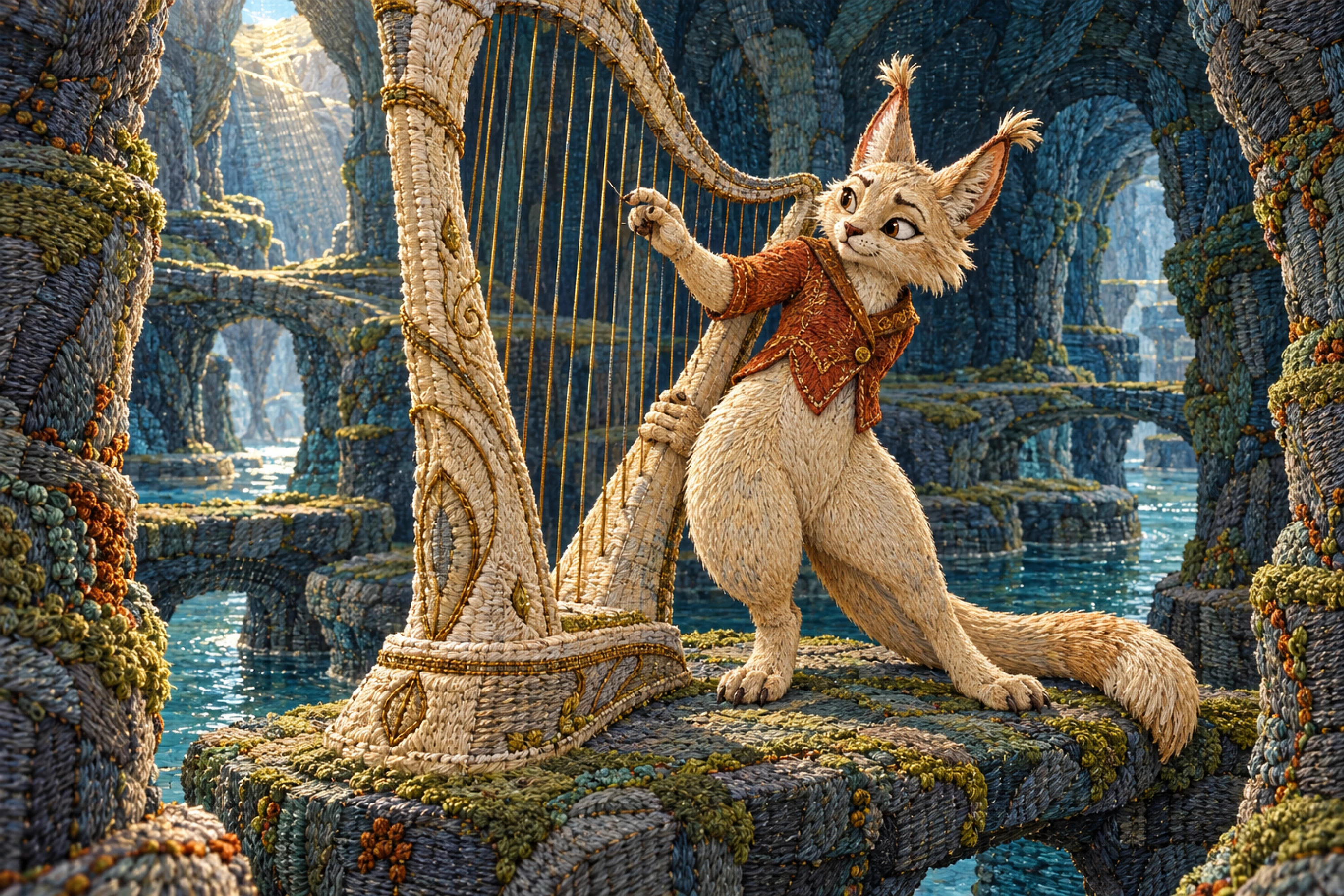
돌 하프를 뜯는 술귀 연주자
동굴의 층층이 겹친 기둥 사이에서 술귀 생명체가 하프 줄을 힘껏 당기고 소리를 기다린다. 솟은 실과 방향성 있는 자수가 몸짓과 공간을 함께 엮는다.
이 이미지로 조합하기돌 하프를 뜯는 술귀 연주자
- 형태 언어
- 겹친 천 조각으로 단순화된 맞물림 형태를 만들고, 부드럽게 고르지 않은 수작업 가장자리와 작은 자연스러운 변화를 허용한다.
- 윤곽선
- 선택한 경계에는 가는 징금수를 쓰고, 나머지 가장자리는 서로 맞닿은 자수 면에서 드러나게 한다.
- 붓질·입자
- 길이를 바꾸어 가며 방향성 있는 평수를 놓고, 성긴 씨앗수와 간간이 솟은 매듭수로 흐름을 끊는다.
- 표면 표현
- 직물 위에 만져질 듯한 실의 부조를 만들고, 작은 천 틈을 남긴 채 실 색조를 끊어진 단계로 겹친다.
우선순위
완성 일러스트가 솟은 실을 지닌 직물 자수로 뚜렷하게 읽혀야 한다.
피할 표현과 결과 확인
이 예시의 실제 생성 프롬프트
MODULE OWNERSHIP
subject: Subject count, type, stable proportions and landmarks, resting face geometry, hair shape, physical materials, garment construction and permanent marks. No emotion, movement, color assignment or rendering recipe.
expression: Facial soft-tissue displacement and pupil direction, muscle coordination, regional intensity, asymmetry and onset/peak/release. No head/body pose, stable appearance, skin color or rendering.
gesture: Head/neck/body/limb orientation, joint movement, support, contact and pose-caused occlusion using existing anatomy. No eye/pupil movement, emotion, identity, props inventory or camera.
props: Prop count, type, construction, physical material and scale relative to the subject. Holding/contact belongs to gesture, position to composition, color to palette.
scene: Environment elements, terrain, backdrop/floor presence and structural detail. No canvas positions, camera, lighting, assigned colors or render texture.
camera: Projection, focal-length impression, camera elevation/yaw/roll, viewing distance and crop. No actor pose, world placement, lighting or canvas aspect ratio.
composition: Normalized 0-100% canvas positions, scale in frame, depth/overlap, focal hierarchy and margins. No joint pose, camera projection, rendering, subject/prop inventory or emotion.
palette: Color anchors, hue/saturation/value ranges, colors assigned to parts and approximate color coverage. No illumination direction, shading algorithm, physical material or layout.
lighting: Light-source direction/softness/intensity, ambient illumination, physical shadow direction/length and highlight position. Absence of directional illumination is allowed. No shading technique, palette or material changes.
style: Reusable form abstraction, contour weight/taper/edge quality, medium and mark scale/density/direction, surface rendering and tonal transition technique. No fixed subject proportions, anatomy, identity, expression, pose, palette, light-source direction, camera or layout.
output: Image count, aspect ratio, size, file/alpha requirements and global lettering/logo/watermark restrictions. No background scenery, crop, style, identity or pose.

SUBJECT
inventory: One original adult tuft-eared creature, actor A, with no other characters.
geometry: A pear-shaped trunk, narrow shoulders, broad hands, a long tapering tail and upright ears ending in soft tufts.
resting-face: A short broad muzzle, widely spaced oval eyes, a small triangular nose and a shallow curved mouth.
appearance: Short fur, longer cheek tufts and a cropped woven jacket with an overlapping front and split hem.

PRIORITY


AVOID


CHECK


EXPRESSION — ACTOR A
brows: The nearer brow rises while the farther brow remains gently gathered.
lids: Upper lids lift slightly; lower lids remain softly engaged.
cheeks: Cheeks stay relaxed with a slight lift beside the muzzle.
nose: Nostrils remain relaxed without wrinkling the nose bridge.
mouth: Lips part in a small uneven opening, with one corner slightly advanced.
jaw: The jaw releases only enough to support the small mouth opening.
gaze: Both pupils converge naturally on the string at the pulling fingertips.
coordination: Brow asymmetry and focused eyes carry the curiosity; the lower face stays quieter.
timing: Hold the peak of attentive curiosity just before the string is released.

PRIORITY


AVOID


CHECK


GESTURE
head: A turns the head toward the pulling hand, with the neck extending slightly forward.
torso: The torso leans away from the harp in counterbalance, with a small twist through the shoulders.
limbs: The nearer elbow draws back as hooked fingertips pull a string; staggered feet brace on the ledge.
contact: The farther palm presses the harp frame; both soles stay supported and the tail rests along the ledge.

PRIORITY


AVOID


CHECK


PROPS
inventory: One asymmetrical arched harp, taller than A, with a freestanding frame.
construction: A carved limestone frame supports flexible metal strings between its curved neck and broad lower rail.

PRIORITY


AVOID


CHECK


SCENE
inventory: A cavern music chamber with split mineral pillars, winding ledges, a shallow pool and a narrow ceiling opening.
structure: Stone ledges connect through the pillars above the pool; the chamber continues through several open recesses.

PRIORITY


AVOID


CHECK


CAMERA
projection: Natural rectilinear perspective with a normal-lens impression.
viewpoint: A slightly elevated three-quarter view shows the visible side of A's face and the harp's string plane.
crop: Include A's whole figure and the full harp, with nearby pillars cropped by the frame.

PRIORITY


AVOID


CHECK


COMPOSITION
placement: A occupies the right-center, the harp rises to the left, and their separating hands form the focal interval.
depth: Near pillars overlap the outer edges; the hand-string encounter leads to the face, then into receding ledges.
spacing: Keep the focal hands distinct from the face and reserve a clear opening between the upper harp and cavern roof.

PRIORITY


AVOID


CHECK


PALETTE
colors: Petrol blue, moss green, warm cream, rust orange and restrained brass gold.
assignment: Cream fur, a rust jacket, petrol cavern walls, moss ledges, a cream harp frame and brass-colored strings.
balance: Cool dark surroundings dominate; warm cream and rust distinguish A and the harp, with sparse gold accents.

PRIORITY


AVOID


CHECK


LIGHTING
sources: Soft daylight descends from the upper-left ceiling opening, supported by dim ambient light.
shadows: Broad shadows extend lower right; raised thread casts tiny close shadows in the same direction.
highlights: Highlights catch upper-left thread ridges and the exposed curves of the harp frame.

PRIORITY


AVOID


CHECK


STYLE GUIDE
form-language: Build simplified interlocking shapes from layered textile pieces; allow gently uneven handmade edges and small natural variations.
contour: Use slender couched cords for selected boundaries, letting other edges emerge from adjoining stitch fields.
mark-making: Lay directional satin stitches in changing lengths, interrupted by loose seed stitches and occasional raised knots.
surface-rendering: Create tangible thread relief over woven cloth; overlap thread tones in broken steps while leaving small cloth gaps visible.

PRIORITY
The finished illustration must visibly read as embroidered textile with raised thread.

AVOID


CHECK


OUTPUT
format: One finished image, 3:2 aspect ratio, 3000 × 2000 pixels, opaque PNG; no lettering, logos or watermarks.
restrictions: One finished image, 3:2 aspect ratio, 3000 × 2000 pixels, opaque PNG; no lettering, logos or watermarks.

PRIORITY


AVOID


CHECK


FINAL INTEGRATION
expression + gesture + composition: Let the facial attention and hand action form one readable moment within the layered setting.
style + lighting: Use the illumination to reveal the embroidery's relief without overwhelming its stitched marks.
모델명은 이미지 출처 정보 기준입니다. 같은 프롬프트를 사용해도 결과는 달라질 수 있습니다.