텍스트 → 이미지화풍스타일 가이드
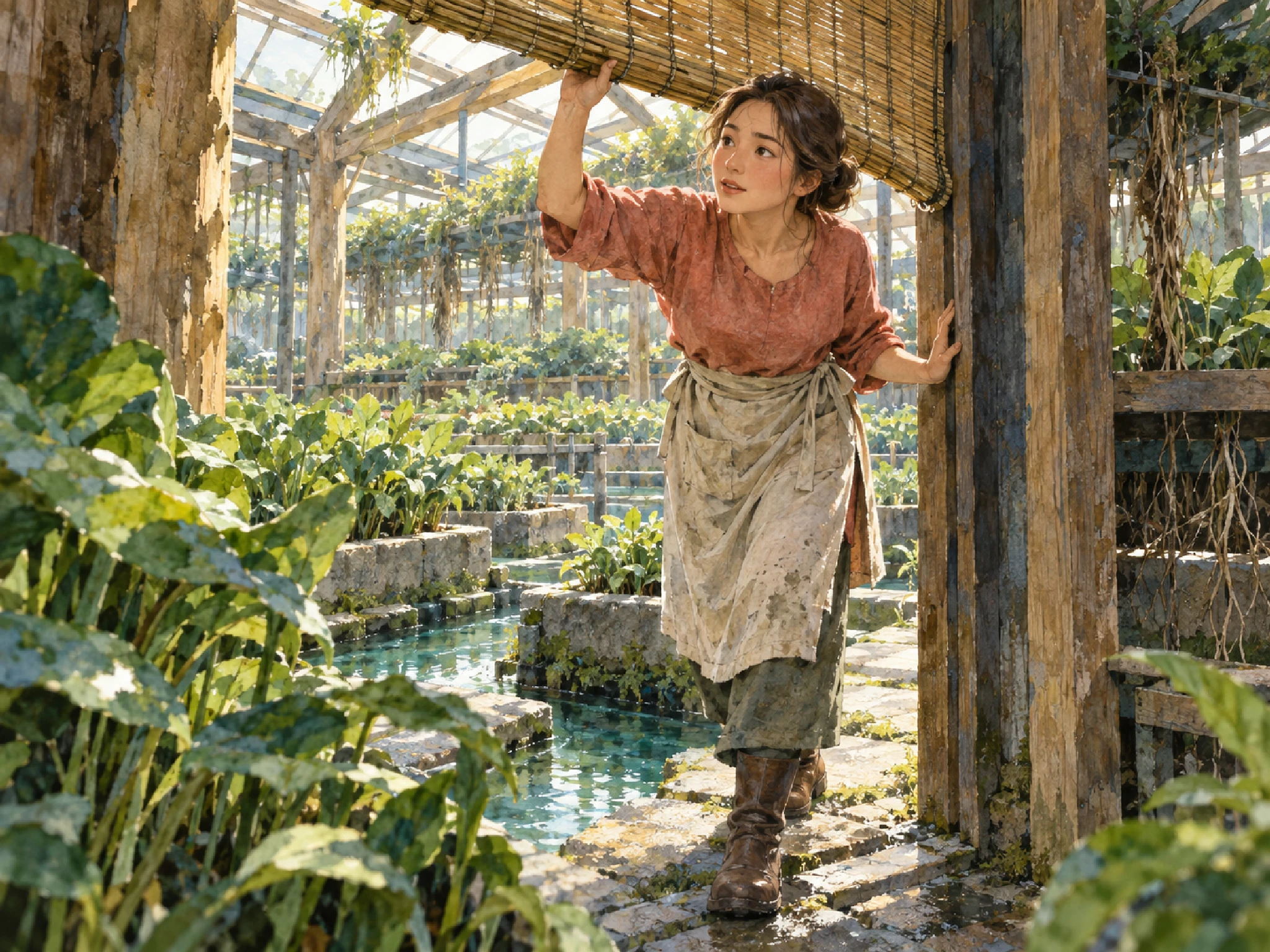
갈대 발을 들어 올리는 관리인
물길이 흐르는 묘목 온실에서 관리인이 갈대 발을 들어 안쪽을 들여다본다. 번진 수채 물감과 끊어진 가장자리가 겹겹의 식생 사이로 열린 순간을 생생하게 만든다.
이 이미지로 조합하기갈대 발을 들어 올리는 관리인
- 형태 언어
- 복잡한 형태를 넓고 불규칙하게 이어진 덩어리와 소수의 설명적 강조로 단순화한다. 둥근 돌출부와 각진 끊김으로 이루어진 느슨한 조형 언어 안에서 부차적인 형태는 달라도 된다.
- 윤곽선
- 붓으로 또렷하게 끊은 가장자리와 녹거나 비어 있는 경계를 교차한다. 모든 형태를 연속된 윤곽선으로 닫기보다 간헐적인 끝 가늘어짐을 사용하여 가장자리가 사라졌다 다시 나타나게 한다.
- 붓질·입자
- 표현적인 수채 붓질, 물감이 고인 붓의 시작점, 드문 마른 붓 걸림을 사용한다. 질감 패턴을 반복하기보다 넓고 젖은 붓질과 작고 끊긴 강조의 폭, 밀도, 방향을 자연스럽게 바꾼다.
- 표면 표현
- 눈에 보이는 역류 번짐과 불균일한 안료 테두리를 가진 투명한 워시를 쌓는다. 젖은 부분이 불규칙한 명도 전이로 합쳐지게 한 뒤 마른 강조로 선택한 가장자리를 되살리고 흡수성 종이 바탕을 드러낸다.
우선순위
번짐과 나타났다 사라지는 가장자리가 수채 표현을 분명히 형성하게 한다.
피할 표현과 결과 확인
균일하게 윤곽을 두른 형태 위에 수채 질감만 덧붙이는 것은 피한다.
워시의 융합과 가장자리 변화가 그림 자체에 내재한 것으로 느껴지는가?
이 예시의 실제 생성 프롬프트
MODULE OWNERSHIP
subject: Subject count, type, stable proportions and landmarks, resting face geometry, hair shape, physical materials, garment construction and permanent marks. No emotion, movement, color assignment or rendering recipe.
expression: Facial soft-tissue displacement and pupil direction, muscle coordination, regional intensity, asymmetry and onset/peak/release. No head/body pose, stable appearance, skin color or rendering.
gesture: Head/neck/body/limb orientation, joint movement, support, contact and pose-caused occlusion using existing anatomy. No eye/pupil movement, emotion, identity, props inventory or camera.
props: Prop count, type, construction, physical material and scale relative to the subject. Holding/contact belongs to gesture, position to composition, color to palette.
scene: Environment elements, terrain, backdrop/floor presence and structural detail. No canvas positions, camera, lighting, assigned colors or render texture.
camera: Projection, focal-length impression, camera elevation/yaw/roll, viewing distance and crop. No actor pose, world placement, lighting or canvas aspect ratio.
composition: Normalized 0-100% canvas positions, scale in frame, depth/overlap, focal hierarchy and margins. No joint pose, camera projection, rendering, subject/prop inventory or emotion.
palette: Color anchors, hue/saturation/value ranges, colors assigned to parts and approximate color coverage. No illumination direction, shading algorithm, physical material or layout.
lighting: Light-source direction/softness/intensity, ambient illumination, physical shadow direction/length and highlight position. Absence of directional illumination is allowed. No shading technique, palette or material changes.
style: Reusable form abstraction, contour weight/taper/edge quality, medium and mark scale/density/direction, surface rendering and tonal transition technique. No fixed subject proportions, anatomy, identity, expression, pose, palette, light-source direction, camera or layout.
output: Image count, aspect ratio, size, file/alpha requirements and global lettering/logo/watermark restrictions. No background scenery, crop, style, identity or pose.

SUBJECT
inventory: A is one original adult nursery caretaker, with an ordinary human build and no additional figures.
geometry: Give A a long oval head, sturdy shoulders and practical adult proportions; recognizable construction matters more than anatomical detail.
resting-face: The resting face has wide-set almond eyes, a straight nose, a broad lower lip and a softly squared chin.
appearance: Hair forms a loose low knot with short temple wisps. A wears a linen pullover with elbow-length sleeves, a wrap apron and ankle boots; minor folds may vary.

PRIORITY
Keep the caretaker recognizable through the low hair knot and workwear construction.

AVOID
Avoid ornamental costume details that obscure the practical silhouette.

CHECK
Does one coherent adult caretaker remain identifiable throughout the image?

EXPRESSION — ACTOR A
brows: Raise one inner brow slightly more than the other, with a gentle opening across the forehead rather than a high arch everywhere curve along the forehead rather than a high arch.
lids: Upper lids lift modestly while lower lids stay soft, keeping the eye openings attentive without exposed rims of white all around the iris without showing white all around the iris.
cheeks: Keep the cheeks mostly relaxed with a faint lift beneath the nearer eye; no pronounced smile compression is present yet beneath the nearer eye; no strong smile compression yet.
nose: Nostrils remain relaxed and the nose bridge unwrinkled, supporting a quiet exploratory expression nose bridge unwrinkled, supporting quiet exploration quiet exploration quiet exploration.
mouth: Part the lips just enough for a narrow opening; one corner begins to rise before a full smile appears before a full smile appears before a full smile appears before a full smile appears.
jaw: Release the jaw slightly without a wide drop, preserving the small scale of the mouth opening without a wide drop, preserving the small mouth opening preserving the small mouth opening.
gaze: Direct both pupils through the newly opened gap toward the nursery interior, with a shared focus newly opened gap toward the nursery interior, with a shared focus with a shared focus.
coordination: Let the brow opening lead and the mouth respond more quietly; retain the small asymmetry without making the face contradictory mouth respond more quietly; keep the small asymmetry coherent.
timing: Capture curiosity just beginning, when the eyes have engaged but the lower face has not settled into a smile lower face has not settled into a smile lower face has not settled into a smile.

PRIORITY
Make the mild, unequal brow lift the clearest facial signal.

AVOID
Avoid a startled stare or a fully developed grin.

CHECK
Do the attentive eyes and restrained mouth read as emerging curiosity?

GESTURE
head: A extends the neck slightly and tips the chin upward beneath the raised screen, following the opening with the whole head.
torso: The torso leans into the doorway while the pelvis stays over the supporting leg, giving the reach a grounded, continuous sweep.
limbs: One arm reaches overhead with a softly bent elbow; the other stays lower against the post. A forward knee bends into the next step.
contact: Raised fingers gather the screen's lower edge; the other palm braces the timber post. The rear boot supports A on the stone path, and the screen partly hides the raised wrist.

PRIORITY
Unify the overhead reach and forward lean into one readable opening gesture.

AVOID
Avoid disconnected arm placement that makes the screen appear unsupported.

CHECK
Can the screen lift and the caretaker's support be understood immediately?

PROPS
inventory: Include one flexible reed screen, approximately shoulder-width and longer than the caretaker's torso.
construction: Build the screen from slender reed rods joined by textile cords, with a reinforced lower binding and a simple suspension along its top edge.

PRIORITY
Keep the screen visibly flexible despite its repeated reed structure.

AVOID
Avoid making the screen resemble a rigid wooden door.

CHECK
Do the connected reeds explain how the screen can gather?

SCENE
inventory: Set the moment inside a tidal plant nursery with timber roof ribs, glazed roof panels, shallow water channels, stone paths and beds of broad-leaved seedlings.
structure: A timber doorway joins two nursery bays. Channels thread between raised growing beds, while repeated roof ribs and trailing roots establish an inhabited working space.

PRIORITY
Make the water channels and connected growing bays feel like one continuous nursery.

AVOID
Avoid unrelated architectural ornaments that dilute the nursery setting.

CHECK
Does the setting read as a functional growing space rather than generic foliage?

CAMERA
projection: Use moderate wide-angle perspective with natural depth and little edge stretching.
viewpoint: View from just below the caretaker's eye level, obliquely across the doorway, with an unrolled horizon.
crop: Choose a medium-wide view that includes the complete reach and supporting boots while allowing nearby foliage to be cropped.

PRIORITY
Let the viewpoint carry the viewer into the doorway.

AVOID
Avoid extreme lens distortion that overwhelms the reach.

CHECK
Are the lifted hand and supporting stance both clearly visible?

COMPOSITION
placement: Place A in the right-middle, occupying roughly 60% of the image height; let the lifted hand reach into the upper middle and the opening extend toward the left.
depth: Overlap cropped foreground leaves with the doorway, the caretaker with the next nursery bay, and successive growing beds farther back.
spacing: Make the hand-to-face opening the focal interval. Preserve breathing room around it while channels and roof ribs carry attention into the layered interior.

PRIORITY
Keep the open interval beside the raised arm stronger than the surrounding layers.

AVOID
Avoid giving every depth layer equal focal importance.

CHECK
Does attention pass from the opening gesture into the nursery depth?

PALETTE
colors: Anchor the image in deep teal, moss green, ochre and muted coral, with pale warm neutrals providing the lightest values.
assignment: Give the water teal notes, vegetation moss green, reeds and timber ochre, and the caretaker's pullover muted coral; skin uses warm neutral tones.
balance: Let cool greens and teals occupy most of the image, with a smaller coral accent and broad pale passages preventing a uniformly dark result.

PRIORITY
Use the restrained coral garment as the warm counterpoint to the cool nursery.

AVOID
Avoid equally saturated accents throughout the vegetation.

CHECK
Does the warm accent remain distinct within the cool dominant group?

LIGHTING
sources: Broad daylight enters through the roof from upper left, with generous ambient light reaching the enclosed nursery.
shadows: Cast soft, short shadows toward lower right; keep the doorway recess deeper than the open growing bays.
highlights: Place broad highlights on upper leaf surfaces, the lifted hand and the upper reed edges; water catches intermittent roof light.

PRIORITY
Keep the roof daylight broad enough to connect the interior layers.

AVOID
Avoid narrow theatrical beams that fragment the nursery.

CHECK
Does soft upper-left daylight remain consistent across the setting?

STYLE GUIDE
form-language: Simplify complex forms into broad, irregular connected masses with a few descriptive accents; let incidental shapes vary within this loose language of rounded lobes and angular breaks.
contour: Alternate crisp brush-cut edges with dissolved and skipped boundaries. Use occasional tapered strokes rather than enclosing every shape with a continuous outline, allowing edges to disappear and return.
mark-making: Use expressive watercolor sweeps, pooled brush starts and sparse dry-brush catches. Let broad wet strokes and small broken accents vary naturally in width, density and direction instead of repeating a texture pattern.
surface-rendering: Build translucent washes with visible backrun blooms and uneven pigment rims. Let wet passages fuse into irregular tonal transitions, then restore selected edges with dry accents while leaving absorbent paper visible.

PRIORITY
Make blooms and lost-and-found edges visibly shape the watercolor treatment.

AVOID
Avoid uniformly outlined shapes with a watercolor texture pasted over them.

CHECK
Do wash fusion and edge variation feel intrinsic to the painting?

OUTPUT
format: Deliver one finished landscape image, 4:3 aspect ratio, 2048 × 1536 pixels, as an opaque PNG.
restrictions: Include no lettering, logos, watermarks or reference-sheet annotations anywhere in the image.

PRIORITY
Deliver a single complete image ready to serve as an artistic reference.

AVOID
Avoid presenting alternate studies or process panels.

CHECK
Is the final file one complete image in the requested format?

FINAL INTEGRATION
gesture + composition + camera: Let framing and focal hierarchy make the physical action legible while preserving immersion in the setting.
style + expression + lighting: Allow expressive painting to carry atmosphere while facial control and illumination preserve the essential reading.
모델명은 이미지 출처 정보 기준입니다. 같은 프롬프트를 사용해도 결과는 달라질 수 있습니다.