텍스트 → 이미지인물스타일 가이드
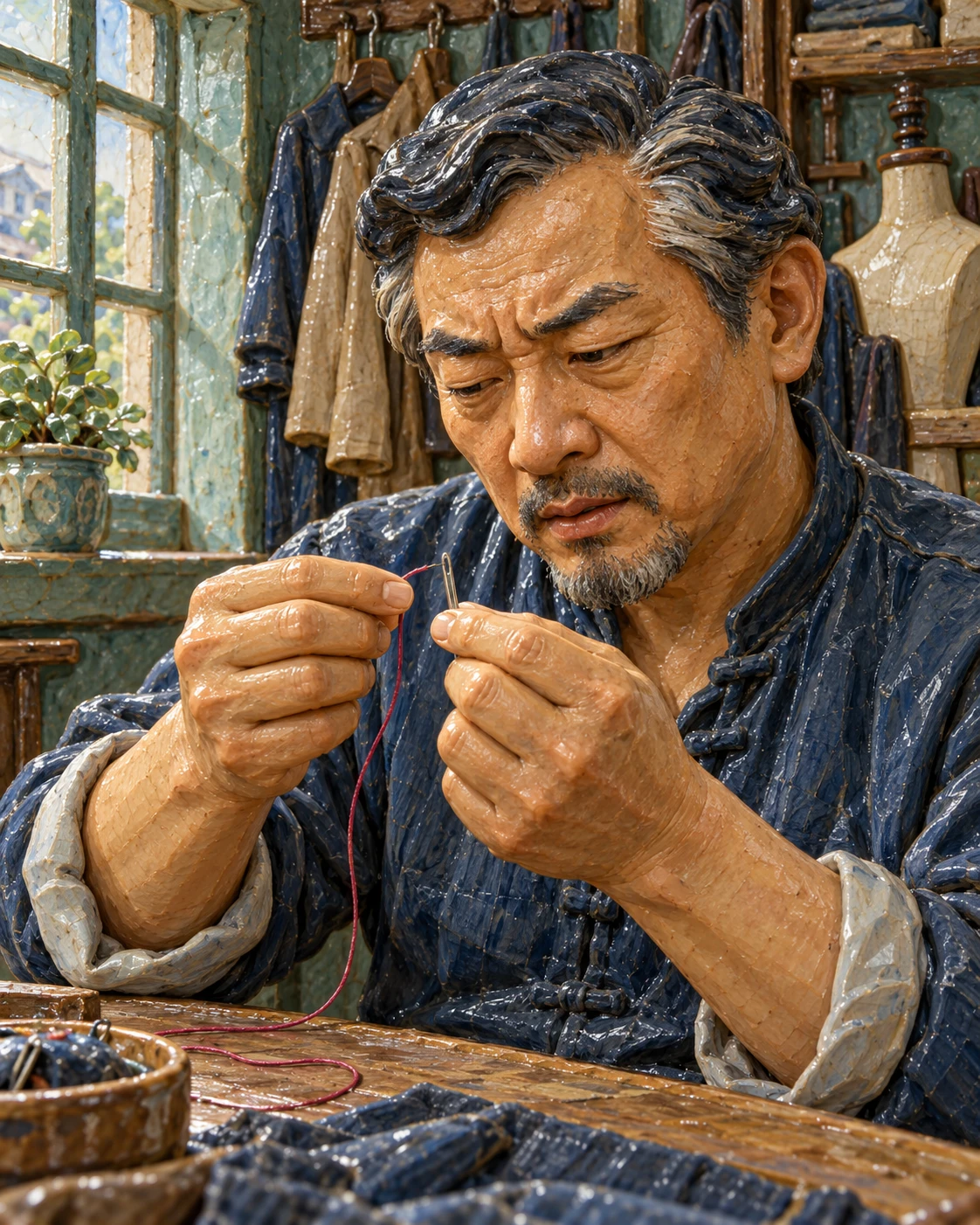
바늘에 실을 꿰는 남자
옷 수선방에서 나이 든 남자가 한쪽 눈을 가늘게 뜨고 바늘에 실을 꿴다. 손과 얼굴을 도드라지게 빚고 골에 유약을 고이게 한 도자 부조 초상이다.
이 이미지로 조합하기바늘에 실을 꿰는 남자
- 형태 언어
- 포개진 얕은 면 위에 부드럽게 이어진 돌출 덩어리를 쌓아 도자 부조 일러스트를 만든다. 깊이를 압축하면서도 부피는 분명히 살린다.
- 윤곽선
- 둥글게 깎인 가장자리에 간간이 손으로 잘라낸 물결 굴곡을 둔다. 그린 외곽선 대신 새긴 홈으로 인접 형태를 구분한다.
- 붓질·입자
- 돌출부에는 넓은 주걱 자국을 남기고 골에는 드물게 곡선을 새긴다. 간격과 압력은 자연스럽게 달라져도 좋다.
- 표면 표현
- 두꺼운 광택 유약이 홈에 고이고 능선에서는 얇아지게 표현한다. 부드러운 명암 전환을 불규칙한 유약 경계로 끊는다.
우선순위
빚어진 부조의 깊이와 불균일한 유약 고임이 매체를 눈에 보이게 규정하도록 한다.
피할 표현과 결과 확인
이 예시의 실제 생성 프롬프트
MODULE OWNERSHIP
subject: Subject count, type, stable proportions and landmarks, resting face geometry, hair shape, physical materials, garment construction and permanent marks. No emotion, movement, color assignment or rendering recipe.
expression: Facial soft-tissue displacement and pupil direction, muscle coordination, regional intensity, asymmetry and onset/peak/release. No head/body pose, stable appearance, skin color or rendering.
gesture: Head/neck/body/limb orientation, joint movement, support, contact and pose-caused occlusion using existing anatomy. No eye/pupil movement, emotion, identity, props inventory or camera.
props: Prop count, type, construction, physical material and scale relative to the subject. Holding/contact belongs to gesture, position to composition, color to palette.
scene: Environment elements, terrain, backdrop/floor presence and structural detail. No canvas positions, camera, lighting, assigned colors or render texture.
camera: Projection, focal-length impression, camera elevation/yaw/roll, viewing distance and crop. No actor pose, world placement, lighting or canvas aspect ratio.
composition: Normalized 0-100% canvas positions, scale in frame, depth/overlap, focal hierarchy and margins. No joint pose, camera projection, rendering, subject/prop inventory or emotion.
palette: Color anchors, hue/saturation/value ranges, colors assigned to parts and approximate color coverage. No illumination direction, shading algorithm, physical material or layout.
lighting: Light-source direction/softness/intensity, ambient illumination, physical shadow direction/length and highlight position. Absence of directional illumination is allowed. No shading technique, palette or material changes.
style: Reusable form abstraction, contour weight/taper/edge quality, medium and mark scale/density/direction, surface rendering and tonal transition technique. No fixed subject proportions, anatomy, identity, expression, pose, palette, light-source direction, camera or layout.
output: Image count, aspect ratio, size, file/alpha requirements and global lettering/logo/watermark restrictions. No background scenery, crop, style, identity or pose.

SUBJECT
inventory: One older adult man, actor A.
geometry: A compact oval face, prominent nose bridge, broad hands and an ordinary adult build establish his recognizable construction.
resting-face: Naturally narrow eye openings, a thin upper lip, fuller lower lip and softly folded cheek contours.
appearance: Short hair sweeps into one broad wave; a cropped goatee and a collarless cotton shirt with cloth buttons and rolled cuffs complete his appearance.

PRIORITY


AVOID


CHECK


EXPRESSION — ACTOR A
brows: Draw the brows slightly inward, with a stronger contraction on his right.
lids: Narrow the right eye more than the left while keeping both slightly open.
cheeks: Gather slight tension beside the upper lip without lifting the cheeks into a smile.
nose: Keep the nostrils relaxed and the bridge unwrinkled.
mouth: Part the lips narrowly with a small uneven pinch at one corner.
jaw: Release the jaw just enough for the narrow lip opening.
gaze: Direct both pupils downward toward the thread end.
coordination: Let the unequal squint carry the effort while the lower face stays comparatively loose.
timing: Hold the facial tension at the apex of concentration.

PRIORITY


AVOID


CHECK


GESTURE
head: Dip the chin toward the work and incline the neck slightly forward.
torso: Lean forward from a seated position, keeping the shoulders low and slightly uneven.
limbs: Raise both bent arms below the face; bring the fingertips together while the elbows remain comfortably apart.
contact: The left thumb and forefinger steady the needle; the right fingertips guide the thread end toward its eye, pausing just before entry.

PRIORITY


AVOID


CHECK


PROPS
inventory: One sewing needle and one loose length of thread, both at ordinary hand-sewing scale.
construction: A slender steel needle has an elongated eye; the cotton thread forms a soft continuous strand.

PRIORITY


AVOID


CHECK


SCENE
inventory: A compact clothing repair shop with hanging coats, a deep window recess and a workbench.
structure: A thick masonry window reveal and hanging garment forms enclose the room; the workbench has a worn solid top.

PRIORITY


AVOID


CHECK


CAMERA
projection: Use a gentle portrait-lens perspective with little near-to-far exaggeration.
viewpoint: Observe from face height at a shallow three-quarter angle, without camera roll.
crop: Frame from above the hair to the lower chest, including both hands and a small amount of the workbench; crop peripheral coats freely.

PRIORITY


AVOID


CHECK


COMPOSITION
placement: Set the face right of center and the hand group below-left; arrange the thread in a small connecting curve, its end beside the needle eye.
depth: Hands overlap the shirt, while the face stands clear of layered coats and the deeper window recess.
spacing: Make the face primary and the fingertip gap secondary; leave breathing room around the hands.

PRIORITY


AVOID


CHECK


PALETTE
colors: Use honey amber, muted celadon, deep ink blue, warm ivory and a small raspberry accent.
assignment: Assign amber to skin, ivory and ink blue to hair, ink blue to the shirt, celadon to the room and raspberry to the thread.
balance: Keep the cool room and shirt dominant, with concentrated warm skin and a very small saturated thread accent.

PRIORITY


AVOID


CHECK


LIGHTING
sources: A broad window source from the upper left provides soft directional light with gentle ambient fill.
shadows: Raised forms cast short soft shadows toward the lower right; deeper recesses retain stronger shadow.
highlights: Broken highlights catch upper-left ridges, with small bright accents on the knuckles and nose.

PRIORITY


AVOID


CHECK


STYLE GUIDE
form-language: Build a ceramic relief illustration from softly joined raised masses over nested shallow planes; compress depth while preserving clear volume.
contour: Use rounded beveled edges with occasional hand-cut scallops; let incised grooves separate adjoining forms instead of drawn outlines.
mark-making: Leave broad spatula sweeps on raised areas and sparse incised arcs in recesses; allow their spacing and pressure to vary naturally.
surface-rendering: Model thick glossy glaze pooling in grooves and thinning over ridges; use softly blended tonal turns interrupted by irregular glaze edges.

PRIORITY
Make modeled relief depth and uneven glaze accumulation visibly define the medium.

AVOID


CHECK


OUTPUT
format: Deliver one finished image.
restrictions: One image, 4:5, 1600 × 2000 pixels, opaque PNG; no lettering, logos or watermarks.

PRIORITY


AVOID


CHECK


FINAL INTEGRATION
expression + gesture: Synchronize the facial apex with the threading stage defined in gesture.
모델명은 이미지 출처 정보 기준입니다. 같은 프롬프트를 사용해도 결과는 달라질 수 있습니다.