이미지 편집만화스타일 가이드
흑백 스크린톤 만화 그림체 · 고리 경계에서 잘린 망점
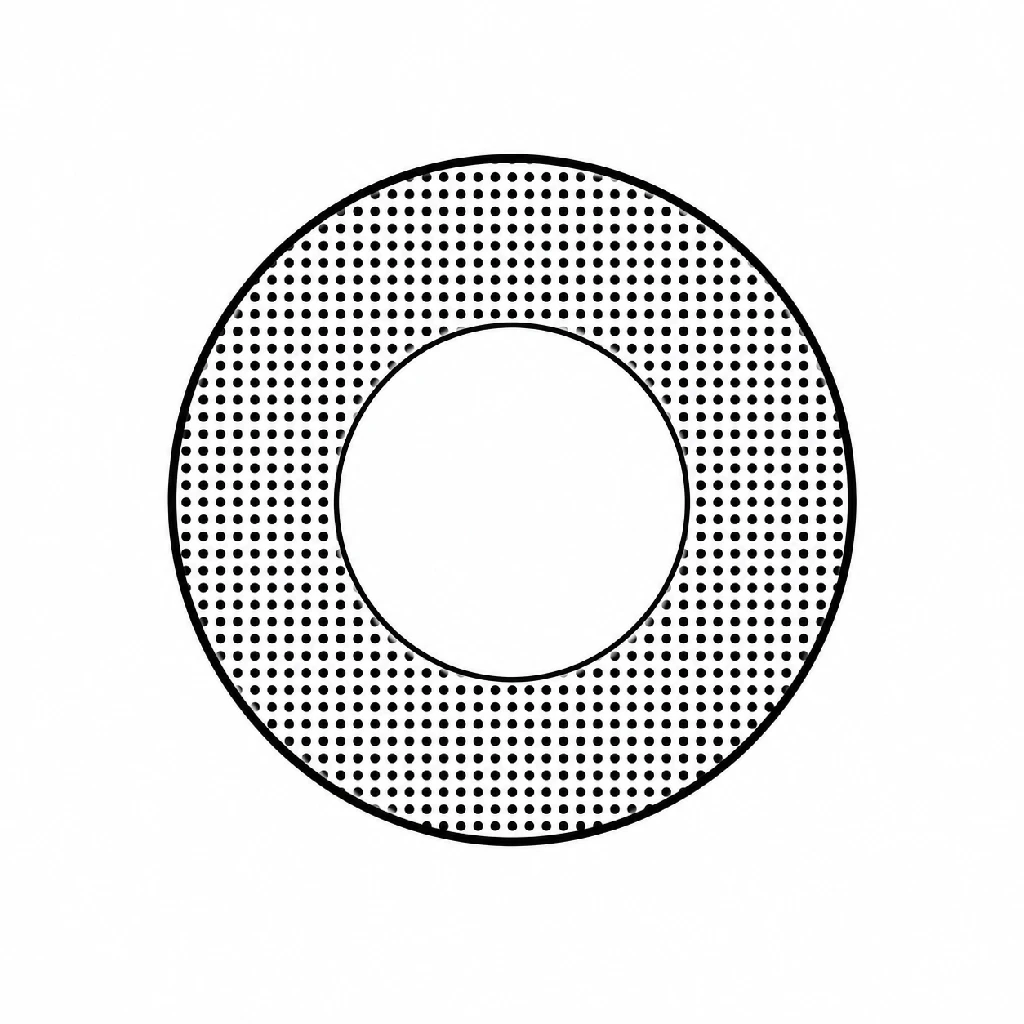
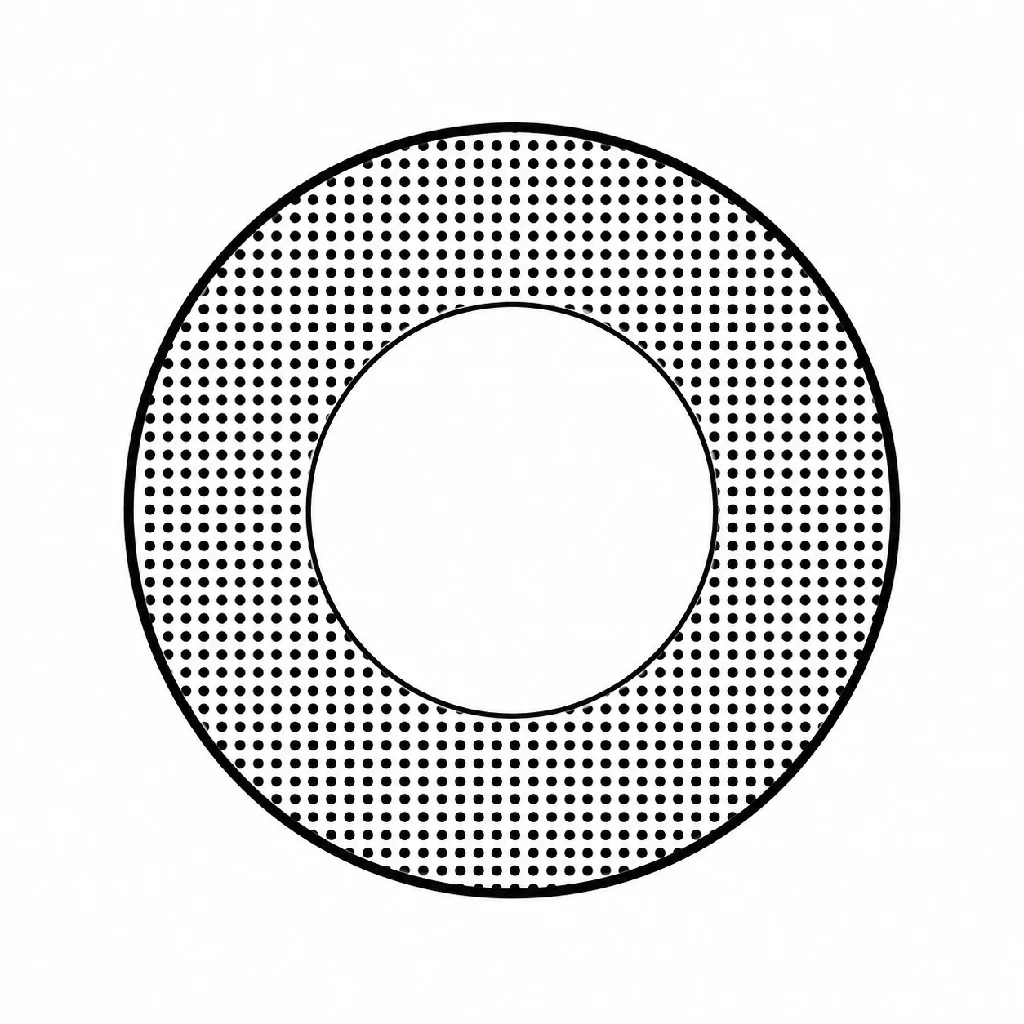
흑백 스크린톤 만화 그림체로 하나의 고리를 그린다. 일정한 망점 격자를 바깥 윤곽과 중앙 구멍에서 잘라, 곡선 경계에서도 망점의 간격과 정렬을 유지하는 기법을 보여 준다.
흑백 스크린톤 만화 그림체 · 고리 경계에서 잘린 망점
- 형태 언어
- 각 연결 형태를 바깥 실루엣, 실제 구멍과 주요 구조 구획으로 간추린다. 매끄럽게 이어지는 곡률과 필요한 모서리는 유지하고, 해당 형태 경계 상자의 최장 치수 중 2–3%보다 작은 부수 세부는 생략한다. 넓게 닫힌 면은 유지하며 장식적인 작은 칸으로 분할하지 않는다.
- 윤곽선
- 매끄럽고 연속된 펜 윤곽을 쓴다. L은 연결된 형태 전체 경계 상자의 최장 치수이며 바깥선과 구멍선에 공통으로 적용한다. 바깥 선폭은 L의 0.6–0.8%, 내부 선폭은 바깥 선폭의 절반인 L의 0.3–0.4%이다. 각 선폭은 일정하고 가늘어짐과 흔들림이 없다. 경계는 닫고 구조선은 가림 경계에서 둥근 끝으로 멈추며 연결부도 둥글게 한다. 겹선과 잉크 뭉침은 없다.
- 붓질·입자
- 원형 망점을 평면 정사각 격자에 둔다. 간격은 각 연결 형태 경계 상자의 최장 치수 중 2.5–3.5%, 점 지름은 간격의 45–55%이다. 행은 수평, 열은 수직이며 분리된 톤 영역에서도 격자 위상을 유지한다. 경계와 구멍에서 점을 잘라 일부 경계 점을 남긴다. 행을 휘거나 경계 점을 안쪽으로 옮기지 않으며 망점 없는 영역에는 자국을 넣지 않는다.
- 표면 표현
- 명도는 깨끗한 면, 고정 밀도 망점 면, 단색 윤곽 잉크의 세 단계만 쓴다. 톤 구획은 망점 적용 전에 명시적으로 나뉜 두 개 이상의 내부 명도 영역이며 균일한 면색에는 없다. 구획이 없으면 가장 큰 닫힌 표면에 망점을 채우고, 있으면 가장 밝은 구획만 비우고 나머지에 채운다. 구멍은 비우고 망점은 틈 없이 윤곽까지 잇는다. 보간은 한 픽셀 이내의 경계에만 허용하며 그라데이션, 톤 지우기, 망점 중첩은 없다.
우선순위
렌더링 매체: 2D 스크린톤 만화 일러스트레이션.
피할 표현과 결과 확인
휘어진 망점 행, 옮겨진 경계 점과 둘레의 빈 틈을 피한다. 바깥선과 내부선의 같은 굵기, 흔들리는 선폭과 울퉁불퉁한 곡선 경계를 피한다.
격자 정렬을 유지한 채 바깥 경계와 구멍 경계에서 점이 잘린다. 내부선은 바깥선의 절반 굵기로 보이며, 두 선 모두 매끄럽고 일정하며 가늘어지지 않는다.
이 예시의 실제 생성 프롬프트
MODULE OWNERSHIP
subject: Subject count, type, stable proportions and landmarks, resting face geometry, hair shape, physical materials, garment construction and permanent marks. No emotion, movement, color assignment or rendering recipe.
expression: Facial soft-tissue displacement and pupil direction, muscle coordination, regional intensity, asymmetry and onset/peak/release. No head/body pose, stable appearance, skin color or rendering.
gesture: Head/neck/body/limb orientation, joint movement, support, contact and pose-caused occlusion using existing anatomy. No eye/pupil movement, emotion, identity, props inventory or camera.
props: Prop count, type, construction, physical material and scale relative to the subject. Holding/contact belongs to gesture, position to composition, color to palette.
scene: Environment elements, terrain, backdrop/floor presence and structural detail. No canvas positions, camera, lighting, assigned colors or render texture.
camera: Projection, focal-length impression, camera elevation/yaw/roll, viewing distance and crop. No actor pose, world placement, lighting or canvas aspect ratio.
composition: Normalized 0-100% canvas positions, scale in frame, depth/overlap, focal hierarchy and margins. No joint pose, camera projection, rendering, subject/prop inventory or emotion.
palette: Color anchors, hue/saturation/value ranges, colors assigned to parts and approximate color coverage. No illumination direction, shading algorithm, physical material or layout.
lighting: Light-source direction/softness/intensity, ambient illumination, physical shadow direction/length and highlight position. Absence of directional illumination is allowed. No shading technique, palette or material changes.
style: Reusable form abstraction, contour weight/taper/edge quality, medium and mark scale/density/direction, surface rendering and tonal transition technique. No fixed subject proportions, anatomy, identity, expression, pose, palette, light-source direction, camera or layout.
output: Image count, aspect ratio, size, file/alpha requirements and global lettering/logo/watermark restrictions. No background scenery, crop, style, identity or pose.

SUBJECT
inventory: Include exactly one abstract annular motif, identified as the annulus. Its three defining anchors are one circular exterior, one circular central opening and one uninterrupted connecting band; add no subsidiary shapes.
geometry: Let D denote the exterior diameter. The opening diameter is 0.46D, with a permitted range of 0.42–0.50D; its center lies within 0.02D of the exterior center. Both boundaries are circles, and the motif has no represented thickness.
appearance: The annulus is an abstract geometric motif with no represented physical material. It has no folds, seams, fasteners, attachments or permanent identifying marks; only its exterior perimeter and central opening define its appearance.

PRIORITY
Preserve the uninterrupted annular topology.

AVOID
Avoid spokes, eccentric openings and represented thickness.

CHECK
One circular opening remains enclosed by one continuous band.

PROPS
inventory: The prop inventory is empty: include exactly zero accessories, tools, containers or other supplementary objects. The geometric motif requires no separate demonstration equipment.
construction: With zero props, there is no prop construction target. Do not introduce a backing plate, mounting hardware, supporting stand or attached component that would require additional construction.

PRIORITY
Keep the supplementary object inventory empty.

AVOID
Avoid mounting hardware and demonstration accessories.

CHECK
No separate accessory or support object is present.

SCENE
inventory: Include one plain illustrated backdrop field and no floor. Exclude buildings, terrain, furniture, vegetation, decorative motifs, lighting fixtures and environmental objects; the backdrop is the complete environment inventory.
structure: The backdrop is one uninterrupted plane without a horizon, architectural divisions, surface joints or repeated elements. It has no represented depth or structural relief and introduces no additional boundaries.

PRIORITY
Maintain one structurally uninterrupted backdrop.

AVOID
Avoid floor divisions and environmental decoration.

CHECK
The backdrop contains no horizon or structural subdivisions.

CAMERA
projection: Use orthographic projection of the planar motif, with no focal-length perspective or depth-dependent size change. Preserve its planar geometry without lens distortion or converging projection lines.
viewpoint: Aim the viewing axis perpendicular to the motif plane. Camera yaw, elevation offset and roll are each 0°, allowing at most ±1° deviation; viewing distance has no magnification effect under this projection.
crop: Show the complete exterior circumference and complete central opening. No part of either boundary is cropped, and no reverse side or thickness edge is visible; the entire planar motif is available for inspection.

PRIORITY
Preserve a complete frontal view of both boundaries.

AVOID
Avoid oblique views, perspective convergence and cropped rims.

CHECK
Both circular boundaries remain complete in the view.

COMPOSITION
placement: Use top-left normalized coordinates. Center the existing motif at x=50%, y=50%, allowing ±2 percentage points per axis. Its complete visible span, including perimeter ink, targets 66% of the shorter canvas dimension, permitted 64–68%. Derive both bounding-box extents from this shared scale and existing proportions. The backdrop covers x=0–100%, y=0–100%.
depth: Use one borderless panel. The motif is the sole focal element over the backdrop, which remains visible through intrinsic openings. Add no independently placed obstruction or overlapping foreground layer.
spacing: Derive edge clearances from the complete centered bounds. On a square canvas, equal-span bounds at nominal scale leave 17% per edge; permitted size and centering deviations must retain at least 14% of the shorter canvas dimension at every edge. Preserve this surrounding space without secondary focal elements.

PRIORITY
Enforce the 66% full visible span target within 64–68%, including perimeter ink.

AVOID
Avoid a three-quarter-canvas span or measuring only the interior of the perimeter ink.
Avoid decorative borders and independently placed occluders.

CHECK
Complete visible bounds, including perimeter ink, span 64–68% of the shorter canvas dimension.
The center is within ±2 percentage points of 50% on each axis; every edge clearance is at least 14%.

PALETTE
colors: Use exactly two color anchors: field white #FFFFFF and ink black #111111. Permit neutral mixtures between these anchors, with equal red, green and blue values; introduce no chromatic hue family.
assignment: Assign ink black to all contours and dot marks. Assign field white to the backdrop, intrinsic openings and spaces between marks within the motif; every visible region uses these roles or their permitted neutral mixtures.
balance: Color coverage follows the actual areas of the assigned regions and totals 100%. Permit only the two anchors and their neutral mixtures; add no independent third color anchor or tinted region.

PRIORITY
Maintain the two neutral anchors and their assigned roles.

AVOID
Avoid tinted whites and independent gray fill colors.

CHECK
Every visible color is an anchor or a neutral mixture.

LIGHTING
sources: Use deliberately unlit flat artwork with zero physical light sources. Illumination has no directional or depth variation; no key light, fill light or ambient intensity gradient is represented.
shadows: Directional cast shadows and contact shadows are absent. No region receives a physical shadow offset, reach or penumbra, and no detached shadow shape suggests elevation above a support surface.
highlights: Physical highlights are absent across the entire motif and backdrop. Include no specular point, reflective streak, rim illumination or luminous hotspot; no region gains brightness from a represented light source.

PRIORITY
Keep physical illumination uniformly absent.

AVOID
Avoid cast shadows, rim light and reflective hotspots.

CHECK
No directional shadow or physical highlight is visible.

STYLE GUIDE
form-language: Reduce each connected form to its outer silhouette, genuine openings and major structural divisions. Retain smooth continuous curvature and necessary corners; omit incidental details smaller than 2–3% of that form's longest bounding-box dimension. Keep broad enclosed surfaces intact rather than fragmenting them into decorative cells.
contour: Use smooth continuous pen contours. Let L be the whole connected form's longest bounding-box dimension, shared by outer and opening lines. Exterior width is 0.6–0.8% of L; interior width is half the exterior width, 0.3–0.4% of L. Keep widths uniform, with no taper or wobble. Close boundaries; stop structural lines at occlusions with rounded caps and joins, without doubled strokes or clots.
mark-making: Use round screentone dots on a planar square grid: pitch 2.5–3.5% of each connected form's longest bounding-box dimension; diameter 45–55% of pitch. Keep rows horizontal, columns vertical and one unchanged phase across tone regions. Clip dots at boundaries and openings, retaining partial edge dots; never curve rows or shift edge dots inward. Unscreened regions have no marks.
surface-rendering: Use only three classes: clean fields, fixed-density screen and solid contour ink. Groups are two or more explicit internal tone regions before screening; uniform fills have none. Screen the largest enclosed surface if ungrouped; otherwise screen all but the lightest group. Keep openings clean and screen flush to contours. Blend within one-pixel edges; no gradients, tone erasure or screen overlap.

PRIORITY
Rendering medium: 2D screentone manga illustration.

AVOID
Avoid curved dot rows, shifted edge dots and reserved rim gaps.
Avoid equally heavy exterior and interior contours, wavering widths and lumpy curve edges.

CHECK
The grid stays aligned while dots are clipped at exterior and opening edges.
Interior contours read at half the exterior width; both remain smooth and uniformly untapered.

OUTPUT
format: Deliver exactly one raster image as a PNG file, 1024×1024 pixels with a 1:1 aspect ratio. Use an opaque image with no alpha channel or transparent pixels; provide no additional image variants.
restrictions: Include no lettering, dialogue, captions, sound-effect characters, logos, signatures or watermarks. Deliver the image without interface controls, metadata labels or an accompanying embedded reference sheet.

PRIORITY
Deliver one opaque PNG at the specified dimensions.

AVOID
Avoid embedded lettering and additional image variants.

CHECK
One 1024×1024 opaque PNG contains no lettering or watermark.

FINAL INTEGRATION
subject + camera + style + palette: Edit the supplied failed output. Retain its single continuous planar annulus, centered frontal view, aligned round dots and clipped fragments, clean opening, flat neutral fields and correct exterior/interior contour weight distinction.
composition + subject + style: Correct the roughly three-quarter-canvas footprint to composition's 66% target, permitted 64–68%, including perimeter ink, restoring at least 14% edge clearance. Apply the unchanged geometry and contour/grid recipes at the corrected shared scale rather than preserving oversized pixel measurements.
subject + composition: Correct the slightly oversized opening using unchanged subject.geometry: opening diameter targets 0.46D within 0.42–0.50D, where D is exterior diameter; center separation stays within 0.02D. Use the corrected overall scale without adopting the failed opening ratio.
subject + style + palette: Correct local contour undulations with unchanged style.contour: smooth closed curves, uniform untapered widths and interior lines half the exterior width. Retain round dot shapes, boundary-clipped fragments and clean/screen/solid-ink surface classes; no mark-length or cap change is required.
모델명은 이미지 출처 정보 기준입니다. 같은 프롬프트를 사용해도 결과는 달라질 수 있습니다.