텍스트 → 이미지화풍스타일 가이드
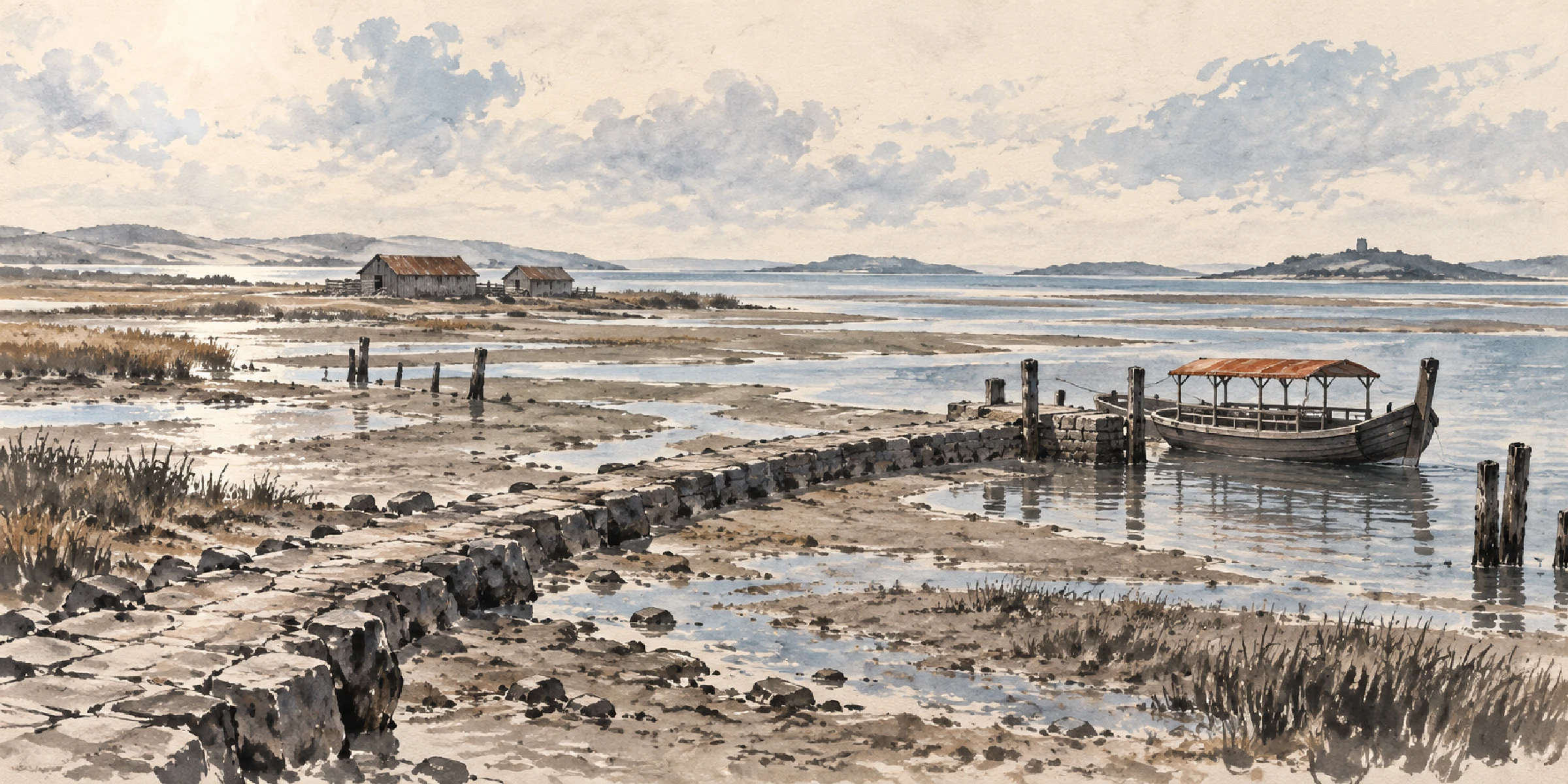
갯벌 끝의 나룻배
굽은 돌길이 드넓은 갯벌을 지나 빈 나룻배로 이어진다. 번지는 먹과 끊어진 붓선, 넉넉한 여백이 조용한 시각적 여정을 만든다.
이 이미지로 조합하기갯벌 끝의 나룻배
- 형태 언어
- 복잡한 형태를 서로 맞물리는 몇 덩어리로 줄이고, 작은 불규칙성은 느슨한 편집 삽화의 조형 언어 안에서 달라지게 한다.
- 윤곽선
- 압력에 따라 부푸는 붓 윤곽에 가늘게 빠지는 끝과 의도적인 끊김을 두고, 일부 가장자리는 먹 번짐 속으로 녹아들게 한다.
- 붓질·입자
- 먹이 소진되는 긴 붓질과 짧은 펜촉 강조를 번갈아 쓰고, 자연스러운 붓털 끊김과 불균일한 먹 머금음을 살린다.
- 표면 표현
- 투명하게 고인 먹, 부드러운 번짐, 손대지 않은 종이 여백으로 명암을 만들고 균일한 채움 대신 드문 겹침을 사용한다.
우선순위
먹의 축적과 손대지 않은 종이가 눈에 보이게 어우러지도록 한다.
피할 표현과 결과 확인
도식적인 단순화, 기계적으로 완결된 외곽선, 균일하게 채운 먹칠은 피한다.
표현적인 붓 압력과 숨 쉴 여유가 있는 종이 여백이 살아 있다.
이 예시의 실제 생성 프롬프트
MODULE OWNERSHIP
subject: Subject count, type, stable proportions and landmarks, resting face geometry, hair shape, physical materials, garment construction and permanent marks. No emotion, movement, color assignment or rendering recipe.
expression: Facial soft-tissue displacement and pupil direction, muscle coordination, regional intensity, asymmetry and onset/peak/release. No head/body pose, stable appearance, skin color or rendering.
gesture: Head/neck/body/limb orientation, joint movement, support, contact and pose-caused occlusion using existing anatomy. No eye/pupil movement, emotion, identity, props inventory or camera.
props: Prop count, type, construction, physical material and scale relative to the subject. Holding/contact belongs to gesture, position to composition, color to palette.
scene: Environment elements, terrain, backdrop/floor presence and structural detail. No canvas positions, camera, lighting, assigned colors or render texture.
camera: Projection, focal-length impression, camera elevation/yaw/roll, viewing distance and crop. No actor pose, world placement, lighting or canvas aspect ratio.
composition: Normalized 0-100% canvas positions, scale in frame, depth/overlap, focal hierarchy and margins. No joint pose, camera projection, rendering, subject/prop inventory or emotion.
palette: Color anchors, hue/saturation/value ranges, colors assigned to parts and approximate color coverage. No illumination direction, shading algorithm, physical material or layout.
lighting: Light-source direction/softness/intensity, ambient illumination, physical shadow direction/length and highlight position. Absence of directional illumination is allowed. No shading technique, palette or material changes.
style: Reusable form abstraction, contour weight/taper/edge quality, medium and mark scale/density/direction, surface rendering and tonal transition technique. No fixed subject proportions, anatomy, identity, expression, pose, palette, light-source direction, camera or layout.
output: Image count, aspect ratio, size, file/alpha requirements and global lettering/logo/watermark restrictions. No background scenery, crop, style, identity or pose.

SUBJECT
inventory: One original, unoccupied wooden ferry with a shallow hull and an open passenger shelter.
geometry: A broad, low hull has a blunt bow, a modest shelter roof and a distinctive upright stern post.
resting-face: No face-bearing subject is present.
appearance: Timber planks, bent wooden roof ribs and a weathered canvas canopy; incidental fittings may vary naturally.

PRIORITY
Preserve the ferry's low, sheltered silhouette.

AVOID
Avoid elaborate decorative fittings.

CHECK
The vessel reads immediately as a small passenger ferry.

GESTURE
head: No head or neck control targets apply to the ferry.
torso: Keep the rigid hull level, with its bow oriented toward the landing approach.
limbs: No articulated limb or joint control targets apply to the ferry.
contact: Water supports the hull while the ferry rests without movement.

PRIORITY
Make the ferry's level, supported resting orientation easy to read.

AVOID
Avoid tilting the hull into an unstable or departing posture.

CHECK
The rigid hull reads as level and supported by the water at rest.

PROPS
inventory: No separate props.
construction: No prop construction applies.

PRIORITY
Keep the prop inventory empty.

AVOID
Avoid accessory clutter.

CHECK
No separate accessories appear.

SCENE
inventory: An exposed estuary with a winding stone causeway, shallow tidal channels, reed beds and salt-store sheds.
structure: The causeway crosses the mudflat toward an old landing; scattered broken pilings mark the former water route.

PRIORITY
Make the exposed crossing the environment's defining structure.

AVOID
Avoid a densely developed waterfront.

CHECK
The estuary feels spacious and shaped by retreating water.

CAMERA
projection: Gentle perspective with a moderately wide focal-length impression and restrained distortion.
viewpoint: A slightly elevated oblique view looks across the estuary; the camera remains level.
crop: A distant environmental view includes the complete ferry and a long stretch of the crossing.

PRIORITY
Make the terrain's continuity legible.

AVOID
Avoid dramatic lens distortion.

CHECK
The viewing angle reveals the crossing's continuous course.

COMPOSITION
placement: Place the ferry at the landing near 75% canvas width; the causeway enters low at the left and leads toward it.
depth: A near crossing, middle-distance ferry and small distant sheds form a gradual journey into depth.
spacing: Keep the upper half mostly spacious; broad intervals around the ferry make it the quiet destination.

PRIORITY
Let the crossing lead the eye to the ferry.

AVOID
Avoid evenly distributed visual weight.

CHECK
The eye travels across the panorama and comes to rest at the ferry.

PALETTE
colors: Paper ivory, smoky charcoal, diluted slate blue and a restrained rust accent.
assignment: Use charcoal for the ferry and crossing, slate blue for channels, and rust on the canopy.
balance: Ivory dominates; subdued middle values carry the terrain, with the canopy supplying the smallest vivid note.

PRIORITY
Keep the rust accent quietly memorable.

AVOID
Avoid competing saturated accents.

CHECK
The limited palette supports a spacious, contemplative image.

LIGHTING
sources: Broad, soft daylight arrives from the upper left through thin cloud, with generous ambient illumination.
shadows: Short, diffuse shadows fall to the right beneath the hull, causeway edges and pilings.
highlights: Subtle highlights touch left-facing roof edges and the upper banks of shallow channels.

PRIORITY
Keep daylight soft across the whole estuary.

AVOID
Avoid theatrical spotlighting.

CHECK
Local shadows share one gentle light direction.

STYLE GUIDE
form-language: Reduce complex forms to a few interlocking masses; let minor irregularities vary within a loose editorial drawing language.
contour: Use pressure-swollen brush contours with tapered departures and deliberate gaps; allow selected edges to dissolve into washes.
mark-making: Alternate long, depleted brush sweeps with brief nib accents; preserve natural bristle breaks and uneven ink loading.
surface-rendering: Build tone through translucent ink pools, soft blooms and untouched paper reserves; use sparse overlaps instead of uniform filling.

PRIORITY
Make ink accumulation and untouched paper visibly cooperate.

AVOID
Avoid diagrammatic schematization, mechanically complete outlines and uniformly filled washes.

CHECK
The image retains expressive brush pressure and breathing paper reserves.

OUTPUT
format: One finished image, 2:1 aspect ratio, 2400 × 1200 pixels, opaque PNG.
restrictions: No lettering, logos, signatures or watermarks.

PRIORITY
Deliver one complete panoramic reference.

AVOID
Avoid alternate panels or process annotations.

CHECK
The export is a single finished image at the requested dimensions.

FINAL INTEGRATION
scene + camera + composition: Environmental continuity and framing cooperate to create an unhurried visual journey.
palette + lighting + style: Color restraint, gentle illumination and variable ink handling keep the atmosphere coherent.
모델명은 이미지 출처 정보 기준입니다. 같은 프롬프트를 사용해도 결과는 달라질 수 있습니다.