텍스트 → 이미지제품 사진스타일 가이드
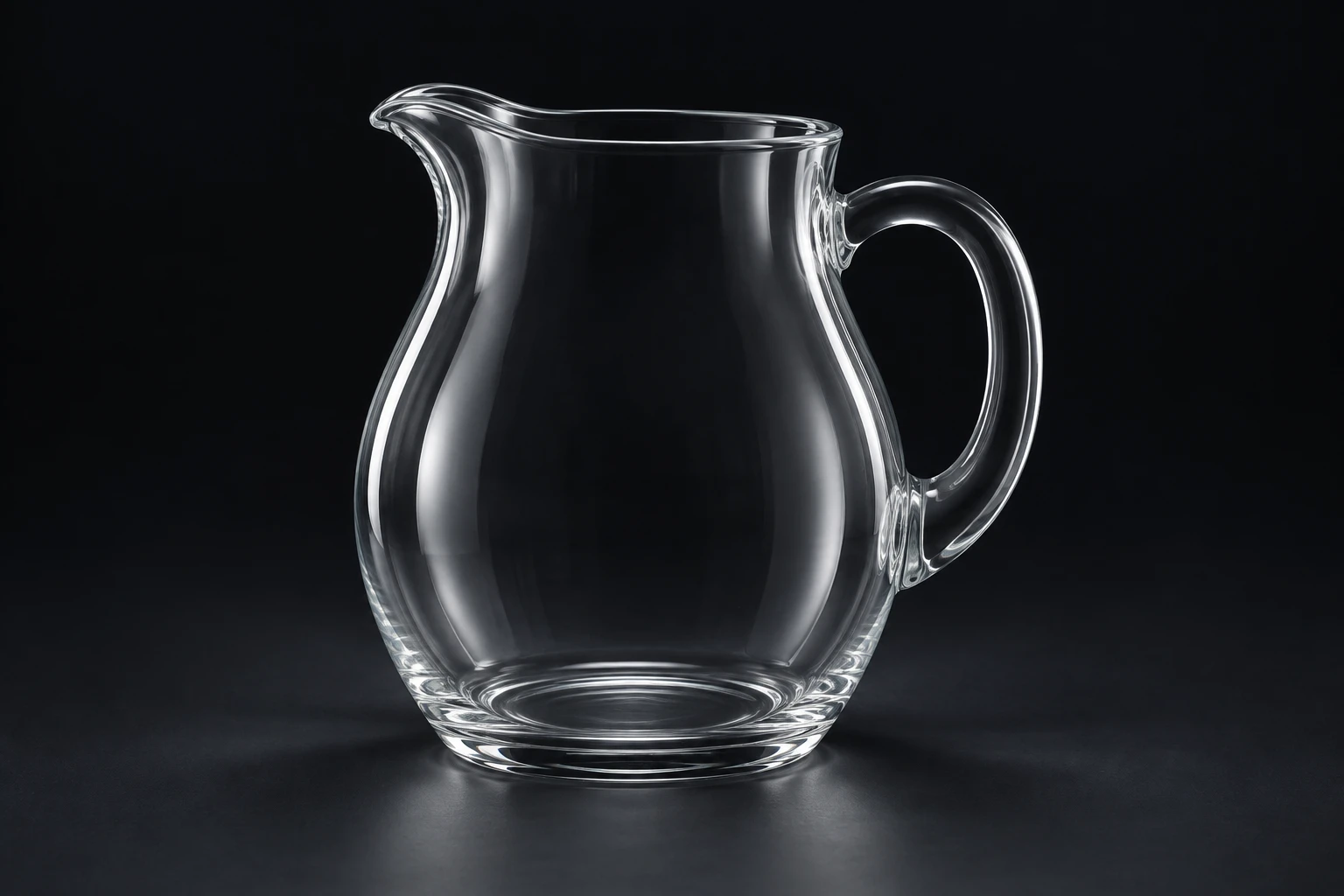
투명 유리 피처 · 암시야 가장자리 조명
뒤쪽의 긴 광원 두 개로 피처의 가장자리, 주둥이와 손잡이를 밝히고 중앙 투과면을 어둡게 유지하는 제품 사진.
이 이미지로 조합하기투명 유리 피처 · 암시야 가장자리 조명
- 형태 언어
- 다면체 추상화 없이 연속 곡률, 실제 구멍과 주요 두께 변화를 유지하는 충실한 사진 형태 묘사를 쓴다. 각 연결 형태 경계 상자의 최장 치수 중 1–2% 이상인 구조 세부를 유지하고 더 작은 부수 결함은 생략한다. 실제 모서리는 구별하고 둥근 전이는 연속 곡면으로 남긴다.
- 윤곽선
- 바깥과 내부의 윤곽 획을 그리지 않는다. 경계는 광학적 불연속으로 나타나며 물리 표면이 연속된 곳에서는 연속성을 유지한다. 가장자리 보간은 연결 형태 최장 치수의 0.1–0.3% 구간이다. 실제 열린 가장자리의 끊김을 남기고 고정 폭 윤곽, 잉크 가늘어짐, 겹선과 인공 둘레 후광은 없다.
- 붓질·입자
- 그리거나 칠하거나 인쇄한 자국이 영 개인 깨끗한 사진 표면을 쓴다. 매끈한 영역에는 일반 표시 크기에서 입자, 점묘, 해칭과 붓 질감이 없다. 남긴 구조 가장자리는 반복 자국이 아니라 연속된 광학 요소이며 채움과 투과 영역에 장식 질감이나 무작위 노이즈를 추가하지 않는다.
- 표면 표현
- 양자화하지 않은 연속 명도 보간으로 묘사한다. 반사·투과 영역은 매끈한 광학 그라데이션을 쓰고 확산 명도로 묘사된 영역도 연속해서 섞인다. 밝음에서 어둠으로의 가장자리 전이는 각 연결 형태 최장 치수의 0.3–1%이며 더 넓은 그라데이션은 끊기지 않는다. 투명 곡면은 경계 가까이에서 투과된 면을 압축한다. 평면 명도 띠, 채색 덩어리와 번짐 발광은 없다.
우선순위
그린 윤곽 없이 연속된 사진 광학 표현을 유지한다.
피할 표현과 결과 확인
셀 명도 띠, 인공 번짐 발광과 채색 질감 덩어리를 피한다.
반사는 연속해서 섞이고 투명 영역은 투과를 유지한다.
이 예시의 실제 생성 프롬프트
MODULE OWNERSHIP
subject: Subject count, type, stable proportions and landmarks, resting face geometry, hair shape, physical materials, garment construction and permanent marks. No emotion, movement, color assignment or rendering recipe.
expression: Facial soft-tissue displacement and pupil direction, muscle coordination, regional intensity, asymmetry and onset/peak/release. No head/body pose, stable appearance, skin color or rendering.
gesture: Head/neck/body/limb orientation, joint movement, support, contact and pose-caused occlusion using existing anatomy. No eye/pupil movement, emotion, identity, props inventory or camera.
props: Prop count, type, construction, physical material and scale relative to the subject. Holding/contact belongs to gesture, position to composition, color to palette.
scene: Environment elements, terrain, backdrop/floor presence and structural detail. No canvas positions, camera, lighting, assigned colors or render texture.
camera: Projection, focal-length impression, camera elevation/yaw/roll, viewing distance and crop. No actor pose, world placement, lighting or canvas aspect ratio.
composition: Normalized 0-100% canvas positions, scale in frame, depth/overlap, focal hierarchy and margins. No joint pose, camera projection, rendering, subject/prop inventory or emotion.
palette: Color anchors, hue/saturation/value ranges, colors assigned to parts and approximate color coverage. No illumination direction, shading algorithm, physical material or layout.
lighting: Light-source direction/softness/intensity, ambient illumination, physical shadow direction/length and highlight position. Absence of directional illumination is allowed. No shading technique, palette or material changes.
style: Reusable form abstraction, contour weight/taper/edge quality, medium and mark scale/density/direction, surface rendering and tonal transition technique. No fixed subject proportions, anatomy, identity, expression, pose, palette, light-source direction, camera or layout.
output: Image count, aspect ratio, size, file/alpha requirements and global lettering/logo/watermark restrictions. No background scenery, crop, style, identity or pose.

SUBJECT
inventory: Include exactly one empty clear-glass pitcher, identified as the pitcher. Its four distinguishing anchors are a rounded belly, open circular rim, short pouring spout and one integral D-shaped handle. The vessel has one continuous base and no lid, contents or permanent identifying marks.
geometry: Let H be the main vessel's base-to-rim height. Maximum belly diameter is 0.65–0.75H at 0.35–0.45H above the base; rim and flat base diameters are each 0.45–0.55H. Above the widest section, the belly narrows continuously into the rim without a separate neck; its lower curve joins the flat base with a rounded transition.
geometry: Using base-to-rim height H, the integral handle projects 0.25–0.30H beyond one side and joins the wall at 0.25–0.35H and 0.70–0.80H above the base. Its open D-shaped aperture is uninterrupted.
geometry: The opposite spout projects 0.10–0.15H beyond the rim and remains an open continuation of it. Its opening is 0.18–0.24H wide across the rim; viewed from above, the lip is a rounded U, not a pinched point. Its continuous curved profile rises 0.02–0.04H above the adjoining rim, with H measured base to rim.
appearance: Use polished transparent glass throughout. Walls and rim are 0.025–0.04H thick, with H measured base to rim; the handle has a rounded solid section 0.05–0.07H thick. Integrated joints are smooth and continuous. Seams, fasteners, engraving, frosting, bubbles and permanent scratches are absent.

PRIORITY
Retain the open spout and uninterrupted handle aperture.

AVOID
Avoid contents, frosting and added manufacturing decorations.

CHECK
One transparent pitcher retains all four structural anchors.

GESTURE
head: The rigid vessel has no head or neck, so head yaw, pitch and roll have no joint targets. Its complete construction keeps one object orientation without cranial articulation or a substitute head movement.
torso: Define world +X as right, +Y as up and +Z as forward. Intrinsic +Y runs base to rim, +X points toward the handle and +Z is normal to the handle–spout plane. Align intrinsic axes with world axes at yaw 0°±5°, pitch and roll 0°±2°. Torso and pelvis joints have no targets.
limbs: No limb joints or finger groups exist on this vessel. Keep the handle, spout, wall and base rigidly related without bending, squeezing, twisting or independent displacement; no articulated component changes its constructed relationship.
contact: The flat base rests on the horizontal floor and carries the entire load. Its downward-facing planar footprint remains in continuous contact, with no tipping or visible gap. The handle and spout bear no load and touch no supporting surface; rigid glass shows no load deformation.

PRIORITY
Preserve upright balance and continuous base contact.

AVOID
Avoid tipping, floating bases and deformed extensions.

CHECK
The upright vessel is supported only through its flat base.

PROPS
inventory: The prop inventory is empty: include exactly zero separate accessories, tools, containers or supplementary objects. No demonstration equipment or removable decoration accompanies the product.
construction: With zero props, there is no prop construction target. Do not introduce a backing plate, mounting hardware, supporting stand or attached component that would require additional construction.

PRIORITY
Keep the supplementary object inventory empty.

AVOID
Avoid mounting hardware and demonstration accessories.

CHECK
No separate accessory or support object is present.

SCENE
inventory: Include exactly one seamless studio sweep, comprising a horizontal floor continuing into a backdrop. Exclude furniture, pedestals, plants, architectural features, decorative motifs and visible lighting fixtures; no other environmental object is present.
structure: The sweep has one uninterrupted flat floor joined to its upright backdrop by a broad continuous curve. The surface is matte and structurally smooth, with no visible horizon seam, panel joints, tiles, repeated divisions or relief. Its outer boundaries are not represented.

PRIORITY
Maintain one seamless floor-to-backdrop surface.

AVOID
Avoid horizon seams, pedestals and environmental decoration.

CHECK
The environment contains one continuous sweep without divisions.

CAMERA
projection: Use photographic perspective with an 85–105 mm full-frame focal-length impression. Depth-dependent size changes remain mild, parallel verticals remain nearly parallel, and neither wide-angle expansion nor barrel distortion is present.
viewpoint: View from world +Z at yaw 0°±5°, elevation 12°±5° above the world XZ plane and roll 0°±3° relative to +Y. Aim at the vessel's geometric center from 5–7 times its base-to-rim height; this distance preserves mild near–far foreshortening.
crop: Show the complete vessel from its highest rim or spout edge to its lowest base, including the full lateral handle and spout. Preserve the visible opening and handle aperture; permit intrinsic rear-wall occlusion but no clipping of the exterior silhouette.

PRIORITY
Reveal the complete vessel and its open apertures.

AVOID
Avoid wide-angle expansion and clipped extensions.

CHECK
The full silhouette and both open apertures remain visible.

COMPOSITION
placement: Using top-left normalized coordinates, center the existing vessel at (50%,48%) within ±5 percentage points. Its longest visible span targets 80% of the shorter canvas side, allowed 70–90%; derive both bounds by uniform scaling. The sweep covers x=0–100%, y=0–100%.
depth: Use one borderless panel. The vessel is the sole focal element ahead of the sweep; its intrinsic surfaces overlap normally and its transparent regions may reveal the environment behind them. Shadows remain subordinate on the sweep, with no independently placed foreground obstruction.
spacing: Keep the complete visible vessel and its associated shadow bounds inside x=5–95%, y=5–95%. Uniform-scale containment overrides nominal fill whenever the complete cluster cannot fit. Scale the cluster together and derive margins from its resulting bounds; no separate object gap is required.

PRIORITY
Contain the complete vessel and subordinate shadow together.

AVOID
Avoid independent extension scaling and decorative framing.

CHECK
The full cluster stays inside the 5% inset without separate resizing.

PALETTE
colors: Use four cool near-achromatic anchors: background #090B0F, deep shadow #050609, intermediate reflection #7B8791 and bright reflection #E5ECF2. Permit continuous mixtures among them, including boundary blends. Introduce no warm tint or additional independent hue family.
assignment: Assign the floor and backdrop to background, and contact or cast shadows to deep shadow. Transmitted regions inherit the environment's background role. Every glass part uses intermediate and bright reflection roles where visible reflections occur, without a body tint. No independent outline or accent color exists.
balance: Coverage follows actual assigned-region areas and closes to 100%, with mixtures counted under their contributing roles. Keep all visible regions within the four anchors and their mixtures. No fixed canvas occupancy is imposed on the background, transmission, reflection or shadow roles.

PRIORITY
Keep the glass untinted and all reflections within the cool anchors.

AVOID
Avoid amber glass, warm highlights and independent accent colors.

CHECK
Every visible region inherits a defined anchor or permitted mixture.

LIGHTING
sources: Use two equal vertical strip sources behind the vessel, each 35–50° from world −Z toward opposite ±X sides and elevated 10–20°. Each subtends 40–60° vertically and 5–10° horizontally. Set each source strength to 1±20% and ambient strength to 1–3% of that reference; no frontal source is present.
shadows: Let H be vessel base-to-rim height. Contact shadow stays within 0.03–0.06H of the base footprint. Two soft cast lobes extend toward world +Z and opposite ±X, reaching 0.15–0.25H with penumbrae 0.08–0.12H wide. Their luminance is 85–95% of adjacent floor; no hard detached shadow appears.
highlights: Using base-to-rim height H, bright reflections trace both outer side edges and source-facing extension edges in bands 0.01–0.03H wide. The rear half of the upper rim carries a broken bright arc. Peak luminance is 8–12 times adjacent backdrop; the central front wall has no broad frontal highlight.

PRIORITY
Reveal paired bright edges around a dark transmitted center.

AVOID
Avoid frontal softbox glare and broad central hotspots.

CHECK
Two rear-source edge reflections remain brighter than the central wall.

STYLE GUIDE
form-language: Use faithful photographic form description, retaining continuous curvature, true openings and major thickness changes without polygonal abstraction. Preserve structural details at least 1–2% of each connected form's longest bounding-box dimension; omit smaller incidental defects. Genuine corners remain distinct, while rounded transitions stay continuously curved.
contour: Draw no exterior or interior contour strokes. Boundaries emerge from optical discontinuities and remain continuous wherever the physical surface is continuous. Edge interpolation spans 0.1–0.3% of the connected form's longest dimension. Preserve real open-edge interruptions; add no fixed-width outline, ink taper, doubled tracing or artificial enclosing halo.
mark-making: Use a clean photographic surface with zero drawn, painted or printed marks. Smooth regions remain free of grain, stippling, hatch lines and brush texture at ordinary display scale. Retained construction edges are continuous optical features rather than repeated marks; no decorative texture or random noise is added to filled or transmitted regions.
surface-rendering: Render continuous, unquantized tonal interpolation. Reflected and transmitted passages use smooth optical gradients; diffusely modeled passages blend continuously. Bright-to-dark edge transitions span 0.3–1% of each connected form's longest dimension; broader gradients remain uninterrupted. Curved transparent regions compress the transmitted field near their boundaries. Exclude flat tone bands, painted patches and bloom.

PRIORITY
Keep continuous photographic optics without drawn outlines.

AVOID
Avoid cel bands, artificial bloom and painted texture patches.

CHECK
Reflections blend continuously while transparent regions retain transmission.

OUTPUT
format: Deliver exactly one raster image as a PNG file, 1536×1024 pixels with a 3:2 aspect ratio. Use an opaque image with no alpha channel or transparent pixels; provide no additional image variants.
restrictions: Include no lettering, dialogue, captions, sound-effect characters, logos, signatures or watermarks. Deliver the image without interface controls, metadata labels or an accompanying embedded reference sheet.

PRIORITY
Deliver one opaque PNG at the specified dimensions.

AVOID
Avoid embedded lettering and additional image variants.

CHECK
One 1536×1024 opaque PNG contains no lettering or watermark.

FINAL INTEGRATION
subject + gesture + camera: The handle–spout plane aligns with world XY, so the near-frontal view places the handle on viewer-right and the spout on viewer-left. The elevated view reveals the rim opening while the flat base remains supported.
lighting + style: Render the strip-source reflections as continuous optical transitions rather than drawn contour bands. The physical penumbrae remain broad soft floor effects, distinct from the narrower reflection transitions.
palette + lighting + style: Reflection and transmission use the permitted cool mixtures. The bright anchor supports the specified edge contrast without clipped bloom; dark transmitted regions retain the backdrop role instead of becoming opaque fill.
gesture + scene + composition: The base contacts the sweep's horizontal floor. Treat the supported vessel and its floor shadows as one uniformly scaled cluster for containment, without altering their physical contact or relative scale.
모델명은 이미지 출처 정보 기준입니다. 같은 프롬프트를 사용해도 결과는 달라질 수 있습니다.