텍스트 → 이미지화풍스타일 가이드
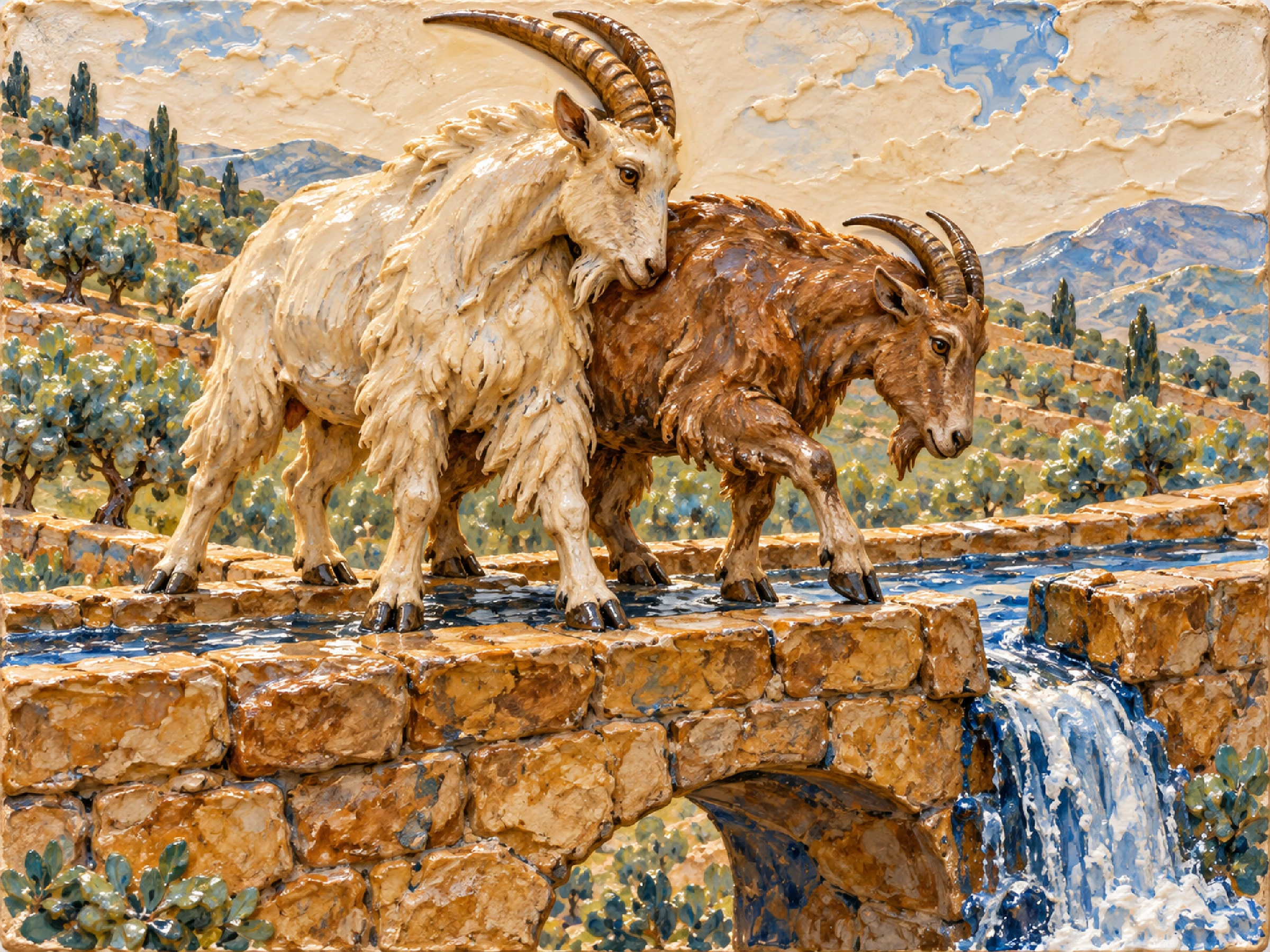
수로 벽에서 엇갈리는 두 염소
좁은 수로 벽에서 어깨를 맞대고 엇갈리는 두 염소와 아래로 쏟아지는 물을, 도톰한 점토 부조와 고인 유약의 깊이로 표현한다.
이 이미지로 조합하기수로 벽에서 엇갈리는 두 염소
- 형태 언어
- 둥글게 눌러 빚은 덩어리와 얕게 파인 면으로 도자 부조를 구성하고, 작은 형태는 넓게 빚은 능선으로 단순화한다.
- 윤곽선
- 불규칙하게 부풀고 부드러워지는 점토 가장자리로 윤곽을 이루고, 가는 음각선은 일부 내부 경계에만 쓴다.
- 붓질·입자
- 덩어리를 따르는 엄지 쓸림과 뭉툭한 도구 홈을 선택적으로 남기고, 자국과 손대지 않은 간격은 자연스럽게 달라지게 한다.
- 표면 표현
- 오목한 곳에는 반투명 유약을 고이게 하고 능선에서는 얇아지게 하며, 불균일한 소성 경계와 간헐적으로 드러난 점토 가장자리를 살린다.
우선순위
전체에서 빚어진 도자 부조와 눈에 보이게 고인 유약을 핵심 표현으로 삼는다.
피할 표현과 결과 확인
이 예시의 실제 생성 프롬프트
MODULE OWNERSHIP
subject: Subject count, type, stable proportions and landmarks, resting face geometry, hair shape, physical materials, garment construction and permanent marks. No emotion, movement, color assignment or rendering recipe.
expression: Facial soft-tissue displacement and pupil direction, muscle coordination, regional intensity, asymmetry and onset/peak/release. No head/body pose, stable appearance, skin color or rendering.
gesture: Head/neck/body/limb orientation, joint movement, support, contact and pose-caused occlusion using existing anatomy. No eye/pupil movement, emotion, identity, props inventory or camera.
props: Prop count, type, construction, physical material and scale relative to the subject. Holding/contact belongs to gesture, position to composition, color to palette.
scene: Environment elements, terrain, backdrop/floor presence and structural detail. No canvas positions, camera, lighting, assigned colors or render texture.
camera: Projection, focal-length impression, camera elevation/yaw/roll, viewing distance and crop. No actor pose, world placement, lighting or canvas aspect ratio.
composition: Normalized 0-100% canvas positions, scale in frame, depth/overlap, focal hierarchy and margins. No joint pose, camera projection, rendering, subject/prop inventory or emotion.
palette: Color anchors, hue/saturation/value ranges, colors assigned to parts and approximate color coverage. No illumination direction, shading algorithm, physical material or layout.
lighting: Light-source direction/softness/intensity, ambient illumination, physical shadow direction/length and highlight position. Absence of directional illumination is allowed. No shading technique, palette or material changes.
style: Reusable form abstraction, contour weight/taper/edge quality, medium and mark scale/density/direction, surface rendering and tonal transition technique. No fixed subject proportions, anatomy, identity, expression, pose, palette, light-source direction, camera or layout.
output: Image count, aspect ratio, size, file/alpha requirements and global lettering/logo/watermark restrictions. No background scenery, crop, style, identity or pose.

SUBJECT
inventory: Two adult mountain goats: A has long swept-back horns; B has shorter curved horns.
geometry: Both have sturdy barrel-shaped bodies, narrow cloven hooves, short tails and small chin beards.
resting-face: Long wedge-shaped muzzles, side-set eyes and short pointed ears establish their resting faces.
appearance: Coarse coats gather into a few shaggy tufts; neither goat wears clothing or accessories.

PRIORITY


AVOID


CHECK


EXPRESSION — ACTOR A
brows: Keep the tissue above the eyes relaxed, without a raised ridge or inward bunching.
lids: Let the visible lids rest at a natural opening, without widening or squeezing.
cheeks: Keep the cheeks loose, without lifting or gathering beside the muzzle.
nose: Keep the nostrils at rest, without flaring or wrinkling the bridge.
mouth: Close the lips softly with level corners and no pursing.
jaw: Keep the jaw settled without clenching or dropping.
gaze: Direct the visible pupil toward B's shoulder.
coordination: Keep upper and lower facial regions equally quiet, without a pronounced asymmetric pull.
timing: Hold a subdued neutral apex with no developing facial reaction.

PRIORITY


AVOID


CHECK


EXPRESSION — ACTOR B
brows: Leave the tissue above the eyes smooth and uncontracted.
lids: Keep the visible lids naturally open, without a startled lift or tight squint.
cheeks: Let the cheeks remain relaxed, with no upward push against the lower lids.
nose: Leave the nostrils unflared and the muzzle tissue unwrinkled.
mouth: Keep the lips lightly together, without pulling back the corners.
jaw: Rest the jaw in a soft closure without visible tension.
gaze: Direct the visible pupil toward the open footing beyond A.
coordination: Maintain a quiet resting face; pupil direction provides the only distinct facial emphasis.
timing: Hold the neutral apex steadily, without a rising or releasing reaction.

PRIORITY


AVOID


CHECK


GESTURE
head: A draws its neck aside; B lowers its head to pass beneath A's horn sweep.
torso: A braces across the narrow footing while B twists its shoulders through the remaining gap.
limbs: A plants its visible legs firmly; B lifts one forehoof in a tentative forward step.
contact: Their shoulders brush; planted hooves bear on the wall cap, with B's far legs partly hidden by A.

PRIORITY


AVOID


CHECK


PROPS
inventory: No separate props.
construction: No prop construction applies.

PRIORITY


AVOID


CHECK


SCENE
inventory: An old hillside irrigation aqueduct, spilling water, terraced orchard slopes and open sky.
structure: A narrow masonry wall borders the channel; a broken outlet releases water over its arched support.

PRIORITY


AVOID


CHECK


CAMERA
projection: Use a gently compressed perspective with little wide-angle distortion.
viewpoint: Look slightly down from a three-quarter side view, close enough to read the crossing clearly.
crop: Keep both goats complete; crop the aqueduct's continuing ends and the lower falling water.

PRIORITY


AVOID


CHECK


COMPOSITION
placement: The two goats dominate the upper middle; the spill answers them below and to the right.
depth: A overlaps B, the wall overlaps the orchard, and falling water crosses the recessed arch opening.
spacing: Keep the crossing tightly interlocked, with generous sky around the horns and a clear opening beneath the arch.

PRIORITY


AVOID


CHECK


PALETTE
colors: Use chalk cream, warm umber, amber ochre, deep cobalt and muted celadon.
assignment: A is cream, B umber, masonry amber ochre, water cobalt, orchard celadon, and sky pale cream.
balance: Warm pale areas predominate; cobalt supplies a concentrated dark accent and celadon stays subdued.

PRIORITY


AVOID


CHECK


LIGHTING
sources: Broad soft light grazes from the upper left, supported by gentle ambient illumination.
shadows: Short soft shadows fall toward the lower right from projecting forms; recesses remain softly shadowed.
highlights: Broad highlights gather on upper-left-facing bulges, with stronger glints along the water.

PRIORITY


AVOID


CHECK


STYLE GUIDE
form-language: Build ceramic relief from rounded, pressed masses and shallow recessed fields; simplify small forms into broad modeled ridges.
contour: Let raised clay edges define irregularly swelling, softened contours; reserve thin incisions for a few internal separations.
mark-making: Leave selective thumb sweeps and blunt tool grooves following each mass; allow natural variation in marks and unworked intervals.
surface-rendering: Pool translucent glaze in hollows and thin it over crests; retain uneven fired transitions and occasional exposed clay edges.

PRIORITY
Make modeled ceramic relief and visibly pooled glaze the defining treatment throughout.

AVOID


CHECK


OUTPUT
format: One finished image, landscape 4:3, 2400 × 1800 pixels, opaque PNG.
restrictions: No lettering, logos or watermarks.

PRIORITY


AVOID


CHECK


FINAL INTEGRATION
gesture + composition: Let overlap strengthen the crowded encounter while keeping the passing action readable.
style + lighting: Let illumination reveal the modeled surface while glaze transitions remain distinct from cast shadows.
모델명은 이미지 출처 정보 기준입니다. 같은 프롬프트를 사용해도 결과는 달라질 수 있습니다.