텍스트 → 이미지풍경스타일 가이드
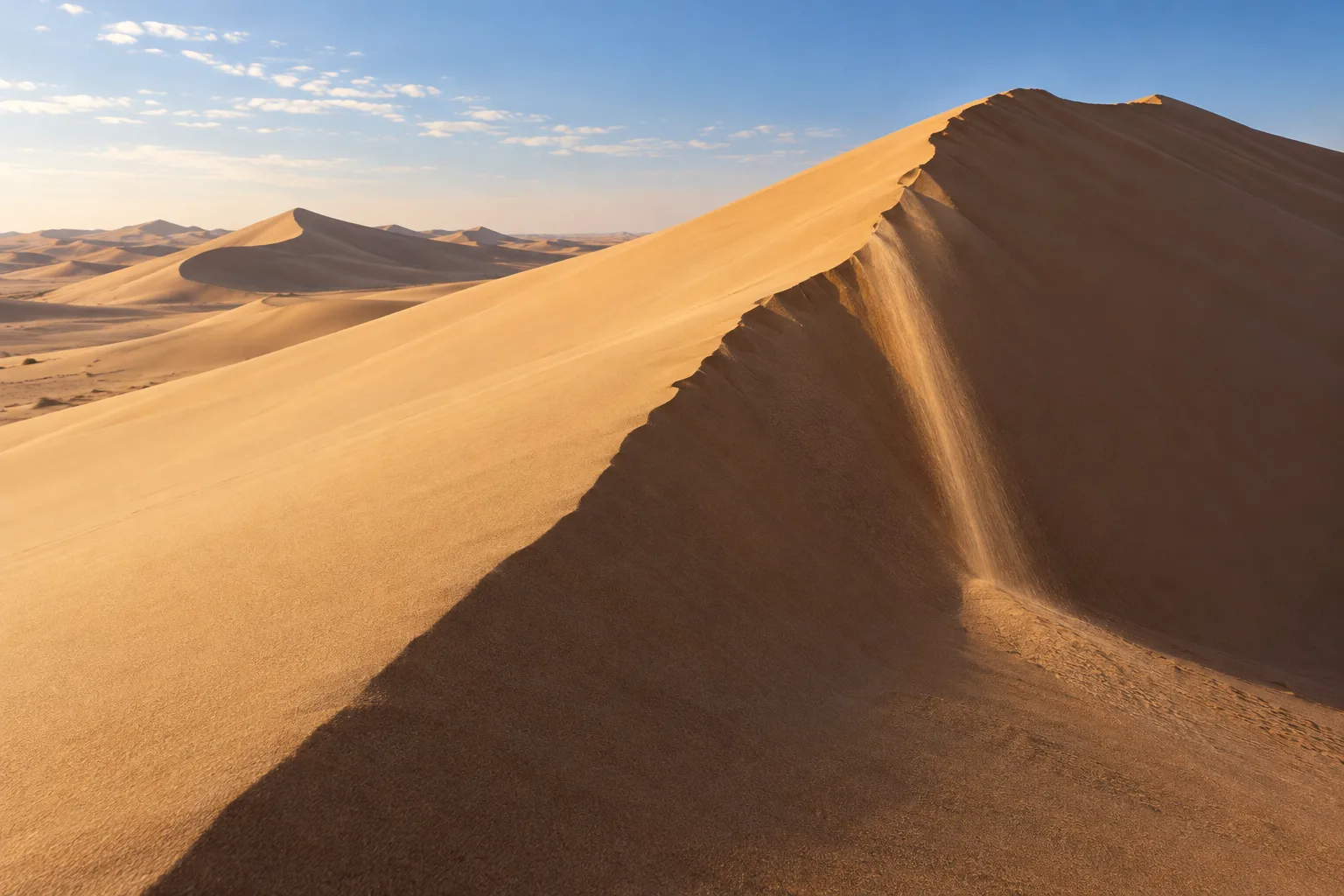
사구 능선 · 미끄럼면 퇴적
바람을 맞는 완만한 면과 급한 미끄럼면, 아래로 흘러내린 모래를 구분해 사구의 형성 과정을 보여주는 풍경.
사구 능선 · 미끄럼면 퇴적
- 형태·선
- 바람을 맞는 경사면에는 길고 매끈한 선을, 능선에는 더 날카롭고 끊긴 가장자리를 쓰며 흘러내리는 물질은 짧은 방향성 선으로 그린다.
- 색·명암
- 바람을 맞는 면은 넓고 고르게 밝히고 급한 그늘면은 한 단계 깊은 명암으로, 새로 흘러내린 부분은 좁은 밝은 강조로 처리한다.
- 질감·재질
- 미세한 입자와 작은 주름은 물질이 쌓이는 곳에 모으고 손대지 않은 넓은 면은 거의 매끈하게 둔다.
- 구도
- 멀어질수록 같은 경사 관계를 더 작은 크기로 반복하되 주 능선 하나가 확실히 우세하게 보이게 한다.
우선순위
능선과 양쪽 경사면, 퇴적 부채꼴, 먼 곳의 반복 순으로 우선한다.
피할 표현과 결과 확인
모든 면에 무작위로 깔린 물결무늬, 똑같은 경사각, 지형을 가리는 과장된 색 효과, 글자, 로고, 워터마크를 피한다.
표기 없이도 완만한 접근면, 날카로운 능선, 급한 그늘면, 새로 흘러내린 모래를 각각 구별할 수 있으면 통과다.
이 예시의 실제 생성 프롬프트
SUBJECT
One long desert dune ridge sheds a narrow fan of sand down its steep lee face as wind crosses the crest.

COMPOSITION
Low, wide landscape view. Place the main crest diagonally from lower left toward upper right; make its slip face the largest plane, with smaller receding dunes and an open sky behind it.

STYLE GUIDE
1. Shape & line
Use long smooth contours on windward slopes and a sharper broken edge at the crest; draw falling material as short directional streaks.

2. Color & light
Keep the windward plane broad and evenly lit; give the steep lee plane a single deeper value and the fresh fall a narrow light accent.

3. Texture & material
Concentrate fine grain and tiny ridges where material accumulates; leave undisturbed planes almost smooth.

4. Composition
Repeat the same slope relationship at smaller scales into the distance, while keeping one dominant crest unmistakable.

PRIORITY
Preserve the requested identity, count, action, composition and output settings. Apply the style rules within those constraints; a style reference must not replace the subject or layout. Within the style: Prioritize the crest and opposing slopes, then the deposition fan, then distant repetition.

AVOID
Avoid random ripples across every surface, identical slope angles, dramatic color effects that obscure terrain, lettering, logos, and watermarks.

OUTPUT
One image, horizontal 3:2, with a continuous natural landscape and no border or inset.

SELF-CHECK
Pass if the gentle approach, sharp crest, steep lee face, and fresh sand fall can each be identified without labels.
표정 세트
기본 얼굴
표정 32
세부 연기
중립
표정 프롬프트
EXPRESSION
Neutral. Resting baseline: release all facial tension.
BROWS: Rest at their natural height without pulling together.
EYES: Rest at natural openness; no squint or widened stare.
CHEEKS: Remain relaxed without lift or nose wrinkling.
MOUTH: Keep lips gently touching and corners level.
JAW: Keep teeth apart slightly behind closed lips; jaw relaxed.
GAZE: Look straight at the viewer with aligned pupils.
EXPRESSION SCOPE: Apply only these facial movements; intensity changes movement amplitude, not identity or rendering style. Keep the head angle, body pose, framing and illumination supplied by the other modules. Use viewer-left/right consistently. Do not add tears, sweat, blush colors, symbols or props unless separately requested.

FACIAL MUSCLE COORDINATION
Resting baseline: release expressive brow, cheek and lip tension. Maintain ordinary eyelid support and comfortable lip contact; leave the jaw unclenched. No unilateral pull, squeezed lids or residual smile.
전체 프롬프트
FACE IDENTITY
IDENTITY: One original adult character, approximately 28 years old, with an androgynous appearance; the same individual in every expression.
PROPORTIONS: Oval face with face height about 1.35 times cheekbone width; eye line near mid-height, with approximately one eye-width between inner eye corners.
EYES: Medium almond-shaped eyes, dark brown irises of equal size, defined upper eyelid folds and gently curved lower lids; preserve inner and outer corner locations.
BROWS: Medium-width straight eyebrows with a soft arch in the outer third; dark brown, with a softly tapered outer tip and a rounded inner end.
NOSE: Straight narrow bridge, softly rounded tip and small symmetrical nostrils; nose base width approximately equals the inner eye-corner distance.
MOUTH: Moderate-width mouth, defined but shallow cupid bow, lower lip slightly fuller than upper lip; preserve resting lip volume and philtrum length.
JAW: Softly tapered jaw, rounded chin and moderate cheekbone projection; ears of equal size at consistent positions beside the head.
SKIN: Even medium warm-brown complexion; keep the same underlying tone and age impression, without expression-dependent changes in skin texture.
HAIR: Short dark brown hair, straight side part at viewer-left, forehead visible, no bangs across the eyes and no facial hair.
MARKS: One small round mole below the viewer-left outer eye corner, about one iris diameter beneath it; no additional freckles, scars or accessories.
These describe the resting identity, not the final expression. Preserve bone structure, landmark spacing, iris size, hairline, age impression and distinctive marks. Only the requested soft-tissue motion may change.

RENDERING STYLE
1. Use long smooth contours on windward slopes and a sharper broken edge at the crest; draw falling material as short directional streaks.
2. Keep the windward plane broad and evenly lit; give the steep lee plane a single deeper value and the fresh fall a narrow light accent.
3. Concentrate fine grain and tiny ridges where material accumulates; leave undisturbed planes almost smooth.
4. Repeat the same slope relationship at smaller scales into the distance, while keeping one dominant crest unmistakable.
STYLE AVOID: Avoid random ripples across every surface, identical slope angles, dramatic color effects that obscure terrain, lettering, logos, and watermarks.

PORTRAIT FRAME
One head-and-shoulders portrait, square frame, face centered, eye-level straight-on view with zero head roll. Hair and chin fully visible; head occupies about 60% of frame height. Plain light neutral background. Keep the same crop and softly even illumination across the set; use only the shading methods supported by the selected style.

MODULE PRIORITY
Identity landmarks first, facial movements second, fixed portrait framing third; transfer contour, palette relationships, shading and texture from the style. A style-only reference must not supply its identity, facial expression, hair, costume, head pose or scene. Translate movement into the style without adding realistic wrinkles or glossy volume to a flat style. Resting mouth/eyelid descriptions yield only to the requested movement, not to a different identity.

STYLE REFERENCE
https://images.imagenframe.com/v1/9743ea4174c38146f85670d86277f2cef02504021af119abb666f3cc2b56a67a/fd603efe013c6b7dce6585f1aa3e9885a5222254683cae7796f85a5ee594942f/1600.webp
Attach this image as a rendering-only reference.

QUALITY CHECK
Check the same face outline, eye spacing, nose shape, resting lip proportions, hairline and identifying marks across the set. Check each requested brow, lid, cheek, lip, jaw and gaze movement. Keep anatomy coherent and preserve the chosen rendering technique. No added labels, lettering or watermarks.

EXPRESSION
Neutral. Resting baseline: release all facial tension.
BROWS: Rest at their natural height without pulling together.
EYES: Rest at natural openness; no squint or widened stare.
CHEEKS: Remain relaxed without lift or nose wrinkling.
MOUTH: Keep lips gently touching and corners level.
JAW: Keep teeth apart slightly behind closed lips; jaw relaxed.
GAZE: Look straight at the viewer with aligned pupils.
EXPRESSION SCOPE: Apply only these facial movements; intensity changes movement amplitude, not identity or rendering style. Keep the head angle, body pose, framing and illumination supplied by the other modules. Use viewer-left/right consistently. Do not add tears, sweat, blush colors, symbols or props unless separately requested.

FACIAL MUSCLE COORDINATION
Resting baseline: release expressive brow, cheek and lip tension. Maintain ordinary eyelid support and comfortable lip contact; leave the jaw unclenched. No unilateral pull, squeezed lids or residual smile.

BASE FACE
Generate the neutral reference first. Review the identity and rendering before using this output as the shared face reference for subsequent expressions.모델명은 이미지 출처 정보 기준입니다. 같은 프롬프트를 사용해도 결과는 달라질 수 있습니다.