텍스트 → 이미지인물스타일 가이드
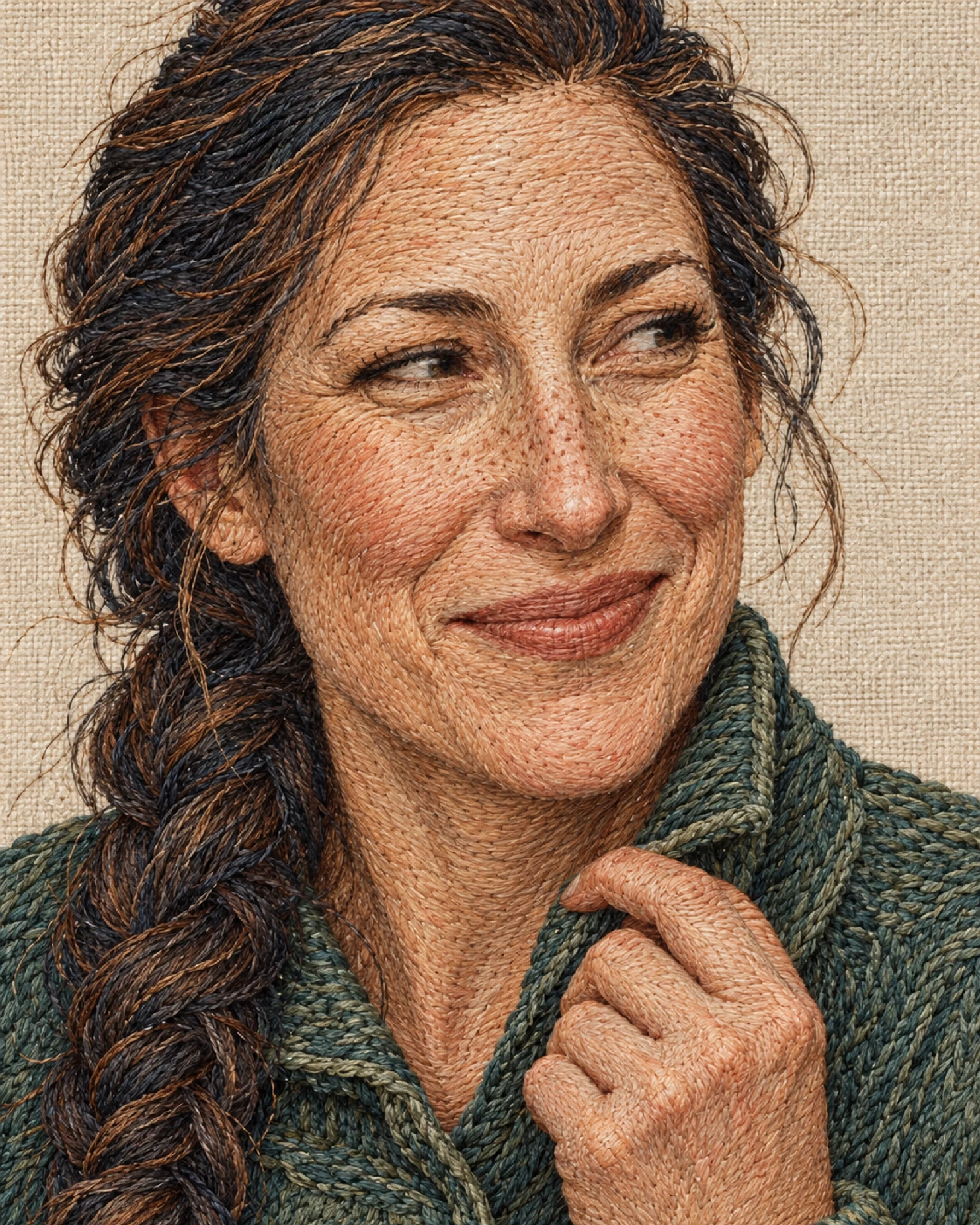
웃음을 참는 땋은 머리 여성
옷깃을 가볍게 쥐고 웃음을 참는 성인 여성의 가까운 초상. 얼굴을 따라 흐르는 자수와 솟은 실의 가장자리가 작은 표정 변화를 촉감 있는 부조로 만든다.
이 이미지로 조합하기웃음을 참는 땋은 머리 여성
- 형태 언어
- 형태를 서로 맞물리는 완만한 곡선의 자수 영역으로 바꾸고 부차적 세부는 단순화하되 의미 있는 불규칙성은 남긴다. 일관된 수작업 언어 안에서 작은 땀과 형태 변화는 허용한다.
- 윤곽선
- 일부 경계는 굵기가 달라지는 가는 징금 끈으로 만들고 부드러운 경계는 드러난 땀 끝으로 마무리한다. 모든 명암 조각을 두꺼운 자수 외곽선으로 감싸지는 않는다, 경계는 선택적으로 강조한다.
- 붓질·입자
- 완만하게 방향을 바꾸는 부채꼴의 불규칙한 롱 앤드 쇼트 스티치를 쓰고 간헐적인 느슨한 교차와 둥근 실 묶음을 드러낸다. 길이와 간격의 자연스러운 변화가 격자 정밀도보다 수작업을 전하게 한다.
- 표면 표현
- 인쇄된 그라데이션 대신 인접한 실색을 섞어 명암 전이를 만든다. 개별 가닥의 부조와 간헐적으로 보이는 바탕 직물을 남기고 땀의 겹침으로 더 부드러운 혼합을 이루게 한다, 실의 존재감은 유지한다.
우선순위
손으로 놓은 실의 부조가 이미지의 명암 언어에 필수적으로 작동하게 한다.
피할 표현과 결과 확인
그린 초상 위에 균일한 자수 질감만 덮는 표현을 피한다.
외곽선, 전이, 작은 불규칙성이 눈에 보이게 땀에서 생겨난다.
이 예시의 실제 생성 프롬프트
MODULE OWNERSHIP
subject: Subject count, type, stable proportions and landmarks, resting face geometry, hair shape, physical materials, garment construction and permanent marks. No emotion, movement, color assignment or rendering recipe.
expression: Facial soft-tissue displacement and pupil direction, muscle coordination, regional intensity, asymmetry and onset/peak/release. No head/body pose, stable appearance, skin color or rendering.
gesture: Head/neck/body/limb orientation, joint movement, support, contact and pose-caused occlusion using existing anatomy. No eye/pupil movement, emotion, identity, props inventory or camera.
props: Prop count, type, construction, physical material and scale relative to the subject. Holding/contact belongs to gesture, position to composition, color to palette.
scene: Environment elements, terrain, backdrop/floor presence and structural detail. No canvas positions, camera, lighting, assigned colors or render texture.
camera: Projection, focal-length impression, camera elevation/yaw/roll, viewing distance and crop. No actor pose, world placement, lighting or canvas aspect ratio.
composition: Normalized 0-100% canvas positions, scale in frame, depth/overlap, focal hierarchy and margins. No joint pose, camera projection, rendering, subject/prop inventory or emotion.
palette: Color anchors, hue/saturation/value ranges, colors assigned to parts and approximate color coverage. No illumination direction, shading algorithm, physical material or layout.
lighting: Light-source direction/softness/intensity, ambient illumination, physical shadow direction/length and highlight position. Absence of directional illumination is allowed. No shading technique, palette or material changes.
style: Reusable form abstraction, contour weight/taper/edge quality, medium and mark scale/density/direction, surface rendering and tonal transition technique. No fixed subject proportions, anatomy, identity, expression, pose, palette, light-source direction, camera or layout.
output: Image count, aspect ratio, size, file/alpha requirements and global lettering/logo/watermark restrictions. No background scenery, crop, style, identity or pose.

SUBJECT
inventory: A is one original middle-aged adult woman with a long face and a substantial, softly built upper body.
geometry: Establish an elongated oval skull, prominent cheekbones, a narrow chin and broad shoulders; retain mature proportions rather than doll-like enlargement.
resting-face: Give her a straight, high nasal bridge, deep-set almond eyes, a broad upper lip and a fuller lower lip, with a fine crease beside each mouth corner.
appearance: Her hair forms a loose side braid with a swept-back crown and escaping short strands. She wears a wool jacket with a folded standing collar; small freckles cross the nose. Secondary hair and garment details may vary naturally.

PRIORITY
Preserve a mature, individual face.

AVOID
Avoid smoothing her features into a generic youthful beauty.

CHECK
The long face, high bridge and loose braid establish one consistent person.

EXPRESSION — ACTOR A
brows: Let both brows settle from a mild lift, retaining a gentle outward arch without a strong unilateral brow gesture; the brow movement should support the easing amusement, not introduce doubt.
lids: Compress the lower lids as the cheeks rise, with the upper lids relaxed into a soft, laughing narrowing; keep the eyes open enough for their pupil direction to remain visible.
cheeks: Lift one cheek slightly more than the other, forming unequal but connected folds beside the mouth; the asymmetry should suggest a laugh being contained rather than a deliberate facial contortion.
nose: Keep the bridge unwrinkled and permit only a slight nostril widening associated with the fading laugh; the nose should remain a quiet participant rather than a dominant expression cue.
mouth: Draw the corners upward while lightly pressing the lips together; one corner escapes a little farther, leaving a small off-center gap but no broad tooth display, as the laugh is held back.
jaw: Bring the jaw back toward closure without clenching, keeping the lower face supple; the closing motion supports the lightly pressed lips while preserving the softness of a laugh in release.
gaze: Aim both pupils toward someone just beyond the image's right edge, keeping the shared direction readable through the narrowed lids and avoiding direct eye contact with the viewer.
coordination: Link cheek lift, lower-lid compression and mouth-corner pull; lip restraint should soften their combined effect rather than suggest discomfort, embarrassment or a grimace unrelated to amusement.
timing: Catch the laugh subsiding while a final uneven smile remains; show the mouth beginning to settle before the cheeks and lower lids have completely relaxed, creating a believable release.

PRIORITY
Make restrained laughter readable through coordinated cheeks, lids and lips.

AVOID
Avoid a stiff closed-mouth grin or exaggerated comic grimace.

CHECK
The uneven smile remains warm as the laugh visibly settles.

GESTURE
head: Tuck the chin gently and turn the head a little toward her left, leaving a soft curve through the neck.
torso: Draw one shoulder slightly forward while the other settles back, as the upper torso turns toward the conversation.
limbs: Raise one forearm toward the upper chest, with a relaxed wrist and loosely curved fingers; let the remaining arm rest without a separate action.
contact: Let the thumb and forefinger lightly pinch the collar edge below the chin; keep the hand clear of the mouth and cheeks.

PRIORITY
Use the small collar touch to support an intimate conversational pose.

AVOID
Avoid a hand covering the defining facial action.

CHECK
The neck, shoulders and collar touch form one relaxed movement.

PROPS
inventory: Use no separate props; the portrait's visible belongings are limited to the garment defined with the subject.
construction: No prop construction, physical material or subject-relative scale applies because the separate-prop inventory is empty.

PRIORITY
Keep the encounter free of accessory storytelling.

AVOID
Avoid adding a needle, hoop, jewelry or handheld object.

CHECK
No separate object competes with the portrait.

SCENE
inventory: Use a continuous, undecorated textile backdrop with no depicted furniture, architecture or floor.
structure: Keep the backdrop uninterrupted, with no frame, sampler border, panel divisions or decorative motifs.

PRIORITY
Let an uninterrupted backdrop preserve the portrait's intimacy.

AVOID
Avoid turning the portrait into a framed embroidery sampler.

CHECK
The backdrop provides continuity without additional scenery.

CAMERA
projection: Use a natural portrait perspective with a short-telephoto impression and minimal facial distortion.
viewpoint: Observe near eye level, almost frontally but with enough lateral yaw to reveal one cheek more fully; keep camera roll level.
crop: Use a close crop cutting generously into the crown and outer shoulders, while retaining both eyes, the full mouth, chin and collar-touching hand.

PRIORITY
Bring the viewer close enough to read the smallest facial changes.

AVOID
Avoid a distant bust view or exaggerated near-lens hand.

CHECK
Expressive cropping retains every defining facial cue.

COMPOSITION
placement: Place the face slightly left of center, filling most of the image height; let the braid continue toward the lower left and the hand enter the lower right.
depth: Make the face the first focal layer, with the hand overlapping the collar and the braid partly disappearing behind the shoulder.
spacing: Keep a narrow, quiet interval beside the face on the right without compressing the space around the mouth.

PRIORITY
Let the face dominate while the hand provides a secondary intimate detail.

AVOID
Avoid equal visual emphasis on face, braid and hand.

CHECK
Attention reaches the expression before following the surrounding overlaps.

PALETTE
colors: Use warm ecru, burnt peach, deep indigo and subdued jade, with rust as a limited intermediate accent.
assignment: Assign ecru to the backdrop, peach and rust to the face and hand, indigo to hair and facial dark accents, and jade to the jacket.
balance: Let warm midtones lead, with a substantial quiet ecru field and smaller deep-color passages; reserve the strongest value contrast for facial features.

PRIORITY
Use warm facial tones against quieter cool garment tones.

AVOID
Avoid rainbow thread accents scattered through the face.

CHECK
The limited anchors keep the face coherent and dominant.

LIGHTING
sources: Use one broad, soft source from the upper left and moderate ambient fill, allowing the textile relief to remain gently visible.
shadows: Keep facial shadows shallow toward the lower right; raised threads cast tiny soft shadows in the same direction.
highlights: Place gentle highlights on the upper cheek, nasal ridge and upper-left edges of raised thread bundles without sharp metallic glints.

PRIORITY
Reveal thread relief without making the face dramatically lit.

AVOID
Avoid hard grazing light that turns every stitch into a dark ridge.

CHECK
Soft facial illumination and small thread shadows share one source.

STYLE GUIDE
form-language: Translate forms into interlocking, gently curved embroidered areas, simplifying secondary detail while keeping meaningful irregularities; allow small stitch and shape variations within a coherent handmade language.
contour: Build selected boundaries from narrow couched cords, varying their thickness and letting softer boundaries end in exposed stitch tips; do not enclose every tonal patch with a heavy stitched outline.
mark-making: Use irregular long-and-short stitches in gently changing fans, with occasional loose crossings and visibly rounded thread bundles; natural length and spacing changes should convey handwork rather than counted-grid precision.
surface-rendering: Create tonal transitions by intermingling adjacent thread colors rather than printed gradients; preserve the relief of individual strands and occasional glimpses of woven ground, with softer blending achieved through stitch overlap.

PRIORITY
Make hand-laid thread relief integral to the image's tonal language.

AVOID
Avoid a painted portrait covered by a uniform embroidery texture.

CHECK
Contours, transitions and small irregularities visibly arise from stitches.

OUTPUT
format: Deliver one finished portrait image, 4:5 aspect ratio, 1600 × 2000 pixels, as an opaque PNG.
restrictions: Include no lettering, labels, logos, signatures or watermarks; deliver the artwork as a complete visual reference.

PRIORITY
Deliver one complete portrait image.

AVOID
Avoid process panels, stitch diagrams or alternate portrait versions.

CHECK
One opaque portrait meets the dimensions and global lettering restrictions.

FINAL INTEGRATION
expression + style: Let stitch decisions follow the facial displacement closely enough to preserve the expression's subtle coordination.
gesture + camera + composition: Coordinate the visible contact and framing so the secondary gesture supports uninterrupted access to the facial performance.
style + lighting: Use illumination to reveal the medium's relief while letting the stitched tonal transitions remain legible.
모델명은 이미지 출처 정보 기준입니다. 같은 프롬프트를 사용해도 결과는 달라질 수 있습니다.