텍스트 → 이미지화풍스타일 가이드
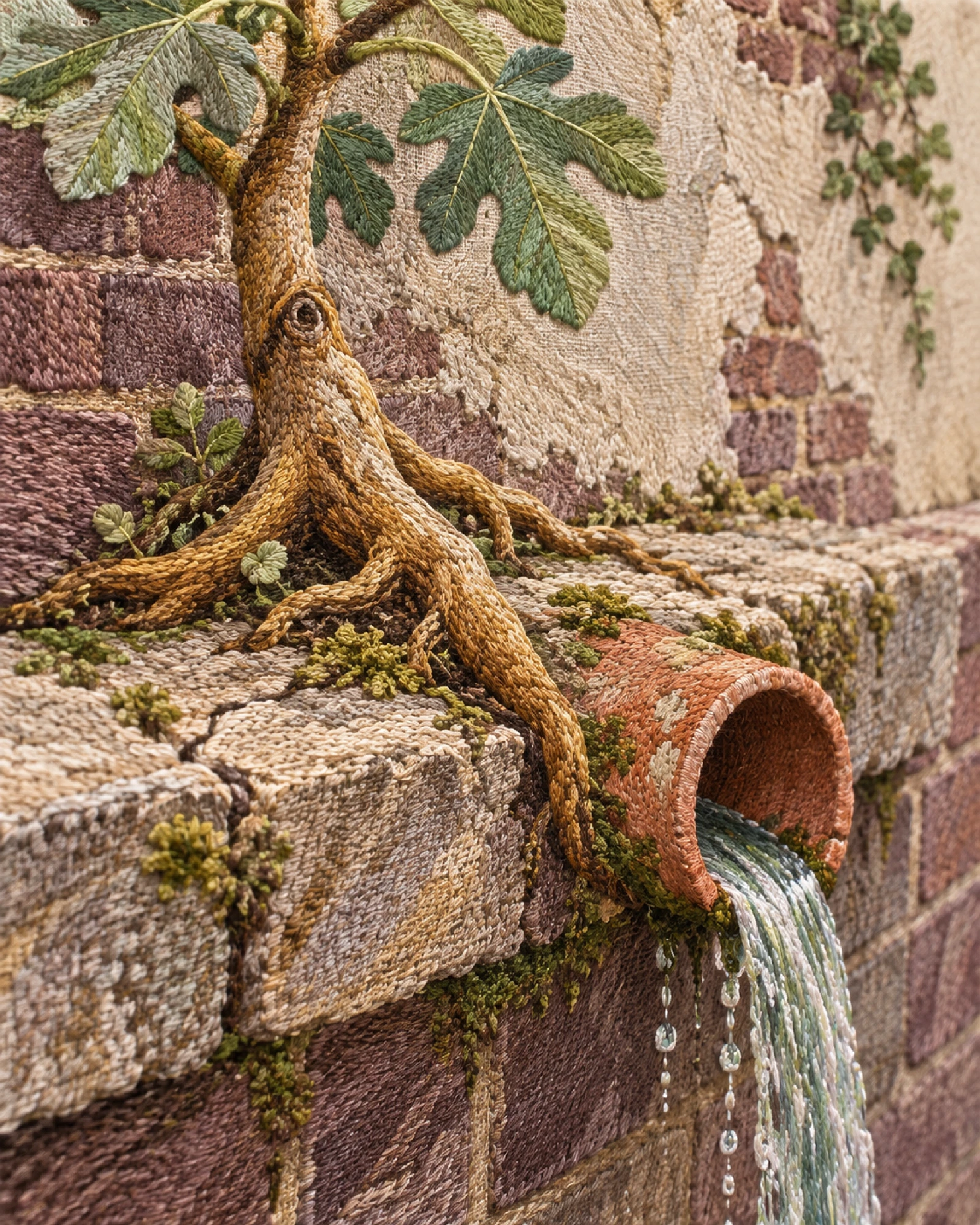
빗물 토출구의 무화과 뿌리
갈라진 돌턱과 빗물 토출구 사이로 자란 무화과 뿌리를 가까이 담은 자수 일러스트. 도톰한 실 능선과 드러난 바탕 직조가 작은 안뜰의 생명력을 전한다.
이 이미지로 조합하기빗물 토출구의 무화과 뿌리
- 형태 언어
- 형태를 맞물리는 곡선 띠와 불규칙한 넓은 면으로 압축하고, 작은 세부는 암시적인 땀 무리로 합쳐지게 한다.
- 윤곽선
- 일부 경계는 부드럽게 꺾이는 징금수 실선으로 두께를 달리하고, 윤곽선 없는 가장자리는 땀 속으로 풀어지게 한다.
- 붓질·입자
- 긴 땀과 짧은 땀이 곡면을 따라 부채처럼 퍼지고, 흩어진 씨앗수와 간간이 놓인 매듭이 촘촘한 부분에 자연스러운 변화를 준다.
- 표면 표현
- 드러난 리넨 직조 위에 살짝 도톰한 새틴수를 쌓아 촉각적인 부조를 만들고, 엇갈린 실 길이로 명암이 부드럽게 섞이게 한다.
우선순위
완성된 일러스트는 솟아오른 실 부조가 있는 자수 직물로 분명하게 보여야 한다.
피할 표현과 결과 확인
이 예시의 실제 생성 프롬프트
MODULE OWNERSHIP
subject: Subject count, type, stable proportions and landmarks, resting face geometry, hair shape, physical materials, garment construction and permanent marks. No emotion, movement, color assignment or rendering recipe.
expression: Facial soft-tissue displacement and pupil direction, muscle coordination, regional intensity, asymmetry and onset/peak/release. No head/body pose, stable appearance, skin color or rendering.
gesture: Head/neck/body/limb orientation, joint movement, support, contact and pose-caused occlusion using existing anatomy. No eye/pupil movement, emotion, identity, props inventory or camera.
props: Prop count, type, construction, physical material and scale relative to the subject. Holding/contact belongs to gesture, position to composition, color to palette.
scene: Environment elements, terrain, backdrop/floor presence and structural detail. No canvas positions, camera, lighting, assigned colors or render texture.
camera: Projection, focal-length impression, camera elevation/yaw/roll, viewing distance and crop. No actor pose, world placement, lighting or canvas aspect ratio.
composition: Normalized 0-100% canvas positions, scale in frame, depth/overlap, focal hierarchy and margins. No joint pose, camera projection, rendering, subject/prop inventory or emotion.
palette: Color anchors, hue/saturation/value ranges, colors assigned to parts and approximate color coverage. No illumination direction, shading algorithm, physical material or layout.
lighting: Light-source direction/softness/intensity, ambient illumination, physical shadow direction/length and highlight position. Absence of directional illumination is allowed. No shading technique, palette or material changes.
style: Reusable form abstraction, contour weight/taper/edge quality, medium and mark scale/density/direction, surface rendering and tonal transition technique. No fixed subject proportions, anatomy, identity, expression, pose, palette, light-source direction, camera or layout.
output: Image count, aspect ratio, size, file/alpha requirements and global lettering/logo/watermark restrictions. No background scenery, crop, style, identity or pose.

SUBJECT
inventory: One young fig tree, identifiable through its exposed roots, slender trunk and a partial cluster of lobed leaves.
geometry: A slender trunk broadens into a branching root base; the leaves have broad lobes and distinct central veins.
resting-face: No face or facial landmarks apply.
appearance: Woody roots carry uneven bark and occasional old scars; flexible leaf blades retain naturally varied edges.

PRIORITY


AVOID


CHECK


PROPS
inventory: No separate props.
construction: No prop construction applies.

PRIORITY


AVOID


CHECK


SCENE
inventory: A narrow courtyard wall, cracked stone ledge, built-in terracotta rain outlet, falling water and small moss patches.
structure: The ledge projects from brick masonry; an open half-round outlet drains through a break in its edge.

PRIORITY


AVOID


CHECK


CAMERA
projection: Use restrained perspective with a gentle telephoto impression, preserving the intimacy of an architectural detail.
viewpoint: Look slightly downward and obliquely along the wall from its right side, at close viewing distance.
crop: Crop through the upper trunk, outer leaves and lower masonry; retain the complete outlet mouth and root fork.

PRIORITY


AVOID


CHECK


COMPOSITION
placement: Place the root fork left of middle and the outlet mouth lower right, joined visually by the ledge's diagonal.
depth: Roots overlap the ledge and partly veil the outlet rim; the receding wall provides a quieter supporting layer.
spacing: Make the root–outlet encounter the focal area; leave breathing room around the falling water and a sparse upper-right wall.

PRIORITY


AVOID


CHECK


PALETTE
colors: Use muted plum, warm ochre, pale celadon, dusty coral and natural flax, with restrained saturation.
assignment: Assign plum to masonry, ochre to roots, celadon to leaves and water, coral to the outlet, and flax to open backing.
balance: Plum and flax occupy broad areas; ochre carries the main contrast, while celadon and coral remain smaller accents.

PRIORITY


AVOID


CHECK


LIGHTING
sources: Broad, soft light enters from the upper left at a shallow angle, with gentle ambient illumination.
shadows: Raised surfaces cast short shadows toward the lower right; the ledge shelters a broader soft shadow beneath it.
highlights: Keep delicate highlights on upper-left-facing ridges and the water's exposed edge.

PRIORITY


AVOID


CHECK


STYLE GUIDE
form-language: Reduce forms to interlocking curved bands and irregular broad planes; let small details merge into suggestive stitch clusters.
contour: Use softly kinked couched cords for selected boundaries, varying their thickness and allowing unoutlined edges to dissolve into stitches.
mark-making: Long-and-short stitches fan along curved planes; scattered seed stitches and occasional knots break up dense passages with natural variation.
surface-rendering: Build tactile relief with lightly padded satin stitches over visible linen weave; staggered thread lengths create softly intermingled tonal transitions.

PRIORITY
The finished illustration must visibly read as embroidered textile with raised thread relief.

AVOID


CHECK


OUTPUT
format: Deliver one opaque PNG, portrait 4:5, 1600 × 2000 pixels; no lettering, logos or watermarks.
restrictions: Deliver one opaque PNG, portrait 4:5, 1600 × 2000 pixels; no lettering, logos or watermarks.

PRIORITY


AVOID


CHECK


FINAL INTEGRATION
style + lighting: Let illumination reveal the embroidery's relief while the stitch language supplies the illustrated forms.
camera + composition + scene: Keep enough architectural context within the intimate framing to make the root encounter feel part of a lived courtyard.
모델명은 이미지 출처 정보 기준입니다. 같은 프롬프트를 사용해도 결과는 달라질 수 있습니다.