텍스트 → 이미지인물스타일 가이드
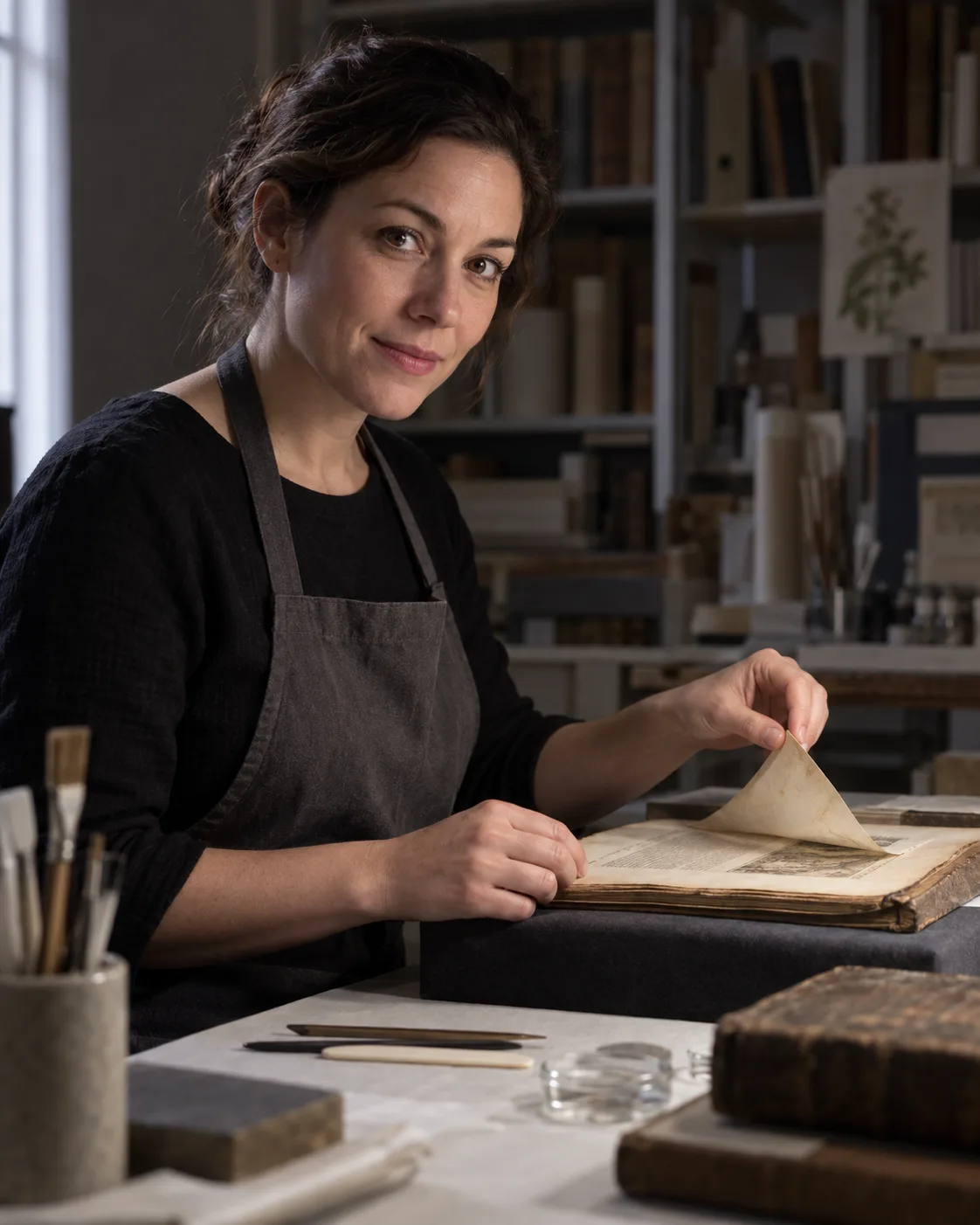
책 복원가 · 검은 가림판으로 빚은 얼굴
넓고 부드러운 빛에서 한쪽 반사를 덜어내 얼굴과 손의 입체감을 만든다.
책 복원가 · 검은 가림판으로 빚은 얼굴
- 형태·선
- 얼굴과 손의 윤곽을 자연스럽게 유지하고 그린 선보다 명암의 변화로 형태를 드러낸다.
- 색·명암
- 넓고 부드러운 광원 하나를 쓰고 한쪽 반사광을 차단해 세부가 사라지지 않는 또렷한 그림자 면을 만든다.
- 질감·재질
- 피부와 재료의 자연스러운 질감을 살리고 보정은 절제하며 인위적인 광택을 피한다.
- 구도
- 가장 밝은 세부를 눈과 작업하는 손 가까이에 두고 배경의 세부는 물러나게 한다.
우선순위
정돈된 그림자 면을 최우선으로 하고 자연스러운 표정과 손, 작업 공간의 맥락 순으로 살린다.
피할 표현과 결과 확인
사방에서 들어오는 평평한 보조광, 완전히 검은 그림자, 미용 필터 같은 피부, 글자, 로고, 워터마크를 피한다.
얼굴 한쪽이 확실히 어두우면서도 두 눈과 페이지를 드는 손가락의 세부가 남아 있으면 통과다.
이 예시의 실제 생성 프롬프트
SUBJECT
One adult book conservator seated at a worktable, gently lifting a loose page while looking toward the camera.

COMPOSITION
Waist-up environmental portrait at eye level; the face is near the upper-left third and the hands remain visible below. A dark flag sits outside the frame on one side; shelves fall softly out of focus behind.

STYLE GUIDE
1. Shape & line
Keep facial and hand contours natural; define form through tonal transitions rather than drawn outlines.

2. Color & light
Use one broad soft source and block ambient bounce on one side to create a clean shadow plane without crushing detail.

3. Texture & material
Preserve believable skin and material texture; keep retouching subtle and avoid artificial sheen.

4. Composition
Place the brightest detail near the eyes and working hands; let background detail recede.

PRIORITY
Preserve the requested identity, count, action, composition and output settings. Apply the style rules within those constraints; a style reference must not replace the subject or layout. Within the style: Prioritize the shaped shadow plane, then natural expression and hands, then workspace context.

AVOID
Avoid flat all-around fill, pitch-black shadows, beauty-filter skin, lettering, logos, and watermarks.

OUTPUT
One 4:5 photographic portrait with a subdued, real workspace background.

SELF-CHECK
Pass if one side of the face is visibly darker while both eyes and the page-lifting fingers retain detail.
표정 세트
기본 얼굴
표정 32
세부 연기
중립
표정 프롬프트
EXPRESSION
Neutral. Resting baseline: release all facial tension.
BROWS: Rest at their natural height without pulling together.
EYES: Rest at natural openness; no squint or widened stare.
CHEEKS: Remain relaxed without lift or nose wrinkling.
MOUTH: Keep lips gently touching and corners level.
JAW: Keep teeth apart slightly behind closed lips; jaw relaxed.
GAZE: Look straight at the viewer with aligned pupils.
EXPRESSION SCOPE: Apply only these facial movements; intensity changes movement amplitude, not identity or rendering style. Keep the head angle, body pose, framing and illumination supplied by the other modules. Use viewer-left/right consistently. Do not add tears, sweat, blush colors, symbols or props unless separately requested.

FACIAL MUSCLE COORDINATION
Resting baseline: release expressive brow, cheek and lip tension. Maintain ordinary eyelid support and comfortable lip contact; leave the jaw unclenched. No unilateral pull, squeezed lids or residual smile.
전체 프롬프트
FACE IDENTITY
IDENTITY: One original adult character, approximately 28 years old, with an androgynous appearance; the same individual in every expression.
PROPORTIONS: Oval face with face height about 1.35 times cheekbone width; eye line near mid-height, with approximately one eye-width between inner eye corners.
EYES: Medium almond-shaped eyes, dark brown irises of equal size, defined upper eyelid folds and gently curved lower lids; preserve inner and outer corner locations.
BROWS: Medium-width straight eyebrows with a soft arch in the outer third; dark brown, with a softly tapered outer tip and a rounded inner end.
NOSE: Straight narrow bridge, softly rounded tip and small symmetrical nostrils; nose base width approximately equals the inner eye-corner distance.
MOUTH: Moderate-width mouth, defined but shallow cupid bow, lower lip slightly fuller than upper lip; preserve resting lip volume and philtrum length.
JAW: Softly tapered jaw, rounded chin and moderate cheekbone projection; ears of equal size at consistent positions beside the head.
SKIN: Even medium warm-brown complexion; keep the same underlying tone and age impression, without expression-dependent changes in skin texture.
HAIR: Short dark brown hair, straight side part at viewer-left, forehead visible, no bangs across the eyes and no facial hair.
MARKS: One small round mole below the viewer-left outer eye corner, about one iris diameter beneath it; no additional freckles, scars or accessories.
These describe the resting identity, not the final expression. Preserve bone structure, landmark spacing, iris size, hairline, age impression and distinctive marks. Only the requested soft-tissue motion may change.

RENDERING STYLE
1. Keep facial and hand contours natural; define form through tonal transitions rather than drawn outlines.
2. Use one broad soft source and block ambient bounce on one side to create a clean shadow plane without crushing detail.
3. Preserve believable skin and material texture; keep retouching subtle and avoid artificial sheen.
4. Place the brightest detail near the eyes and working hands; let background detail recede.
STYLE AVOID: Avoid flat all-around fill, pitch-black shadows, beauty-filter skin, lettering, logos, and watermarks.

PORTRAIT FRAME
One head-and-shoulders portrait, square frame, face centered, eye-level straight-on view with zero head roll. Hair and chin fully visible; head occupies about 60% of frame height. Plain light neutral background. Keep the same crop and softly even illumination across the set; use only the shading methods supported by the selected style.

MODULE PRIORITY
Identity landmarks first, facial movements second, fixed portrait framing third; transfer contour, palette relationships, shading and texture from the style. A style-only reference must not supply its identity, facial expression, hair, costume, head pose or scene. Translate movement into the style without adding realistic wrinkles or glossy volume to a flat style. Resting mouth/eyelid descriptions yield only to the requested movement, not to a different identity.

STYLE REFERENCE
https://images.imagenframe.com/v1/0c84fc6ccbfa5325115c64071153cca4d39893a51d21b7455caad4f1c6498d57/55ff42a9887c4e1cf5c242a2873b537c2f16d2500571675520ae1e2483b03d40/1600.webp
Attach this image as a rendering-only reference.

QUALITY CHECK
Check the same face outline, eye spacing, nose shape, resting lip proportions, hairline and identifying marks across the set. Check each requested brow, lid, cheek, lip, jaw and gaze movement. Keep anatomy coherent and preserve the chosen rendering technique. No added labels, lettering or watermarks.

EXPRESSION
Neutral. Resting baseline: release all facial tension.
BROWS: Rest at their natural height without pulling together.
EYES: Rest at natural openness; no squint or widened stare.
CHEEKS: Remain relaxed without lift or nose wrinkling.
MOUTH: Keep lips gently touching and corners level.
JAW: Keep teeth apart slightly behind closed lips; jaw relaxed.
GAZE: Look straight at the viewer with aligned pupils.
EXPRESSION SCOPE: Apply only these facial movements; intensity changes movement amplitude, not identity or rendering style. Keep the head angle, body pose, framing and illumination supplied by the other modules. Use viewer-left/right consistently. Do not add tears, sweat, blush colors, symbols or props unless separately requested.

FACIAL MUSCLE COORDINATION
Resting baseline: release expressive brow, cheek and lip tension. Maintain ordinary eyelid support and comfortable lip contact; leave the jaw unclenched. No unilateral pull, squeezed lids or residual smile.

BASE FACE
Generate the neutral reference first. Review the identity and rendering before using this output as the shared face reference for subsequent expressions.모델명은 이미지 출처 정보 기준입니다. 같은 프롬프트를 사용해도 결과는 달라질 수 있습니다.