텍스트 → 이미지캐릭터스타일 가이드
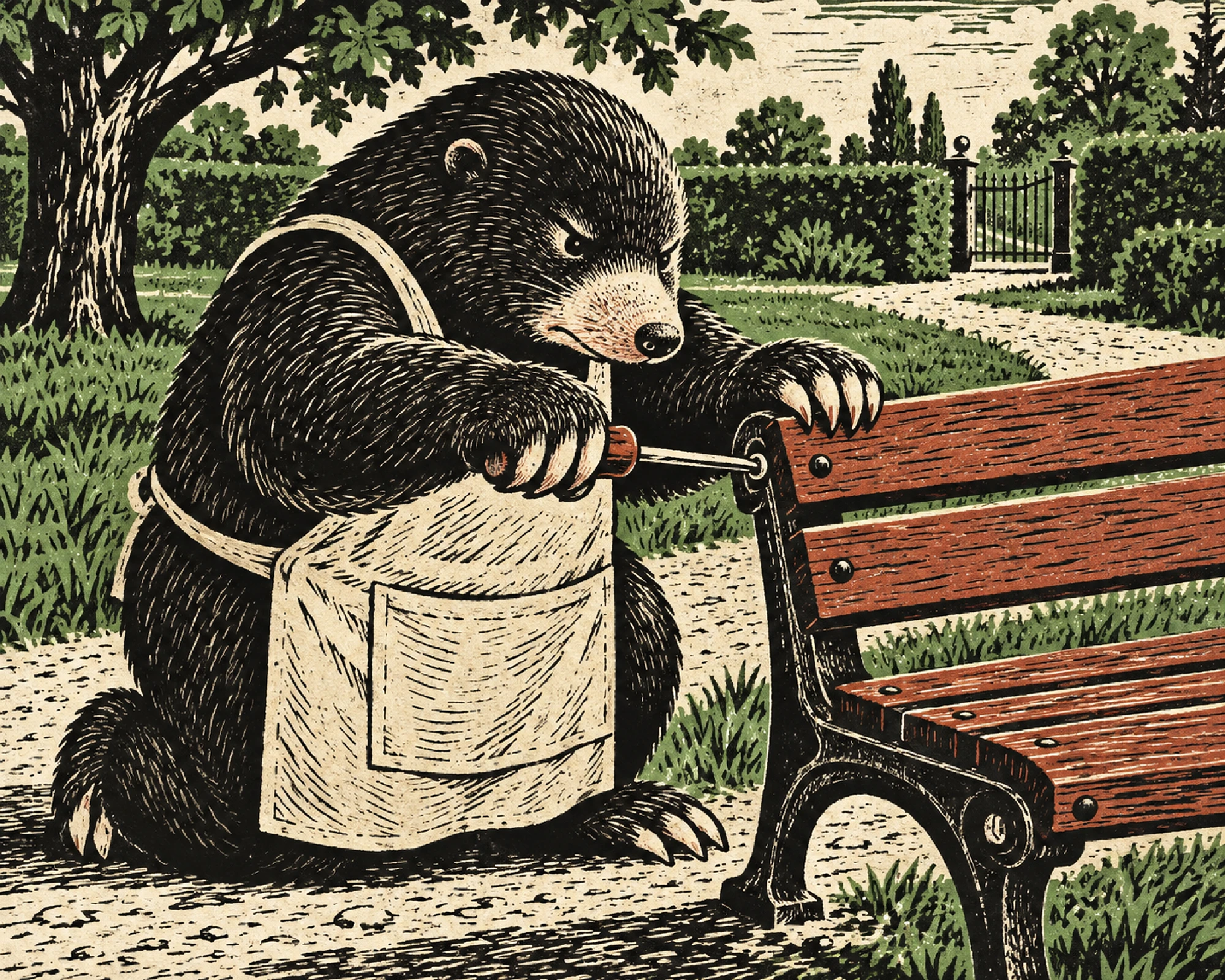
공원 벤치를 고치는 거대한 두더지
거대한 두더지 수리공이 작은 공원 벤치 앞에 무릎을 꿇고 나사를 조인다. 굵은 리놀륨 판화의 덩어리와 리듬 있는 칼자국이 육중한 몸과 섬세한 작업을 함께 보여준다.
이 이미지로 조합하기공원 벤치를 고치는 거대한 두더지
- 형태 언어
- 형태를 묵직하게 연결된 덩어리와 넉넉히 파낸 소수의 빈 공간으로 줄이며 부차적 세부는 자유롭게 단순화한다.
- 윤곽선
- 매끈한 외곽선 대신 끝이 가늘어지는 칼자국으로 끊기는 굵고 조금 흔들리는 인쇄 경계를 쓴다.
- 붓질·입자
- 리듬 있는 곡선 묶음과 짧은 쐐기 자국을 파내며 간격, 압력과 도구의 떨림은 자연스럽게 달라지게 한다.
- 표면 표현
- 단단한 잉크 면과 점점 넓어지는 파낸 여백으로 명암을 만들며 간헐적인 불균일한 잉크 전사를 남긴다.
우선순위
굵은 리놀륨 판화 덩어리와 리듬 있는 칼자국을 완성 이미지의 핵심으로 뚜렷하게 유지한다.
피할 표현과 결과 확인
이 예시의 실제 생성 프롬프트
MODULE OWNERSHIP
subject: Subject count, type, stable proportions and landmarks, resting face geometry, hair shape, physical materials, garment construction and permanent marks. No emotion, movement, color assignment or rendering recipe.
expression: Facial soft-tissue displacement and pupil direction, muscle coordination, regional intensity, asymmetry and onset/peak/release. No head/body pose, stable appearance, skin color or rendering.
gesture: Head/neck/body/limb orientation, joint movement, support, contact and pose-caused occlusion using existing anatomy. No eye/pupil movement, emotion, identity, props inventory or camera.
props: Prop count, type, construction, physical material and scale relative to the subject. Holding/contact belongs to gesture, position to composition, color to palette.
scene: Environment elements, terrain, backdrop/floor presence and structural detail. No canvas positions, camera, lighting, assigned colors or render texture.
camera: Projection, focal-length impression, camera elevation/yaw/roll, viewing distance and crop. No actor pose, world placement, lighting or canvas aspect ratio.
composition: Normalized 0-100% canvas positions, scale in frame, depth/overlap, focal hierarchy and margins. No joint pose, camera projection, rendering, subject/prop inventory or emotion.
palette: Color anchors, hue/saturation/value ranges, colors assigned to parts and approximate color coverage. No illumination direction, shading algorithm, physical material or layout.
lighting: Light-source direction/softness/intensity, ambient illumination, physical shadow direction/length and highlight position. Absence of directional illumination is allowed. No shading technique, palette or material changes.
style: Reusable form abstraction, contour weight/taper/edge quality, medium and mark scale/density/direction, surface rendering and tonal transition technique. No fixed subject proportions, anatomy, identity, expression, pose, palette, light-source direction, camera or layout.
output: Image count, aspect ratio, size, file/alpha requirements and global lettering/logo/watermark restrictions. No background scenery, crop, style, identity or pose.

SUBJECT
inventory: A is one original anthropomorphic mole repairer; no other characters.
geometry: A has a broad barrel torso, short sturdy limbs, wide forepaws, tiny ears and a blunt projecting muzzle.
resting-face: Small oval eye openings sit above full muzzle pads; the short mouth rests beneath a rounded nose.
appearance: Dense short fur and broad claws accompany a canvas apron with one large patch pocket and plain straps.

PRIORITY


AVOID


CHECK


EXPRESSION — ACTOR A
brows: Brow tissue lowers gently toward the inner eye corners.
lids: Upper lids narrow slightly; lower lids remain relaxed.
cheeks: Cheek tissue tightens faintly beside the mouth.
nose: The nose stays unwrinkled with relaxed nostrils.
mouth: Lips meet lightly; one corner draws inward a little.
jaw: The jaw remains closed without a forceful clench.
gaze: Both pupils point down toward the screwdriver tip.
coordination: Mild brow concentration pairs with a quiet mouth rather than facial strain.
timing: Hold the apex of steady concentration, with only a small mouth asymmetry.

PRIORITY


AVOID


CHECK


GESTURE
head: A bends the neck toward the bench, keeping the muzzle clear of the working forepaw.
torso: The torso folds forward from a kneeling base, with the shoulders gently turned toward the bench.
limbs: One bent forearm guides the screwdriver while the other reaches to steady the bench back.
contact: One forepaw grips the handle with its tip engaged in a screw; the other braces the backrest, and knees bear weight.

PRIORITY


AVOID


CHECK


PROPS
inventory: One ordinary park bench and one screwdriver; the bench seat is roughly as long as A's forearm.
construction: The bench has wooden slats on curved iron supports; the screwdriver has a steel shaft and stout wooden handle.

PRIORITY


AVOID


CHECK


SCENE
inventory: A neighborhood park with lawn, a gravel path, clipped hedges and a low iron gate.
structure: The path borders the lawn and passes through the gate; hedge openings suggest adjoining garden spaces.

PRIORITY


AVOID


CHECK


CAMERA
projection: Use moderately wide perspective that makes the setting recognizable without stretching the limbs.
viewpoint: View from bench-seat height at an oblique front angle, with a level horizon.
crop: Include the full figure, the complete bench and enough surrounding park to establish scale.

PRIORITY


AVOID


CHECK


COMPOSITION
placement: A fills the left two thirds; the bench occupies the lower right and the gate remains small in the distance.
depth: The working forepaw overlaps the bench back; the path recedes between the foreground pair and distant hedges.
spacing: Make the small repair contact the focal point, followed by A's face; keep open space beyond the bench.

PRIORITY


AVOID


CHECK


PALETTE
colors: Limit image colors to soot black, bone cream, moss green and a restrained rust red.
assignment: Black defines fur and iron, cream the apron and path, green the planting, and rust the bench wood and handle.
balance: Black and cream carry most of the image; green spreads broadly and rust stays a compact accent.

PRIORITY


AVOID


CHECK


LIGHTING
sources: Broad afternoon light enters from the upper right, softened by open-sky ambient illumination.
shadows: Ground shadows extend moderately toward the lower left, joining beneath the knees and bench feet.
highlights: Light catches the upper-right muzzle, shoulder and top edges of the bench slats.

PRIORITY


AVOID


CHECK


STYLE GUIDE
form-language: Reduce forms to weighty connected masses and a few generous carved openings; simplify secondary detail freely.
contour: Use stout, slightly wavering printed boundaries interrupted by tapered gouge cuts instead of polished keylines.
mark-making: Carve rhythmic curved bundles and short wedge marks; let spacing, pressure and tool chatter vary naturally.
surface-rendering: Create tones through solid ink fields and widening carved reserves, retaining occasional uneven ink transfer.

PRIORITY
Keep bold linocut masses and rhythmic carved marks visibly central to the finished image.

AVOID


CHECK


OUTPUT
format: Deliver one finished 5:4 image, 2000 × 1600 pixels, as an opaque PNG.
restrictions: No lettering, logos, signatures or watermarks.

PRIORITY


AVOID


CHECK


FINAL INTEGRATION
gesture + props + composition + style: Preserve the repair contact through carved simplification so the scale contrast remains tied to a readable action.
모델명은 이미지 출처 정보 기준입니다. 같은 프롬프트를 사용해도 결과는 달라질 수 있습니다.