텍스트 → 이미지캐릭터스타일 가이드
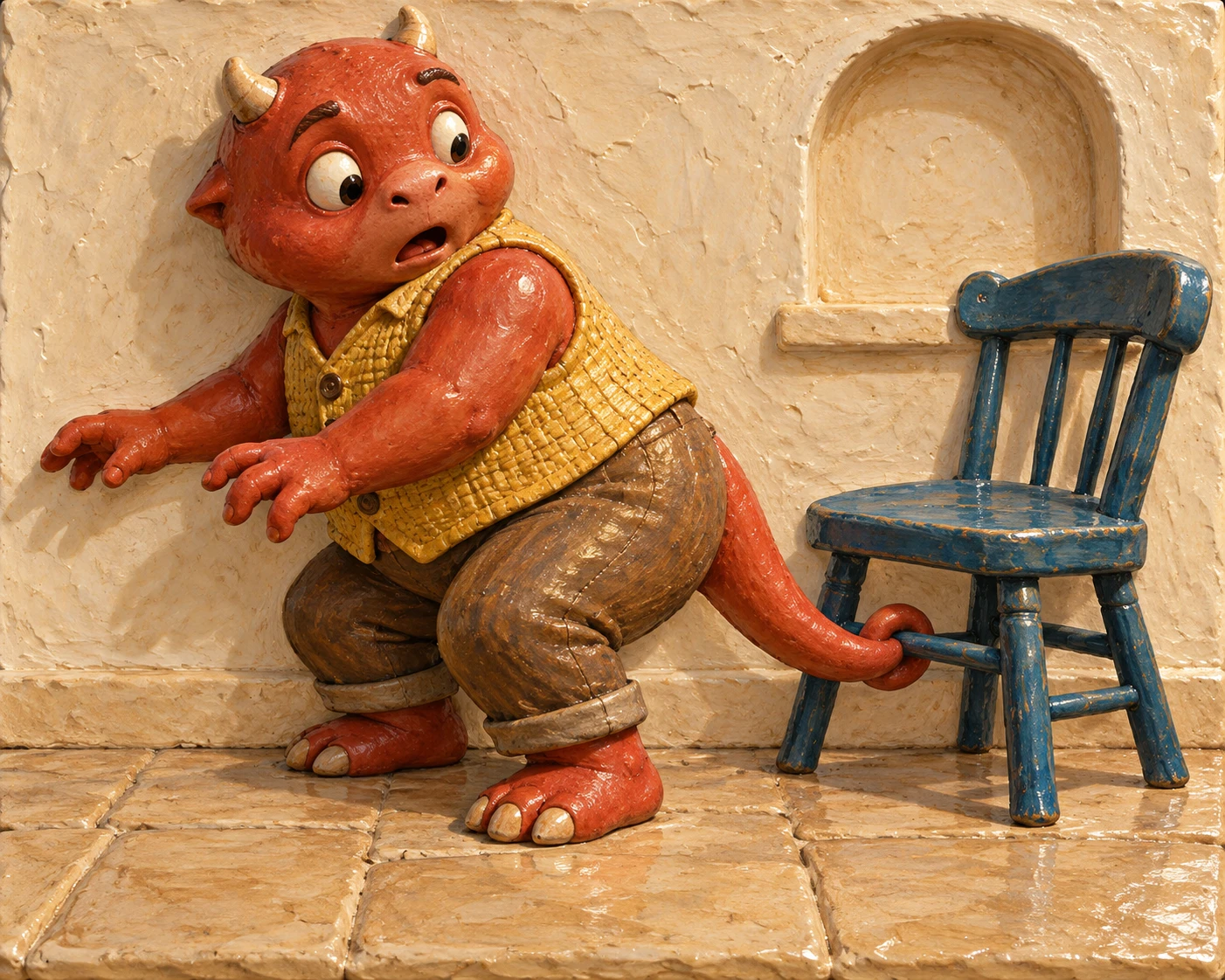
제 의자를 빼는 괴물
앉으려던 작은 괴물이 자기 꼬리로 의자를 당겨 버린다. 겹치는 팔다리와 둥근 가구, 고인 유약의 깊이가 익살스러운 순간을 만드는 도자 부조 일러스트.
이 이미지로 조합하기제 의자를 빼는 괴물
- 형태 언어
- 연속된 판에서 솟는 둥글고 압축된 점토 덩어리로 형태를 옮기고 겹침은 높이가 다른 부조로 표현한다.
- 윤곽선
- 부드럽게 말린 테두리와 간헐적인 얕은 음각을 쓰며 손으로 빚은 구조에 따라 가장자리 두께를 달리한다.
- 붓질·입자
- 넓은 면에 엄지로 쓸어낸 자국과 짧게 도구를 끈 흔적을 선별해 남기며 작은 수작업의 불규칙함은 자연스럽게 달라져도 된다.
- 표면 표현
- 오목한 곳에는 반투명하게 고인 유약을, 능선에는 얇은 유약 막을 표현하고 명암은 부드럽게 잇되 맨점토가 드러난 부분도 둔다.
우선순위
완성된 일러스트는 만져질 듯한 깊이를 지닌, 형태를 빚고 유약을 입힌 도자 부조로 읽혀야 한다.
피할 표현과 결과 확인
이 예시의 실제 생성 프롬프트
MODULE OWNERSHIP
subject: Subject count, type, stable proportions and landmarks, resting face geometry, hair shape, physical materials, garment construction and permanent marks. No emotion, movement, color assignment or rendering recipe.
expression: Facial soft-tissue displacement and pupil direction, muscle coordination, regional intensity, asymmetry and onset/peak/release. No head/body pose, stable appearance, skin color or rendering.
gesture: Head/neck/body/limb orientation, joint movement, support, contact and pose-caused occlusion using existing anatomy. No eye/pupil movement, emotion, identity, props inventory or camera.
props: Prop count, type, construction, physical material and scale relative to the subject. Holding/contact belongs to gesture, position to composition, color to palette.
scene: Environment elements, terrain, backdrop/floor presence and structural detail. No canvas positions, camera, lighting, assigned colors or render texture.
camera: Projection, focal-length impression, camera elevation/yaw/roll, viewing distance and crop. No actor pose, world placement, lighting or canvas aspect ratio.
composition: Normalized 0-100% canvas positions, scale in frame, depth/overlap, focal hierarchy and margins. No joint pose, camera projection, rendering, subject/prop inventory or emotion.
palette: Color anchors, hue/saturation/value ranges, colors assigned to parts and approximate color coverage. No illumination direction, shading algorithm, physical material or layout.
lighting: Light-source direction/softness/intensity, ambient illumination, physical shadow direction/length and highlight position. Absence of directional illumination is allowed. No shading technique, palette or material changes.
style: Reusable form abstraction, contour weight/taper/edge quality, medium and mark scale/density/direction, surface rendering and tonal transition technique. No fixed subject proportions, anatomy, identity, expression, pose, palette, light-source direction, camera or layout.
output: Image count, aspect ratio, size, file/alpha requirements and global lettering/logo/watermark restrictions. No background scenery, crop, style, identity or pose.

SUBJECT
inventory: One original bipedal creature, actor A.
geometry: A broad oval belly, short sturdy legs, small crescent horns, and a long tail ending in an open hook define its build.
resting-face: Widely spaced oval eyes sit above a shallow broad muzzle with a flat nose and a wide mouth seam.
appearance: Smooth hide remains exposed around a woven sleeveless waistcoat and soft trousers with turned cuffs.

PRIORITY


AVOID


CHECK


EXPRESSION — ACTOR A
brows: Both brows rise, with the nearer one lifting slightly higher.
lids: Upper lids lift quickly while lower lids remain relaxed.
cheeks: Cheeks loosen without lifting into a smile.
nose: The nose stays unwrinkled and the nostrils barely widen.
mouth: The mouth parts into a small off-center oval.
jaw: The jaw has just begun to drop.
gaze: Pupils turn down and toward the viewer's right to look at the chair.
coordination: The widened eyes register the discovery before the mouth fully reacts.
timing: Catch surprise at onset.

PRIORITY


AVOID


CHECK


GESTURE
head: The head turns back over the right shoulder and dips toward the chair.
torso: The body lowers halfway into sitting while the upper torso twists back; the belly overlaps the nearer thigh. Capture this before any attempt to regain balance.
limbs: Bent knees and planted feet support the body; both arms reach forward as the tail curls backward.
contact: The tail passes behind the body and crosses in front of a chair rung, hooking it to pull the chair backward; the creature's seat has not touched the chair.

PRIORITY


AVOID


CHECK


PROPS
inventory: One wooden dining chair sized for the creature.
construction: A thick rounded seat, curved backrest, and sturdy legs with low cross-rungs give the chair a recognizable build.

PRIORITY


AVOID


CHECK


SCENE
inventory: A modest domestic nook contains a floor, a wall, and a shallow arched wall niche.
structure: A broad skirting ledge joins wall and floor; the niche is empty and has a rounded sill.

PRIORITY


AVOID


CHECK


CAMERA
projection: Use shallow, near-orthographic perspective suitable for reading a sculpted relief.
viewpoint: View mostly frontally from slightly above, with a small yaw that reveals the chair seat.
crop: Show the full figure, tail, and chair at a medium viewing distance.

PRIORITY


AVOID


CHECK


COMPOSITION
placement: The creature occupies the left-middle and the chair the right-middle, leaving a larger open area toward the left edge.
depth: The creature and chair occupy the foreground, with the wall niche recessed behind them.
spacing: Lead from the face to the tail-chair connection; preserve the gap beneath the body and generous outer margins.

PRIORITY


AVOID


CHECK


PALETTE
colors: Use oxide red, butter yellow, petrol blue, and warm ivory, with restrained dark brown accents.
assignment: Assign oxide red to the hide, butter yellow to the waistcoat, brown to the trousers, petrol blue to the chair, and ivory to the room.
balance: Let the pale room occupy the largest color area; keep the creature rich and the chair deeper in value.

PRIORITY


AVOID


CHECK


LIGHTING
sources: A broad light from upper right grazes the relief, with moderate ambient fill.
shadows: Short soft shadows fall lower left, deepening beneath projecting forms and within overlaps.
highlights: Broad highlights gather on upper-right curves, with smaller bright catches on raised edges.

PRIORITY


AVOID


CHECK


STYLE GUIDE
form-language: Translate forms into rounded, compressed clay volumes rising from a continuous slab, using stepped relief for overlaps.
contour: Use softly rolled rims and occasional shallow incisions; edge thickness varies with the hand-built construction.
mark-making: Leave selective thumb sweeps and short tool drags in broad passages; small handmade irregularities may vary naturally.
surface-rendering: Model glaze as translucent pools in recesses and thinner veils over ridges, with softened tonal transitions and occasional bare-clay breaks.

PRIORITY
The finished illustration must read as modeled glazed ceramic relief with tangible depth.

AVOID


CHECK


OUTPUT
format: Deliver one image.
restrictions: One 5:4 image, 2000 × 1600 pixels, opaque PNG; no lettering, logos, signatures, or watermarks.

PRIORITY


AVOID


CHECK


FINAL INTEGRATION
gesture + composition: Make the cause of the mishap readable through the relationship between the action and its overlaps.
style + lighting + expression: Use relief depth and illumination together without allowing small sculptural recesses to overpower the facial acting.
모델명은 이미지 출처 정보 기준입니다. 같은 프롬프트를 사용해도 결과는 달라질 수 있습니다.