텍스트 → 이미지풍경스타일 가이드
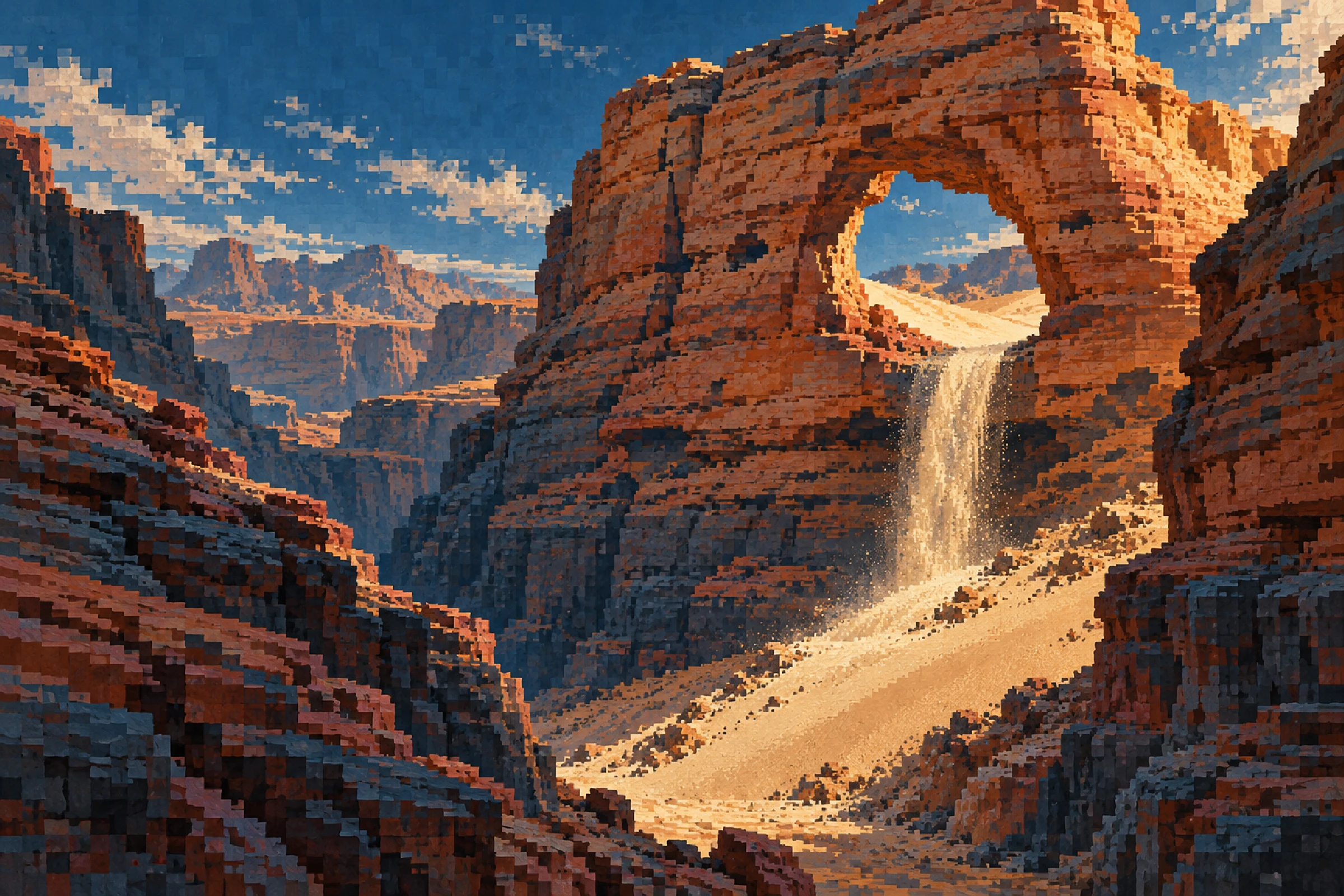
바위 창으로 쏟아지는 모래
협곡의 사암 창을 통과하는 모래 폭포를 직조하듯 맞물리는 픽셀 형태로 그린 깊이 있는 풍경.
이 이미지로 조합하기바위 창으로 쏟아지는 모래
- 형태 언어
- 직조 띠처럼 읽히는 직사각형 덩어리를 맞물려 큰 형태를 만들고, 작은 불규칙함은 공통된 저해상도 조형 언어 안에서 허용한다.
- 윤곽선
- 넓고 각진 구간과 짧은 홈을 번갈아 잇는 의도적인 계단형 가장자리를 사용하고, 연속 외곽선 없이 형태를 구분한다.
- 붓질·입자
- 짧은 가로와 세로 픽셀 줄을 날실과 씨실처럼 엇갈리게 놓고, 간혹 끊긴 끝과 자연스럽게 고르지 않은 간격을 둔다.
- 표면 표현
- 겹겹이 들어가는 픽셀 조각과 성긴 직조형 디더링으로 명암을 바꾸고, 잔잔한 부분에는 크고 읽기 쉬운 덩어리를 남긴다.
우선순위
직조형 픽셀 구성과 의도적인 저해상도 가장자리가 형태의 구조로 뚜렷하게 보여야 한다.
피할 표현과 결과 확인
이 예시의 실제 생성 프롬프트
MODULE OWNERSHIP
subject: Subject count, type, stable proportions and landmarks, resting face geometry, hair shape, physical materials, garment construction and permanent marks. No emotion, movement, color assignment or rendering recipe.
expression: Facial soft-tissue displacement and pupil direction, muscle coordination, regional intensity, asymmetry and onset/peak/release. No head/body pose, stable appearance, skin color or rendering.
gesture: Head/neck/body/limb orientation, joint movement, support, contact and pose-caused occlusion using existing anatomy. No eye/pupil movement, emotion, identity, props inventory or camera.
props: Prop count, type, construction, physical material and scale relative to the subject. Holding/contact belongs to gesture, position to composition, color to palette.
scene: Environment elements, terrain, backdrop/floor presence and structural detail. No canvas positions, camera, lighting, assigned colors or render texture.
camera: Projection, focal-length impression, camera elevation/yaw/roll, viewing distance and crop. No actor pose, world placement, lighting or canvas aspect ratio.
composition: Normalized 0-100% canvas positions, scale in frame, depth/overlap, focal hierarchy and margins. No joint pose, camera projection, rendering, subject/prop inventory or emotion.
palette: Color anchors, hue/saturation/value ranges, colors assigned to parts and approximate color coverage. No illumination direction, shading algorithm, physical material or layout.
lighting: Light-source direction/softness/intensity, ambient illumination, physical shadow direction/length and highlight position. Absence of directional illumination is allowed. No shading technique, palette or material changes.
style: Reusable form abstraction, contour weight/taper/edge quality, medium and mark scale/density/direction, surface rendering and tonal transition technique. No fixed subject proportions, anatomy, identity, expression, pose, palette, light-source direction, camera or layout.
output: Image count, aspect ratio, size, file/alpha requirements and global lettering/logo/watermark restrictions. No background scenery, crop, style, identity or pose.

SUBJECT
inventory: One freestanding sandstone fin with a large natural window is the principal landform.
geometry: A broad, tapering slab surrounds an uneven keyhole opening; a thick lower sill gives the aperture weight.
resting-face: No facial anatomy applies.
appearance: Bedded sandstone has rounded erosion pockets, a few deep fractures, and a durable weathered crust.

PRIORITY


AVOID


CHECK


PROPS
inventory: No separate props.
construction: No prop construction applies.

PRIORITY


AVOID


CHECK


SCENE
inventory: A narrow desert canyon contains an elevated dune, a falling sand veil, a fresh sand fan, and distant broken ridges.
structure: The dune feeds sand through the rock window into a steep gully; undercut canyon banks enclose the passage.

PRIORITY


AVOID


CHECK


CAMERA
projection: Use a broad, approximately 28 mm perspective with clear near-to-far expansion.
viewpoint: Look slightly upward from below the window, obliquely across the canyon, with a level roll.
crop: Include the complete aperture and its lower gully while cutting into nearby canyon banks at the edges.

PRIORITY


AVOID


CHECK


COMPOSITION
placement: Set the window near 60% width and 40% height; its falling sand is the focal stroke across the middle distance.
depth: Overlapping foreground banks lead through the fin to distant ridges; the sand remains distinct against the canyon recess.
spacing: Give the gully a spacious lower opening and leave an irregular wedge of sky above the compressed rock masses.

PRIORITY


AVOID


CHECK


PALETTE
colors: Use burnt apricot, muted terracotta, deep petrol blue, and pale oat, with restrained saturation.
assignment: Assign apricot and terracotta to rock, petrol blue to sky and canyon depths, and pale oat to the falling sand.
balance: Warm earth hues dominate; the pale sand is a narrow accent within a substantial field of cool darks.

PRIORITY


AVOID


CHECK


LIGHTING
sources: Broad sunlight enters from the upper right, with weak ambient light reaching into the canyon.
shadows: The window sill casts a long shadow down and left; the canyon recess stays deeply shaded.
highlights: Catch light along the window's right rim and the exposed edge of the sand veil.

PRIORITY


AVOID


CHECK


STYLE GUIDE
form-language: Build large forms from interlocking rectangular clusters that read as woven bands; keep small irregularities within a shared low-resolution vocabulary.
contour: Use deliberate stair-step edges, alternating broad blocky runs with short notches; distinguish forms without continuous outlines.
mark-making: Interleave short horizontal and vertical pixel runs like warp and weft, with occasional broken ends and naturally uneven spacing.
surface-rendering: Create tonal changes through nested pixel patches and sparse woven dithering; let quieter passages retain broad, readable blocks.

PRIORITY
The woven pixel construction and deliberate low-resolution edges must remain visibly structural.

AVOID


CHECK


OUTPUT
format: Deliver one finished image, landscape 3:2, 2400 × 1600 pixels, opaque PNG.
restrictions: No lettering, logos, signatures, or watermarks.

PRIORITY


AVOID


CHECK


FINAL INTEGRATION
subject + style: Let the woven abstraction simplify geological detail while preserving the recognizable opening.
composition + lighting + palette: Use light and color separation to support the layered depth and the sand's focal role.
모델명은 이미지 출처 정보 기준입니다. 같은 프롬프트를 사용해도 결과는 달라질 수 있습니다.