텍스트 → 이미지캐릭터스타일 가이드
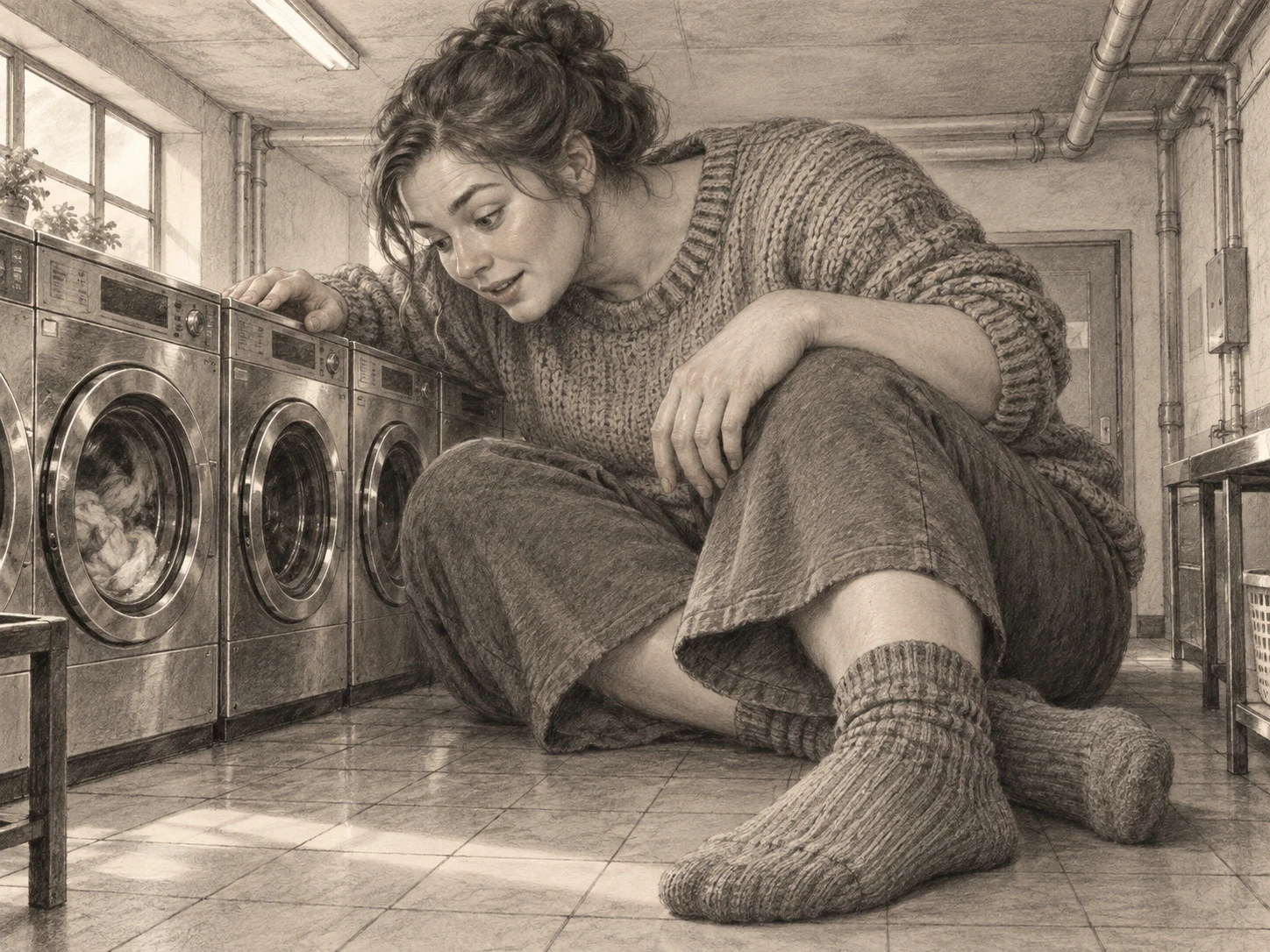
세탁소의 거인
평범한 동네 세탁소 바닥에 몸을 접어 앉은 거대한 여성이 세탁기 안을 들여다본다. 문지른 목탄과 지우개로 걷어낸 빛이 놀라운 크기 차이를 친근한 일상으로 만든다.
이 이미지로 조합하기세탁소의 거인
- 형태 언어
- 관찰에 기반한 덩어리 소묘로 넓은 부피를 먼저 잡고 구조적 강조를 선별해 더하며, 작은 디테일은 암시적으로 남긴다.
- 윤곽선
- 끊기며 압력이 변하는 목탄선과 사라지는 경계를 번갈아 쓰고, 의미 있는 겹침에 더 단단한 경계를 남긴다.
- 붓질·입자
- 목탄의 넓은 옆면을 끌고 손으로 문지른 뒤 느슨한 탐색선을 다시 더하며, 입자 무늬를 반복하지 않고 자국을 자연스럽게 바꾼다.
- 표면 표현
- 먼지 같은 목탄 톤을 겹쳐 쌓고 반죽 지우개로 쓸어 목탄을 덜어내 밝은 영역을 드러내며, 번진 테두리와 부분 지움을 남긴다.
우선순위
문지른 톤과 지우개로 드러낸 밝은 영역을 완성 소묘의 핵심으로 삼는다.
피할 표현과 결과 확인
매끈한 디지털 명암 위에 균일하고 날카로운 연필 외곽선을 두지 않는다.
목탄을 더한 선택과 지우개로 덜어낸 선택이 모두 보이는가?
이 예시의 실제 생성 프롬프트
MODULE OWNERSHIP
subject: Subject count, type, stable proportions and landmarks, resting face geometry, hair shape, physical materials, garment construction and permanent marks. No emotion, movement, color assignment or rendering recipe.
expression: Facial soft-tissue displacement and pupil direction, muscle coordination, regional intensity, asymmetry and onset/peak/release. No head/body pose, stable appearance, skin color or rendering.
gesture: Head/neck/body/limb orientation, joint movement, support, contact and pose-caused occlusion using existing anatomy. No eye/pupil movement, emotion, identity, props inventory or camera.
props: Prop count, type, construction, physical material and scale relative to the subject. Holding/contact belongs to gesture, position to composition, color to palette.
scene: Environment elements, terrain, backdrop/floor presence and structural detail. No canvas positions, camera, lighting, assigned colors or render texture.
camera: Projection, focal-length impression, camera elevation/yaw/roll, viewing distance and crop. No actor pose, world placement, lighting or canvas aspect ratio.
composition: Normalized 0-100% canvas positions, scale in frame, depth/overlap, focal hierarchy and margins. No joint pose, camera projection, rendering, subject/prop inventory or emotion.
palette: Color anchors, hue/saturation/value ranges, colors assigned to parts and approximate color coverage. No illumination direction, shading algorithm, physical material or layout.
lighting: Light-source direction/softness/intensity, ambient illumination, physical shadow direction/length and highlight position. Absence of directional illumination is allowed. No shading technique, palette or material changes.
style: Reusable form abstraction, contour weight/taper/edge quality, medium and mark scale/density/direction, surface rendering and tonal transition technique. No fixed subject proportions, anatomy, identity, expression, pose, palette, light-source direction, camera or layout.
output: Image count, aspect ratio, size, file/alpha requirements and global lettering/logo/watermark restrictions. No background scenery, crop, style, identity or pose.

SUBJECT
inventory: One original giant adult woman, actor A.
geometry: Keep ordinary adult proportions, with broad shoulders, long forearms, substantial hands and a gently squared face.
resting-face: At rest, brows are nearly straight, eyes broadly oval, the nose short and lips full with a soft central bow.
appearance: A loose braided bun, knitted pullover, roomy cropped trousers and ribbed socks define her practical appearance.

PRIORITY
Make her a believable adult whose extraordinary trait is her stature.

AVOID
Avoid enlarging only the head or hands to suggest giant size.

CHECK
Do her landmarks remain coherent at this extraordinary scale?

EXPRESSION — ACTOR A
brows: Both brows lift mildly without a central furrow.
lids: Upper lids open a little; lower lids remain relaxed.
cheeks: Cheeks remain soft, without smile-driven compression.
nose: The nose stays relaxed, with no flare or wrinkle.
mouth: Lips separate slightly, with one corner just beginning to lift.
jaw: The jaw releases slightly without a large drop.
gaze: Both pupils focus downward toward the washer's circular window.
coordination: The eyes lead the discovery; the mouth responds more quietly.
timing: Catch the first small response to something interesting inside.

PRIORITY
Keep curiosity intimate despite her immense size.

AVOID
Avoid turning the discovery into shock.

CHECK
Does her attention clearly gather at the washer window?

GESTURE
head: She lowers and turns her head toward the washer, bringing her cheek close without pressing against it.
torso: Seated on the floor, she folds her torso forward and sideways to fit beneath the ceiling.
limbs: Both knees bend toward her torso; one forearm reaches to the washer while the other settles across a knee.
contact: Her seat and feet rest on the tiles; one open palm lightly braces on the washer top.

PRIORITY
Let the folded pose feel considerate of the small room.

AVOID
Avoid a contorted neck or visibly unsupported balance.

CHECK
Do the visible floor and hand contacts make the seated lean convincing?

PROPS
inventory: No separate props.
construction: No prop construction applies.

PRIORITY
Maintain the absence of separate props.

AVOID
Avoid adding handheld objects.

CHECK
Is the encounter complete without separate props?

SCENE
inventory: An ordinary laundrette with a row of installed front-loading washers, tiled floor, low ceiling and exposed service pipes.
structure: Washers have steel housings, circular glass doors and simple controls; worn tile joints and wall junctions establish the room.

PRIORITY
Make the laundrette familiar enough to establish the surprising scale.

AVOID
Avoid turning the room into a fantasy building.

CHECK
Can the setting be recognized from its fixtures and structure?

CAMERA
projection: Use natural perspective with a normal-lens impression and readable room recession.
viewpoint: View obliquely from ordinary adult standing height, with a level horizon and no roll.
crop: Use a room-wide view that retains the full figure, the floor beneath her and a strip of ceiling.

PRIORITY
Show the encounter from an everyday human vantage.

AVOID
Avoid dramatic lens distortion as the source of giant scale.

CHECK
Does the scale remain surprising under natural perspective?

COMPOSITION
placement: The figure fills the right two-thirds; her face and the nearest washer window form the focal pair.
depth: The washer row recedes leftward behind the near machine; her shoulders nearly reach the room's upper boundary.
spacing: Leave a narrow breathing gap above her and an open floor wedge toward the lower left.

PRIORITY
Make ordinary machinery the immediate measure of her extraordinary size.

AVOID
Avoid isolating the figure from the room's scale cues or dividing the image into model-sheet panels.

CHECK
Does the face-window pairing lead before the rest of the room?

PALETTE
colors: Use warm paper ivory, dusty middle gray and deep charcoal black in a restrained monochrome range.
assignment: Ivory carries the pale walls and skin lights; middle gray holds clothing and tiles; the deepest values anchor hair and washer interiors.
balance: Let middle values occupy most surfaces, with generous pale passages and a few concentrated dark anchors.

PRIORITY
Keep the monochrome range rich enough for an inhabited room.

AVOID
Avoid introducing a decorative colored accent.

CHECK
Do pale, middle and deep values remain clearly differentiated?

LIGHTING
sources: Broad daylight enters from the left, with soft ambient bounce throughout the room.
shadows: Soft shadows fall rightward and gather beneath the body, legs and washer housings.
highlights: Light catches the left cheek, knuckles, upper sweater folds and arcs of the glass doors.

PRIORITY
Let broad daylight make the improbable encounter feel ordinary.

AVOID
Avoid a supernatural glow around the giant.

CHECK
Do the figure and machinery share the same soft illumination?

STYLE GUIDE
form-language: Use observational mass drawing: broad volumes first, selective structural accents second, allowing minor details to remain suggestive.
contour: Alternate broken, pressure-sensitive charcoal lines with lost edges; reserve firmer boundaries for meaningful overlaps.
mark-making: Drag broad charcoal sides, rub passages by hand and return with loose searching strokes; vary marks naturally rather than repeating a grain pattern.
surface-rendering: Layer dusty charcoal tones; kneaded-eraser sweeps remove charcoal to reveal paler passages, retaining smudge halos and partial erasures.

PRIORITY
Make rubbed tone and eraser-revealed pale passages integral to the finished drawing.

AVOID
Avoid a uniformly sharp pencil outline over smooth digital shading.

CHECK
Can the viewer see both additive charcoal and subtractive eraser decisions?

OUTPUT
format: Deliver one finished image.
restrictions: One opaque PNG, 2000 × 1500 pixels, 4:3 aspect ratio; no lettering, logos or watermarks.

PRIORITY
Deliver one complete image at the specified size.

AVOID
Avoid process labels.

CHECK
Is the deliverable a single opaque image at the specified size?

FINAL INTEGRATION
gesture + scene + composition: Use visible contact and environmental comparison together to make the encounter spatially convincing.
expression + lighting + style: Preserve the small facial response while interpreting shared illumination through charcoal darks and eraser-revealed light passages.
모델명은 이미지 출처 정보 기준입니다. 같은 프롬프트를 사용해도 결과는 달라질 수 있습니다.