텍스트 → 이미지애니메이션스타일 가이드
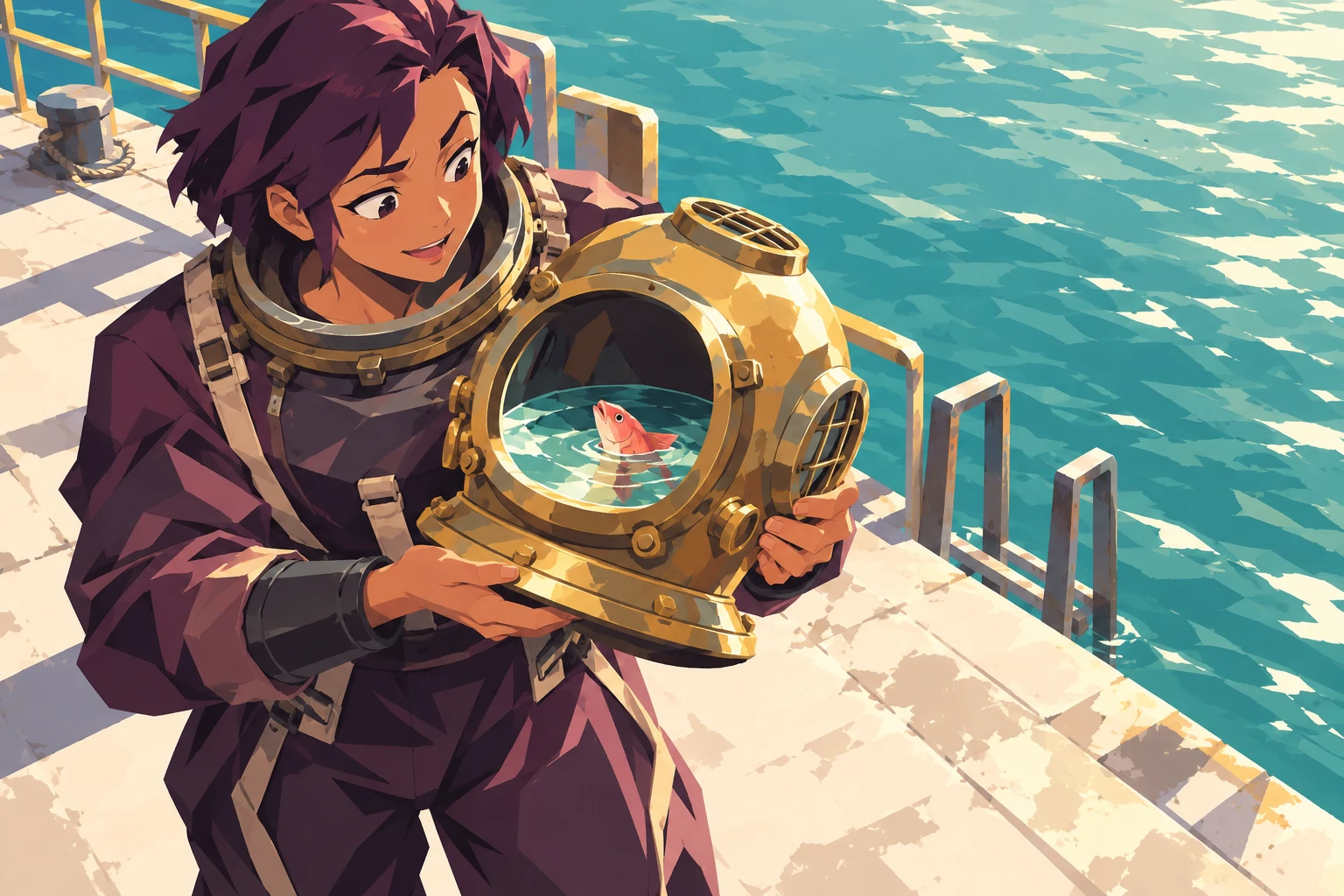
잠수모 속 물고기
잠수부가 벗어 든 잠수모 안에서 작은 물고기를 발견한다. 서로를 들여다보는 순간을 날카로운 각면과 넓게 열린 바다 여백으로 표현한다.
이 이미지로 조합하기잠수모 속 물고기
- 형태 언어
- 표면을 쐐기, 삼각형과 각진 면으로 추상화하고 부차적 세부는 단순화하되 일관된 불규칙성을 허용한다.
- 윤곽선
- 외곽선 굵기에 강한 대비를 주고 끝은 급하게 가늘어지며 내부에는 짧고 날카로운 절단선을 쓴다. 일부 가장자리는 선 없이 둔다.
- 붓질·입자
- 성긴 각진 조각과 단호하게 뾰족한 필획을 쓰며 크기는 자연스럽게 달리하고 매끈한 면에는 필획을 넣지 않는다.
- 표면 표현
- 그라데이션 대신 단단히 분리된 소수의 명암 면으로 표면을 만들고 때때로 경계가 날카로운 반사광 조각을 더한다.
우선순위
렌더링 매체: 각진 형태의 2D 일본 애니메이션 그래픽 일러스트; 형식적 렌더링 참고: 트리거 · 2010년대 · 프로메어(2019)
피할 표현과 결과 확인
이 예시의 실제 생성 프롬프트
MODULE OWNERSHIP
subject: Subject count, type, stable proportions and landmarks, resting face geometry, hair shape, physical materials, garment construction and permanent marks. No emotion, movement, color assignment or rendering recipe.
expression: Facial soft-tissue displacement and pupil direction, muscle coordination, regional intensity, asymmetry and onset/peak/release. No head/body pose, stable appearance, skin color or rendering.
gesture: Head/neck/body/limb orientation, joint movement, support, contact and pose-caused occlusion using existing anatomy. No eye/pupil movement, emotion, identity, props inventory or camera.
props: Prop count, type, construction, physical material and scale relative to the subject. Holding/contact belongs to gesture, position to composition, color to palette.
scene: Environment elements, terrain, backdrop/floor presence and structural detail. No canvas positions, camera, lighting, assigned colors or render texture.
camera: Projection, focal-length impression, camera elevation/yaw/roll, viewing distance and crop. No actor pose, world placement, lighting or canvas aspect ratio.
composition: Normalized 0-100% canvas positions, scale in frame, depth/overlap, focal hierarchy and margins. No joint pose, camera projection, rendering, subject/prop inventory or emotion.
palette: Color anchors, hue/saturation/value ranges, colors assigned to parts and approximate color coverage. No illumination direction, shading algorithm, physical material or layout.
lighting: Light-source direction/softness/intensity, ambient illumination, physical shadow direction/length and highlight position. Absence of directional illumination is allowed. No shading technique, palette or material changes.
style: Reusable form abstraction, contour weight/taper/edge quality, medium and mark scale/density/direction, surface rendering and tonal transition technique. No fixed subject proportions, anatomy, identity, expression, pose, palette, light-source direction, camera or layout.
output: Image count, aspect ratio, size, file/alpha requirements and global lettering/logo/watermark restrictions. No background scenery, crop, style, identity or pose.

SUBJECT
inventory: One adult woman diver, actor A, and one small fish.
geometry: A has broad shoulders, sturdy forearms and a broad face with a blunt nose; the fish has a compact body and fan tail.
resting-face: A has straight brows, almond-shaped eye openings, full lower cheeks and a wide mouth at rest.
appearance: A has short hair grouped into broad locks and a canvas diving suit with rubber cuffs and a rigid neck ring.

PRIORITY


AVOID


CHECK


EXPRESSION — ACTOR A
brows: Raise one brow slightly higher than the other.
lids: Lift the upper lids while keeping the lower lids gently engaged.
cheeks: Lift the cheeks subtly, more on the raised mouth-corner side.
nose: Keep the nostrils relaxed without a wrinkle across the bridge.
mouth: Part the lips slightly and lift one corner into a tentative smile.
jaw: Release the jaw just enough to support the parted lips.
gaze: Direct both pupils toward the fish.
coordination: Let the questioning brow lead; keep the mouth response quieter.
timing: Hold the apex of recognition, before the small smile broadens.

PRIORITY


AVOID


CHECK


GESTURE
head: A bends her neck toward the helmet, with her chin slightly tucked.
torso: Lean the torso forward slightly, with one shoulder lower than the other.
limbs: Keep both elbows bent and separated, allowing the forearms to form an uneven cradle.
contact: The helmet is off A's head; one hand supports its base and the other steadies its rim; the fish's snout breaks the water inside.

PRIORITY


AVOID


CHECK


PROPS
inventory: One diving helmet, slightly wider than A's head, containing a shallow pool of water.
construction: The brass helmet has a domed shell, circular glass ports and a broad open neck flange.

PRIORITY


AVOID


CHECK


SCENE
inventory: An open harbor service platform, a short safety rail, a descending ladder and tidal water.
structure: Broad platform slabs meet an exposed edge; the rail and ladder establish a working waterfront with few details.

PRIORITY


AVOID


CHECK


CAMERA
projection: Use perspective with a moderately wide focal-length impression and restrained near-field enlargement.
viewpoint: View from slightly above in a three-quarter direction, with a level camera roll.
crop: Frame A from mid-thigh upward, retaining the entire helmet and both hands.

PRIORITY


AVOID


CHECK


COMPOSITION
placement: Group A and the helmet in the left half; the face-to-fish exchange leads, followed by the harbor edge.
depth: Place the fish inside the helmet; let the helmet overlap the torso, with the platform edge receding behind this group toward open water.
spacing: Leave the right half spacious, with clear gaps around the face and helmet opening and generous upper breathing room.

PRIORITY


AVOID


CHECK


PALETTE
colors: Use pale jade, deep plum, warm ochre, muted coral and warm ivory as the main anchors.
assignment: Assign jade to water, plum to suit and hair, ochre to helmet, coral to fish, and ivory to the platform; skin is warm tan.
balance: Let pale values dominate, with a concentrated dark mass and small stronger accents; keep secondary hues restrained.

PRIORITY


AVOID


CHECK


LIGHTING
sources: A broad upper-right daylight source provides clear direction with moderate softness and open ambient fill.
shadows: Cast shadows fall toward the lower left; the helmet interior remains shaded but readable.
highlights: Place highlights along upper-right helmet edges and a small glint on the exposed water surface.

PRIORITY


AVOID


CHECK


STYLE GUIDE
form-language: Abstract surfaces into wedges, triangles and angular facets; simplify secondary detail while allowing coherent irregularity.
contour: Use strong exterior line-weight contrast, abrupt tapered endings and short sharp interior cuts; leave selected edges unoutlined.
mark-making: Use sparse angular chips and decisive pointed strokes; vary their size naturally and leave clean planes free of marks.
surface-rendering: Build surfaces from a few sharply separated tonal planes instead of gradients, with occasional hard-edged reflected-light slivers.

PRIORITY
Rendering medium: 2D angular Japanese anime graphic illustration; formal rendering reference: TRIGGER · 2010s · Promare (2019)

AVOID


CHECK


OUTPUT
format: Deliver one finished image.
restrictions: Landscape 3:2, 1800 × 1200 PNG, opaque; no lettering, logos or watermarks.

PRIORITY


AVOID


CHECK


FINAL INTEGRATION
expression + gesture + camera + composition: Coordinate facial readability, supported contact and viewing access so the encounter reads immediately.
화풍 참고
트리거 / TRIGGER · 2010s · 프로메어(2019) / Promare (2019) ↗- 형태 표면을 쐐기·삼각형·각진 면으로 그래픽화
- 굵기 대비가 큰 외곽선과 짧고 날카로운 내부 절단선
- 각진 작은 면과 날카로운 필획, 매끈한 면에는 필획 생략
- 그라데이션 대신 단단히 분리된 소수의 명암 면
모델명은 이미지 출처 정보 기준입니다. 같은 프롬프트를 사용해도 결과는 달라질 수 있습니다.