텍스트 → 이미지인물스타일 가이드
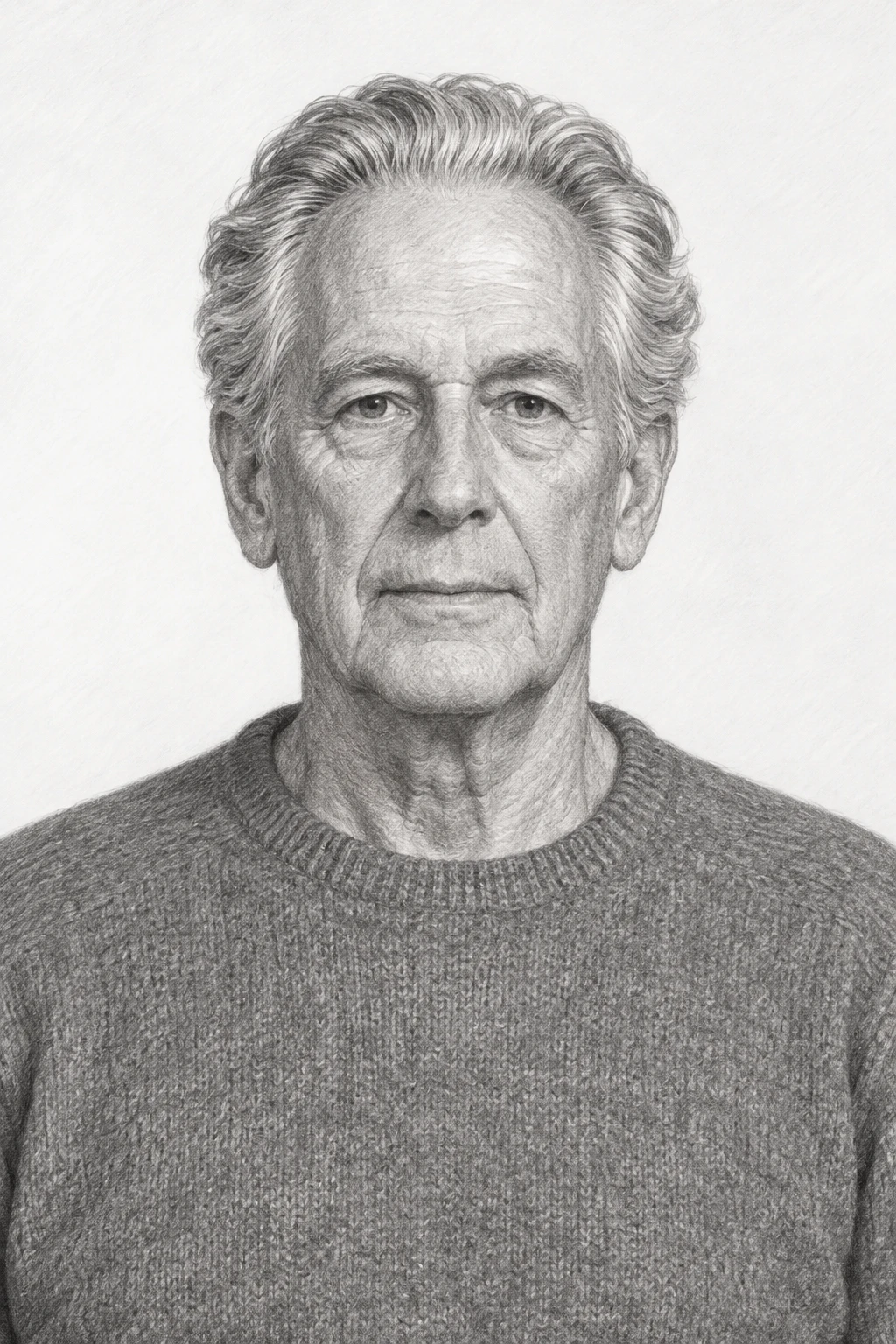
머리를 뒤로 넘긴 노년 성인 · 흑연 지우개 하이라이트
노년 성인의 얼굴을 연속적인 흑연 명암으로 묘사하고 이마·광대의 밝은 면에 지우개로 걷어 낸 흔적을 남기는 세로 초상.
이 이미지로 조합하기머리를 뒤로 넘긴 노년 성인 · 흑연 지우개 하이라이트
- 형태 언어
- 큰 면·곡면 입체·구멍·특징적인 주름군을 남기는 관찰형 흑연 단순화를 쓴다. 각 연결 형태의 짧은 바운딩 폭의 2–3%보다 작은 불규칙은 줄인다. 큰 곡률은 연속되고 구조 모서리는 구별되며 미세 모공은 생략하되 큰 표면 요철은 평평하게 만들지 않는다.
- 윤곽선
- 둘러싸는 잉크 외곽선은 쓰지 않는다. 인접 흑연 명도로 실루엣을 정하고 경계 전이 폭은 연결된 전체 형태의 짧은 폭의 0.4–0.8%이다. 기존 내부 주름은 너비 0.2–0.4%의 연필선이며 마지막 4분의 1에서 20–30%로 가늘어진다. 연결은 부드럽고 숨은 경계 추적선은 없다.
- 붓질·입자
- 각 부분의 짧은 폭 기준 길이 2–5%, 간격 0.5–1%의 흑연 획이 국소 곡률을 따르며 중간·어두운 면에서 겹친다. 밝은 명도 영역에는 같은 폭 기준 길이 6–12%, 너비 2–4%의 뭉툭한 곡선 지우개 흔적을 걷어 낸다. 흔적은 밝은 영역의 10–20%를 차지하고 사이의 흑연은 남기며 점이나 긁힌 격자는 없다.
- 표면 표현
- 연속적이고 단계화하지 않은 흑연 명도를 쓰며 넓은 명암 전이 폭은 각 부분의 짧은 폭의 3–8%이다. 흑연이 쌓인 면에는 연필 입자를 남기고 걷어 낸 흔적은 가장 밝은 허용 명도에 가까워지며 가장자리는 폭 1–2%로 끊기고 풀린다. 전이는 계단식이 아닌 연속적이며 에어브러시 평활화나 불투명 채색 조각은 없다.
우선순위
연속적으로 묘사된 흑연 안에 지우개로 걷어 낸 흔적을 보이게 한다.
피할 표현과 결과 확인
불투명 물감의 하이라이트 조각·매끈한 에어브러시·단계화 명도 띠를 피한다.
끊긴 걷어냄 흔적이 흑연 입자를 나누되 입체 명암을 평평하게 만들지 않는다.
이 예시의 실제 생성 프롬프트
MODULE OWNERSHIP
subject: Subject count, type, stable proportions and landmarks, resting face geometry, hair shape, physical materials, garment construction and permanent marks. No emotion, movement, color assignment or rendering recipe.
expression: Facial soft-tissue displacement and pupil direction, muscle coordination, regional intensity, asymmetry and onset/peak/release. No head/body pose, stable appearance, skin color or rendering.
gesture: Head/neck/body/limb orientation, joint movement, support, contact and pose-caused occlusion using existing anatomy. No eye/pupil movement, emotion, identity, props inventory or camera.
props: Prop count, type, construction, physical material and scale relative to the subject. Holding/contact belongs to gesture, position to composition, color to palette.
scene: Environment elements, terrain, backdrop/floor presence and structural detail. No canvas positions, camera, lighting, assigned colors or render texture.
camera: Projection, focal-length impression, camera elevation/yaw/roll, viewing distance and crop. No actor pose, world placement, lighting or canvas aspect ratio.
composition: Normalized 0-100% canvas positions, scale in frame, depth/overlap, focal hierarchy and margins. No joint pose, camera projection, rendering, subject/prop inventory or emotion.
palette: Color anchors, hue/saturation/value ranges, colors assigned to parts and approximate color coverage. No illumination direction, shading algorithm, physical material or layout.
lighting: Light-source direction/softness/intensity, ambient illumination, physical shadow direction/length and highlight position. Absence of directional illumination is allowed. No shading technique, palette or material changes.
style: Reusable form abstraction, contour weight/taper/edge quality, medium and mark scale/density/direction, surface rendering and tonal transition technique. No fixed subject proportions, anatomy, identity, expression, pose, palette, light-source direction, camera or layout.
output: Image count, aspect ratio, size, file/alpha requirements and global lettering/logo/watermark restrictions. No background scenery, crop, style, identity or pose.

SUBJECT
inventory: Use exactly one original older adult, identified A, with ordinary bilateral human anatomy. Distinguishing anchors are an elongated oval skull, broad cheek planes, open temples and swept-back wavy hair. Anatomical left and right always mean A's own sides.
geometry: Let H be crown-to-chin head height. Head width is 0.70–0.76H, total standing height 6.5–7H and shoulder span 1.8–2.1H. Neck length from lower mandibular angle to the clavicular plane is 0.30–0.40H. Retain ordinary paired limbs and five digits per hand.
geometry: Upper arms and forearms measure 1.0–1.2H and 0.9–1.1H; hands measure 0.70–0.85H from wrist crease to middle fingertip. Thighs and shins each measure 1.4–1.7H, and feet 0.9–1.1H from heel to longest toe. Bilateral partners share these ranges without structural asymmetry.
resting-face: At rest, eye centers lie 50% ±3% down crown-to-chin height. Each eye width E is 0.18–0.20 of head width; the inter-eye gap is 0.9–1.1E and aperture 0.30–0.36E. Iris diameter is 0.45–0.55E. Brows form shallow arches 0.30–0.40E above the upper lids, with level medial ends.
resting-face: The nose base lies 50% ±5% down the eye-line-to-chin gap and spans 0.9–1.1E. A straight bridge ends in a rounded tip projecting 0.45–0.55E from the facial plane. The closed mouth lies 35–45% down the nose-base-to-chin gap and spans 1.5–1.7E along a shallow horizontal curve. Upper/lower lip thicknesses are 0.10–0.14E and 0.14–0.18E.
appearance: Wavy scalp hair sweeps directly backward with no part or fringe, rising 0.10–0.15H above the skull. The hairline forms a shallow M with open temples. Skin retains broad mature creases without scars; facial hair, tattoos, birthmarks and permanent pierced skin openings are absent.
appearance: A wears one wool crew-neck sweater, one cotton trouser layer and two plain leather slip-on shoes. The sweater has one collar join, two sleeve joins and two side seams; trousers have two side seams and one waist fastener. No garment pattern or exposed underlayer is present.
resting-face: Jaw width is 0.72–0.80 of cheek width, tapering to a rounded chin without a cleft. Both ears have oval rims and attached rounded lobes, extending from brow height to nose-base height within 0.10E at each endpoint; each outer rim projects 0.35–0.45E beyond the adjacent head edge. Retain fine forehead creases and shallow nasolabial folds.

PRIORITY
Preserve the oval skull, broad cheek planes and open swept-back hairline.

AVOID
Avoid added facial hair or decorative garment patterns.

CHECK
One older adult retains the defined facial landmarks and plain garment layers.

EXPRESSION — ACTOR A
brows: Both medial and lateral brow ends remain at their resting landmarks within 0.05 eye width vertically. Medial spacing changes by no more than 0.05 eye width, and left/right height difference remains within that same tolerance; no inward pinch occurs.
lids: Upper and lower lids retain resting positions within 0.04 eye width; visible aperture stays within 0.04 eye width of its resting height. Both eyes remain open with equal aperture within that tolerance, without squinting, lid squeeze or additional upper-lid lift.
cheeks: Cheek soft tissue has no active lift or compression: displacement from rest stays within 0.05 eye width on both sides. Existing nasolabial folds retain their resting depth and span, with no new bunching beneath the lower lids or asymmetric cheek contraction.
nose: Both alar edges remain within 0.04 eye width of their resting positions; nostril opening stays unchanged within that range. Release nasal scrunch and alar dilation, with no coupled upper-lip lift or added crease across the nasal bridge at this instant.
mouth: Both corners remain within 0.04 resting mouth width of their baseline vertically and laterally. Preserve the resting shallow lip curve; lips touch continuously without compression or parting. Teeth and tongue remain concealed, and neither corner rises independently.
jaw: Jaw opening remains at its closed resting baseline within 0.04 eye width of vertical displacement. Keep masseter tension at resting support rather than clenching; the chin does not thrust or retract independently, and left/right jaw tension remains matched.
gaze: Center both pupils in their sockets, allowing displacement of 0.05 eye width horizontally or vertically. Maintain matched pupil direction without convergence beyond this tolerance; neither eye tracks independently, and visible iris exposure remains matched between sides.
coordination: Frontalis, corrugator, zygomaticus and lip-compression groups remain released; eyelid and jaw support retain resting tone. Do not combine brow lift with mouth contraction. Regional left/right displacement differences stay within the tolerances assigned to each channel.
timing: Show the apex of a settled neutral interval: every channel is already at its stated resting target. No transitional blink, corner rise, lip parting or jaw closure remains visible. The channel tolerances describe this instant and do not apply a second motion multiplier.

PRIORITY
Maintain matched resting displacement across all facial regions.

AVOID
Avoid a smile, squint, brow lift or clenched jaw.

CHECK
Open resting lids accompany touching lips and a released jaw.

GESTURE
head: Define world forward as the neutral standing body's front. A's head and neck remain aligned with the trunk: yaw 0° ±5°, pitch 0° ±5° and roll 0° ±3°. Keep the neck elongated without forward jutting, lateral bend or independent chin elevation.
torso: A stands upright with trunk and pelvis facing world forward within 5° of yaw. Their pitch and roll remain within 5° of world vertical and level. Keep ordinary spinal curvature without a forward bend or opposing hip tilt; distribute balance symmetrically over both legs.
limbs: Both shoulders rest with arms downward within 5° of vertical; elbows flex 5–15°, wrists remain straight within 5°. Fingers form loose matching curves and palms face inward. Hips remain neutral within 5°, knees flex 0–5° and ankles stay within 5° of a right-angle resting position; toes point forward.
contact: Both complete shoe soles lie flush on the horizontal floor, with equal support and no lifted heel. Feet are parallel; inner-edge separation is 0.9–1.1 times the maximum width of either existing shoe sole. Hands remain free beside the thighs without pressing the garment; no other body surface contacts a support.

PRIORITY
Maintain upright bilateral support and unchanged resting joint chains.

AVOID
Avoid head tilt, hip shift or newly introduced hand contact.

CHECK
Aligned head and trunk accompany relaxed arms and two grounded soles.

PROPS
inventory: The prop inventory is exactly zero. Include no loose accessory, display stand, removable ornament, independent container or accompanying object.
construction: No prop construction has a target because no separate physical item is included. Do not introduce accessory folds, attachments, fasteners or support hardware.

PRIORITY
Maintain the explicit zero-prop inventory.

AVOID
Avoid loose accessories or a separate display stand.

CHECK
No independent accessory or display object is present.

SCENE
inventory: Use exactly one plain studio cyclorama combining a floor and upright backdrop as one connected structure. Furniture, visible fixtures, plants, windows, architectural ornaments and decorative scenery are absent.
structure: The horizontal floor curves smoothly into the upright backdrop without a seam or horizon line. Both surfaces extend beyond the viewed area; there are no exposed outer edges, repeated divisions, panels, relief patterns or additional structures.

PRIORITY
Keep one continuous floor-to-backdrop structure.

AVOID
Avoid visible corners, backdrop seams or decorative scenery.

CHECK
The plain environment has no visible structural division.

CAMERA
projection: Use ordinary perspective with an 85–105 mm full-frame focal-length impression. Depth produces restrained convergence and modest near-to-far size differences; avoid wide-angle expansion and perfectly parallel orthographic flattening.
viewpoint: View from world forward with yaw 0° ±5°, at the head midpoint's elevation within 5° and roll 0° ±3°. Aim at the head midpoint from a distance of 5–7 crown-to-chin head heights. Keep both sides of the face comparably exposed without a steep overhead or underside view.
crop: Retain the entire skull, hair and both ears. Place the lower crop 0.65–0.75 crown-to-chin head heights below the suprasternal notch. Lateral crop boundaries may pass through outer shoulders and upper arms; anatomy outside these boundaries remains present.

PRIORITY
Retain the complete head in a frontal upper-body view.

AVOID
Avoid clipped hair or ears and wide-angle facial expansion.

CHECK
Both ears and the entire hair boundary remain visible within the stated crop.

COMPOSITION
placement: Use top-left normalized 0–100% coordinates. Center the existing head silhouette at x=50%, y=32%, allowing 5 percentage points of displacement. The environmental surface fills the canvas behind the focal figure; use one borderless panel.
depth: Give the existing head sole focal priority, with the remaining figure secondary and the environment last. Preserve intrinsic overlaps among existing parts. Permit no independently placed obstruction across the focal silhouette; the environmental surface stays behind it.
spacing: Target head-silhouette height at 44% of canvas height, within 6 percentage points; derive all other bounds by uniform scaling. Keep that silhouette inside a 5% edge inset. Remaining visible figure regions may intersect side and bottom edges. Containment overrides nominal fill if proportions change.

PRIORITY
Keep the focal head contained above the permitted edge intersections.

AVOID
Avoid independent obstructions, competing focal elements or decorative borders.

CHECK
One contained head dominates a borderless panel with permitted lower intersections.

PALETTE
colors: Use white #FFFFFF and black #111111 as the only anchors. Permit neutral mixtures between them for derived values and adjoining boundaries; channel values remain equal. No chromatic hue family or independently tinted variant is allowed.
assignment: Assign the white-based neutral family to skin, hair, lips, ears and all garment surfaces, with black darker variants. Eyes, pupils, creases, seams and contours use the dark neutral family. The cyclorama uses white with neutral darker variants; every feature inherits these families.
balance: Coverage follows the actual assigned surface, feature, line and environmental areas rather than fixed canvas percentages. The two anchors and their permitted neutral mixtures together cover approximately 100% of the image; no separate accent family is introduced.

PRIORITY
Keep every visible region within the two-anchor neutral family.

AVOID
Avoid colored accents, tinted shadows or unrelated gray anchors.

CHECK
All surfaces, lines and boundary mixtures remain achromatic.

LIGHTING
sources: Use one broad rectangular key centered at world-forward-left azimuth 30° ±10° and elevation 35° ±10°. Its angular width is 35–45° and vertical height 10–15°. Uniform ambient illumination is 45–55% of key strength. No second directional source or rear light is introduced.
shadows: Self-shadows fall world right and downward, with penumbrae 5–10% of the casting component's width. Floor shadows extend right-back: center-ray reach is 1.0–2.2 standing heights from the caster's ground projection; the outer fade ends at 1.2–3.3 heights, following source elevation and vertical extent. Contact shadows stay at sole-floor junctions.
highlights: Source-facing convex surfaces receive broad diffuse brightening over 20–35% of their exposed span. Its peak illumination is 1.3–1.5 times adjacent diffuse surface illumination. Concentrated specular spots, glare, reflective streaks and luminous rims are absent.

PRIORITY
Maintain broad diffuse light with soft, coherent self-shadows.

AVOID
Avoid sharp specular spots or competing directional sources.

CHECK
Convex surfaces show broad brightening beside soft rightward self-shadows.

STYLE GUIDE
form-language: Use observational graphite abstraction retaining major planes, curved volumes, openings and characteristic crease groups. For each connected form, simplify irregularities below 2–3% of its short bounding span. Keep broad curvature continuous and structural corners distinct; omit microscopic pores without flattening the larger surface relief.
contour: Do not use an enclosing ink outline. Establish silhouettes through adjacent graphite values with boundary transitions spanning 0.4–0.8% of each whole connected form's short span. Existing interior creases use pencil lines 0.2–0.4% wide, tapering to 20–30% over their final quarter; keep joins soft and omit hidden-edge tracing.
mark-making: Use graphite strokes 2–5% of each component's short span long, spaced 0.5–1% apart and following local curvature; overlap them in middle and dark regions. Lift blunt curved eraser streaks from light-value regions: length 6–12%, width 2–4% of that same span. Streaks occupy 10–20% of light regions; leave intervening graphite intact and omit dots or scratch grids.
surface-rendering: Use continuous, unquantized graphite values with broad tonal transitions spanning 3–8% of each component's short span. Preserve visible pencil grain in deposited regions; lifted streaks approach the lightest available value with broken, feathered edges 1–2% wide. Keep transitions continuous rather than stepped, without airbrushed smoothing or opaque painted patches.

PRIORITY
Make eraser-lift streaks visible within continuously modeled graphite.

AVOID
Avoid opaque painted highlight patches, smooth airbrush finish or quantized tone bands.

CHECK
Broken lifted streaks interrupt visible graphite grain without flattening its modeling.

OUTPUT
format: Deliver exactly one raster image, 1024 × 1536 pixels, with a 2:3 aspect ratio, encoded as PNG. Use fully opaque pixels with no alpha transparency; export no mockup, contact sheet or supplementary image.
restrictions: Include no lettering, numbers, logos, signatures or watermarks anywhere in the image. Add no company name, slogan, annotations, interface elements or export labels; deliver only the finished image.

PRIORITY
Deliver one opaque PNG at the specified dimensions.

AVOID
Avoid typography, commercial logos or supplemental mockups.

CHECK
One opaque 1024 × 1536 PNG contains no lettering.

FINAL INTEGRATION
subject + lighting + style: The broad forehead and cheek planes provide readable diffuse bright regions for the lifted graphite streaks. Preserve their structural creases through the surrounding graphite rather than treating the erasures as new skin markings.
expression + gesture + style: Resting facial displacement and the aligned head keep the plane changes legible beneath the graphite marks. Eraser streaks change deposited tone only; they do not introduce squinting, cheek lift or altered head orientation.
lighting + style + palette: Render the broad diffuse brightening with lifted light-value streaks and intact graphite between them. Soft physical penumbrae remain continuous graphite transitions; neutral mixtures accommodate both grain and feathered erased edges.
camera + composition + output: On the vertical canvas, the nominal head size and center place the complete head above the upper-chest crop. Apply one shared scale; the wider lower figure may cross side edges while the head remains inside its containment inset.
gesture + scene + camera: The standing body retains both sole-floor contacts on the continuous cyclorama even though the selected crop excludes them. Anatomical joint states outside the view remain unchanged and do not add visible acting.
모델명은 이미지 출처 정보 기준입니다. 같은 프롬프트를 사용해도 결과는 달라질 수 있습니다.