텍스트 → 이미지제품 사진스타일 가이드
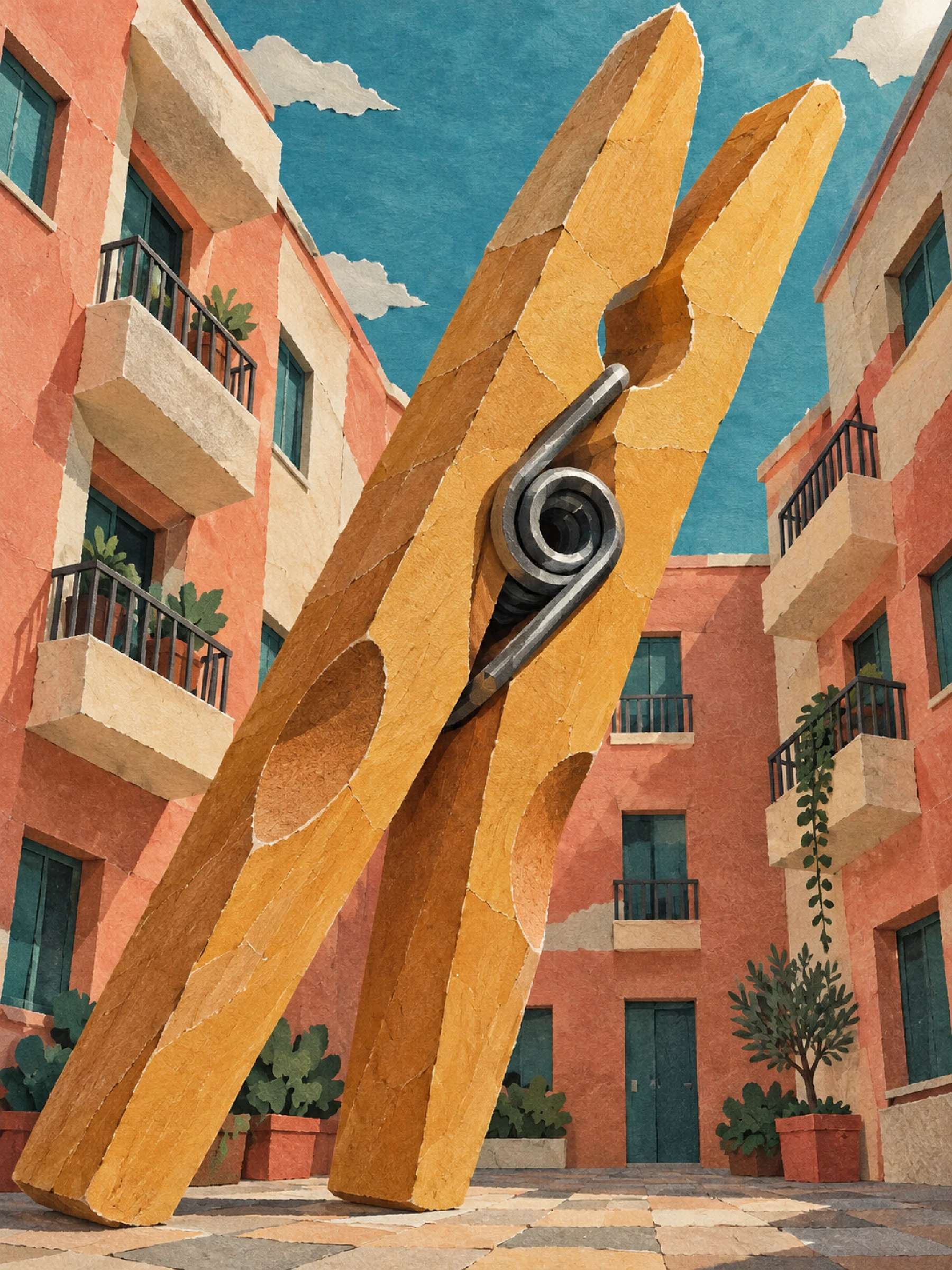
발코니 사이의 거대한 빨래집게
아파트 안뜰의 발코니보다 큰 나무 빨래집게를 겹겹의 종이 콜라주로 표현한다. 작은 건축 요소와 손으로 자른 가장자리가 익숙한 제품에 뜻밖의 기념비적 크기를 부여한다.
이 이미지로 조합하기발코니 사이의 거대한 빨래집게
- 형태 언어
- 입체를 넓게 맞물리는 종이 면으로 바꾸며, 필수 연결부는 유지하고 작은 분할은 단순화한다.
- 윤곽선
- 조금씩 흔들리는 가위 절단선과 간헐적인 찢긴 가장자리를 쓰며, 드러난 층의 가장자리가 실루엣에 변화를 주게 한다.
- 붓질·입자
- 차분한 종이 색면에 드문 문지른 줄무늬와 넓은 붓 자국을 섞으며, 흔적은 각 조각마다 자연스럽게 달라진다.
- 표면 표현
- 보이는 겹침과 불균일하게 솟은 이음으로 촉각적인 오려 붙인 종이 콜라주를 만들고, 넓은 명암 전환에는 서로 다른 종이 톤을 쓴다.
우선순위
보이는 종이 겹침으로 콜라주가 손으로 조립된 느낌을 드러내게 한다.
피할 표현과 결과 확인
이 예시의 실제 생성 프롬프트
MODULE OWNERSHIP
subject: Subject count, type, stable proportions and landmarks, resting face geometry, hair shape, physical materials, garment construction and permanent marks. No emotion, movement, color assignment or rendering recipe.
expression: Facial soft-tissue displacement and pupil direction, muscle coordination, regional intensity, asymmetry and onset/peak/release. No head/body pose, stable appearance, skin color or rendering.
gesture: Head/neck/body/limb orientation, joint movement, support, contact and pose-caused occlusion using existing anatomy. No eye/pupil movement, emotion, identity, props inventory or camera.
props: Prop count, type, construction, physical material and scale relative to the subject. Holding/contact belongs to gesture, position to composition, color to palette.
scene: Environment elements, terrain, backdrop/floor presence and structural detail. No canvas positions, camera, lighting, assigned colors or render texture.
camera: Projection, focal-length impression, camera elevation/yaw/roll, viewing distance and crop. No actor pose, world placement, lighting or canvas aspect ratio.
composition: Normalized 0-100% canvas positions, scale in frame, depth/overlap, focal hierarchy and margins. No joint pose, camera projection, rendering, subject/prop inventory or emotion.
palette: Color anchors, hue/saturation/value ranges, colors assigned to parts and approximate color coverage. No illumination direction, shading algorithm, physical material or layout.
lighting: Light-source direction/softness/intensity, ambient illumination, physical shadow direction/length and highlight position. Absence of directional illumination is allowed. No shading technique, palette or material changes.
style: Reusable form abstraction, contour weight/taper/edge quality, medium and mark scale/density/direction, surface rendering and tonal transition technique. No fixed subject proportions, anatomy, identity, expression, pose, palette, light-source direction, camera or layout.
output: Image count, aspect ratio, size, file/alpha requirements and global lettering/logo/watermark restrictions. No background scenery, crop, style, identity or pose.

SUBJECT
inventory: One original oversized spring clothespin, with no people or animals.
geometry: Two elongated wooden arms form a forked jaw and curved handles, joined by a visible coil spring at the waist.
resting-face: No face or facial landmarks.
appearance: Solid carved wood and a bent steel spring; shallow thumb hollows distinguish the handles.

PRIORITY


AVOID


CHECK


PROPS
inventory: No separate props.
construction: No prop construction applies.

PRIORITY


AVOID


CHECK


SCENE
inventory: A residential courtyard enclosed by two apartment facades, with balconies, windows, paving, and open sky.
structure: Projecting balcony slabs, simple railings, and recessed windows make the courtyard recognizable; minor details may vary.

PRIORITY


AVOID


CHECK


CAMERA
projection: Moderately wide perspective with clear architectural depth.
viewpoint: View upward from courtyard level, at a three-quarter yaw that reveals the clothespin spring; keep roll level.
crop: Include both clothespin ends while cropping the surrounding facades beyond the frame.

PRIORITY


AVOID


CHECK


COMPOSITION
placement: The clothespin spans from the lower-left region toward the upper-right region and fills most of the frame height.
depth: The clothespin overlaps the smaller balconies; its jaw and spring lead, with architecture supplying the scale comparison.
spacing: Leave an irregular sky opening beside the handles and narrow breathing gaps around both ends.

PRIORITY


AVOID


CHECK


PALETTE
colors: Use honey ochre, dusty coral, pale cream, deep teal, and small charcoal accents.
assignment: Ochre defines the clothespin, charcoal the spring, coral and cream the facades, and teal the sky and window recesses.
balance: Warm fields dominate, with restrained teal areas keeping the product distinct from its surroundings.

PRIORITY


AVOID


CHECK


LIGHTING
sources: Broad soft daylight arrives from the upper right with moderate ambient fill.
shadows: Soft shadows fall down and left; overlapping edges cast short shadows that reveal shallow relief.
highlights: Gentle highlights sit on upper-right facing planes and the exposed spring arcs.

PRIORITY


AVOID


CHECK


STYLE GUIDE
form-language: Translate volume into broad interlocking paper planes; retain essential junctions while simplifying minor subdivisions.
contour: Use slightly wandering scissor-cut edges, with occasional torn margins; let exposed layer edges interrupt the silhouette.
mark-making: Combine quiet paper fields with sparse rubbed streaks and broad brushed patches; marks vary naturally across individual pieces.
surface-rendering: Build tactile cut-paper collage through visible overlaps and uneven raised seams; use separate paper tones for broad transitions.

PRIORITY
Visible cut-paper overlaps must make the collage feel assembled by hand.

AVOID


CHECK


OUTPUT
format: One finished image, 3:4 portrait, 1800 × 2400 pixels, opaque PNG.
restrictions: No lettering, logos, signatures, or watermarks.

PRIORITY


AVOID


CHECK


FINAL INTEGRATION
subject + style: Paper abstraction should preserve the product's recognizable mechanism while allowing handmade irregularity.
scene + camera + composition: Architectural cues and the view work together to make the scale surprise immediately legible.
lighting + style: Illumination should reveal the collage's layered construction without obscuring its cut shapes.
모델명은 이미지 출처 정보 기준입니다. 같은 프롬프트를 사용해도 결과는 달라질 수 있습니다.