텍스트 → 이미지인물스타일 가이드
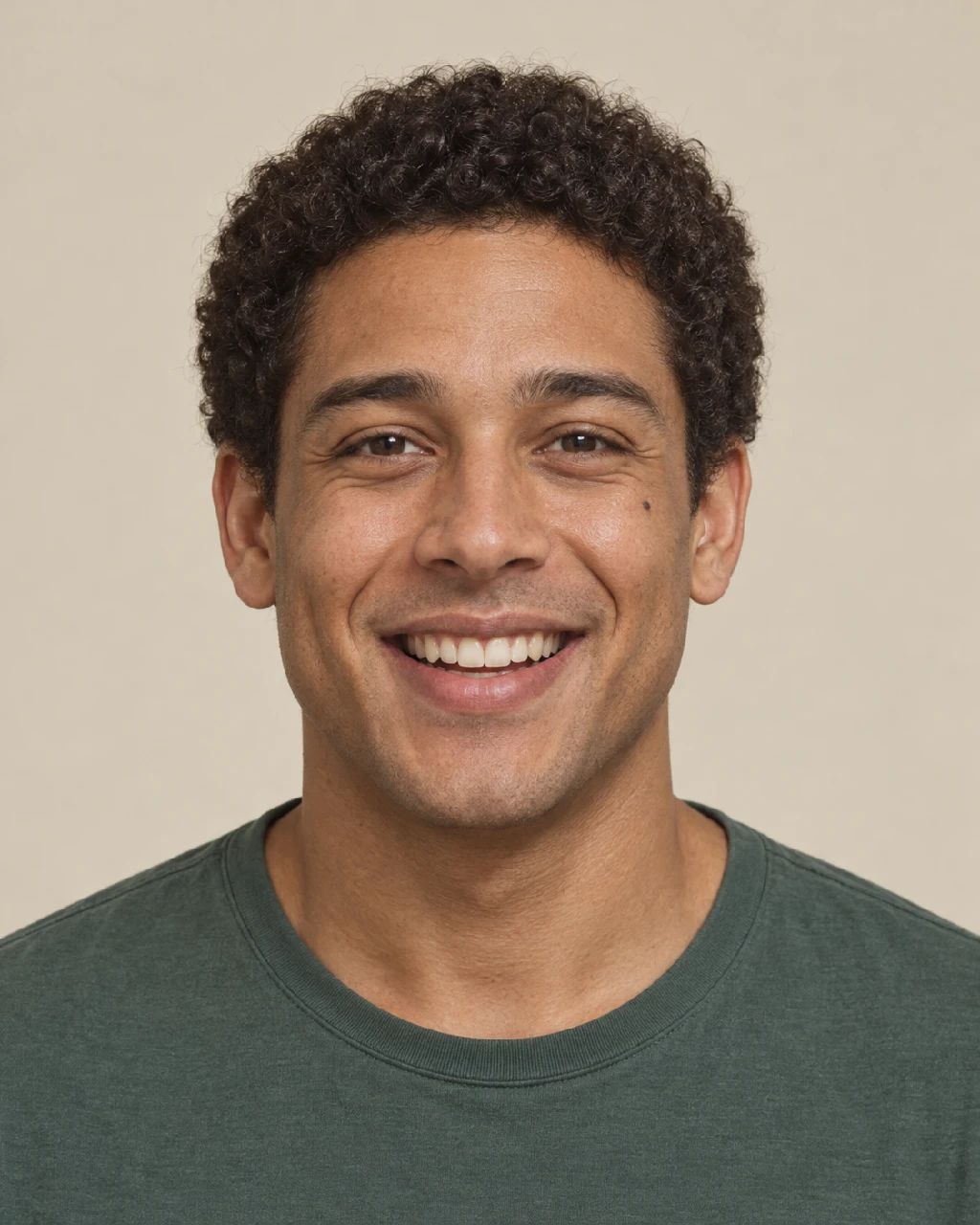
웃는 성인 · 볼과 아래눈꺼풀의 동반 상승
볼의 상승과 아래눈꺼풀 압축을 연결하고 턱은 풀어, 눈과 입이 함께 웃는 순간을 보여 주는 사진 인물 참고.
이 이미지로 조합하기웃는 성인 · 볼과 아래눈꺼풀의 동반 상승
- 형태 언어
- 도식적 간추림 없는 구상 사진 형태를 사용한다. 연속 실루엣, 구멍, 표면 주름과 실제 구조 경계를 유지한다. 각 연결 형태 경계 상자 최장 치수의 0.5–1%까지 보조 세부를 남기고 더 작은 세부는 표면 변화에 합친다. 곡선은 연속되며 모서리는 과장하지 않는다.
- 윤곽선
- 그린 윤곽선, 가장자리 띠와 겹선은 사용하지 않는다. 인접 표면 명도로 경계를 만들고 단단한 전이 폭은 연결 형태 최장 치수의 0.15–0.40%, 부드러운 경계는 0.5–1.2%이다. 경계 곡률은 연속되며 가늘어지는 잉크 끝이나 모든 내부 전이의 동일한 선명화는 없다.
- 붓질·입자
- 붓자국, 해칭, 점묘와 장식 입자 없는 사진 래스터를 사용한다. 각 연결 형태 최장 치수의 0.2–0.5% 크기인 미세하고 비반복적인 표면 변화를 기존 질감 영역에만 남긴다. 매끈한 영역은 표식 없이 유지하고 미세 변화는 분리된 짙은 점이나 반복 무늬가 되지 않는다.
- 표면 표현
- 양자화하지 않은 연속 명도 보간을 사용하고 넓은 전이는 각 표면 최장 치수의 8–20%에 걸친다. 전이 안에서도 국소 미세 변화를 유지하며 왁스 같은 매끈한 조각으로 지우지 않는다. 가림 경계는 넓은 그라데이션과 구별하고 셀 명도 띠, 회화 조각, 금속 광택 덧씌움과 인공 번짐은 제외한다.
우선순위
연속 표면과 알아볼 수 있는 국소 변위를 유지한다.
피할 표현과 결과 확인
왁스 같은 평활화, 그린 외곽선과 단계 얼굴 명도를 피한다.
연속 혼합 명도 안에서 표면 주름이 보이는 상태를 유지한다.
이 예시의 실제 생성 프롬프트
MODULE OWNERSHIP
subject: Subject count, type, stable proportions and landmarks, resting face geometry, hair shape, physical materials, garment construction and permanent marks. No emotion, movement, color assignment or rendering recipe.
expression: Facial soft-tissue displacement and pupil direction, muscle coordination, regional intensity, asymmetry and onset/peak/release. No head/body pose, stable appearance, skin color or rendering.
gesture: Head/neck/body/limb orientation, joint movement, support, contact and pose-caused occlusion using existing anatomy. No eye/pupil movement, emotion, identity, props inventory or camera.
props: Prop count, type, construction, physical material and scale relative to the subject. Holding/contact belongs to gesture, position to composition, color to palette.
scene: Environment elements, terrain, backdrop/floor presence and structural detail. No canvas positions, camera, lighting, assigned colors or render texture.
camera: Projection, focal-length impression, camera elevation/yaw/roll, viewing distance and crop. No actor pose, world placement, lighting or canvas aspect ratio.
composition: Normalized 0-100% canvas positions, scale in frame, depth/overlap, focal hierarchy and margins. No joint pose, camera projection, rendering, subject/prop inventory or emotion.
palette: Color anchors, hue/saturation/value ranges, colors assigned to parts and approximate color coverage. No illumination direction, shading algorithm, physical material or layout.
lighting: Light-source direction/softness/intensity, ambient illumination, physical shadow direction/length and highlight position. Absence of directional illumination is allowed. No shading technique, palette or material changes.
style: Reusable form abstraction, contour weight/taper/edge quality, medium and mark scale/density/direction, surface rendering and tonal transition technique. No fixed subject proportions, anatomy, identity, expression, pose, palette, light-source direction, camera or layout.
output: Image count, aspect ratio, size, file/alpha requirements and global lettering/logo/watermark restrictions. No background scenery, crop, style, identity or pose.

SUBJECT
inventory: Include exactly one original adult, identified as A, with ordinary bilateral human anatomy. Distinguishing anchors are a compact curled hair cap, a long straight nasal bridge, a rounded-square jaw and one permanent cheek mole. Anatomical left/right mean A's own sides, not the viewer's.
geometry: Let H run from scalp crown to chin. Standing height is 7.0–7.5H, shoulder-joint span 1.7–1.9H and head width 0.72–0.78H. Neck length from the underside of the jaw midpoint to the top of the sternum is 0.22–0.28H. Upper-arm length is 1.1–1.2 times forearm length; retain ordinary bilateral segment symmetry.
resting-face: Let H be scalp-crown-to-chin height and E resting eye width, 0.16–0.18H. Eye centers lie 0.46–0.50H below the crown; inner-eye spacing is 1.0–1.2E and aperture 0.28–0.34E. Eyes have almond outlines with pointed corners and outer-to-inner corner inclination 0°±3°. Both eyes share these resting ranges.
resting-face: Let E be resting eye width and H scalp-crown-to-chin height. Brows sit 0.15–0.20E above upper lids with shallow continuous arches. The straight nasal bridge runs 0.28–0.32H from the midpoint between inner eye corners to the nasal base. Resting alar width is 0.20–0.24H; both alae have matching rounded outlines.
resting-face: Let E be resting eye width, H scalp-crown-to-chin height. Closed, level lips span 1.45–1.65E, each 0.12–0.16E thick; their seam is 30–36% down nasal base to chin. Rounded jaw angles span 0.68–0.74H with broad chin. Rounded ears align tops/lobes to brows/nasal base ±0.04H; breadth is 0.09–0.13H, projection from temples 0.03–0.06H.
resting-face: Let H be scalp-crown-to-chin height. The hairline lies 0.18–0.22H above the brows; compact curls measure 0.04–0.07H across and form one rounded cap. Skin has fine pores without scars or permanent deep folds. One mole, diameter 0.01–0.015H, lies 0.08–0.12H below the anatomical-left outer eye corner.
appearance: A wears one collarless cotton jersey shirt with short sleeves ending 40–60% from shoulder joint to elbow. Construction has one round neck binding, two shoulder seams, two side seams, two armhole seams and two sleeve underside seams. No fasteners, patches or permanent garment marks are present.
appearance: A wears one pair of plain woven trousers with one elastic waistband and two continuous leg tubes reaching the ankles. Include two outer-leg seams, two inner-leg seams and one crotch seam. Fly, fasteners, pockets and permanent garment marks are absent. Both feet are bare.

PRIORITY
Retain A's hair cap, straight bridge, jaw shape and single mole.

AVOID
Avoid extra people and altered permanent facial anchors.

CHECK
One adult retains the defined resting landmarks and garment layers.

EXPRESSION — ACTOR A
brows: Let E be resting eye width. Raise both medial and lateral brow portions 0.05–0.10E from rest while preserving their arch curvature. Medial spacing changes by no more than 0.05E, and bilateral height difference stays within 0.03E; no inward brow knot forms.
lids: Let Q be each eye's resting vertical aperture. Lower the upper lid by 0.15–0.20Q and raise the lower lid by 0.25–0.30Q, leaving 0.50–0.60Q visible aperture. Keep both eyes open with bilateral aperture difference within 0.05Q; do not introduce a wink or full closure.
cheeks: Let E be resting eye width. Lift both cheek apices 0.08–0.12E, compressing the tissue immediately beneath the lower lids. Nasolabial grooves become visibly deeper but remain single continuous folds. Bilateral lift differs by at most 0.03E; the lower cheek region does not inflate.
nose: Let E be resting eye width. Keep each alar edge within 0.02E of its resting position, with unchanged nostril aperture and no bridge wrinkling. Upper-lip elevation does not pull the alae upward; preserve bilateral nasal symmetry within the same 0.02E tolerance.
mouth: Let M be resting mouth width. Move each corner outward 0.06–0.08M and upward 0.06–0.10M, forming one broad upward-curved opening. Central lip separation is 0.20–0.25M. Expose a continuous upper tooth row; lower teeth and tongue remain concealed, with corner-height difference within 0.03M.
jaw: Let M be resting mouth width. Lower the chin through jaw opening by 0.18–0.23M relative to rest, without lateral displacement beyond 0.02M. Release the jaw-closing tension: no clenched masseter bulge or compressed tooth contact appears. Keep the opening bilateral rather than skewed.
gaze: Let E be resting eye width. Place both pupil centers at the centers of their own sockets, with horizontal and vertical offsets limited to ±0.05E. Keep pupil directions parallel without convergence, divergence or upward rolling; visible iris portions may be occluded by the displaced lids.
coordination: Activate the zygomaticus major for corner lift and orbicularis oculi for cheek-linked lower-lid compression. Keep corrugator and nasal wrinkling activity released, with only the specified mild brow lift. Release masseter tension for jaw opening; bilateral action stays within the stated channel tolerances.
timing: Capture one apex instant with the stated cheek lift, narrowed open lids, raised mouth corners and released jaw simultaneously present. These are the complete displacements at this instant, without an additional timing multiplier. No channel remains at onset or returns toward its resting state.

PRIORITY
Couple cheek lift to lower-lid compression while releasing the jaw.

AVOID
Avoid a wide-eyed open mouth with inactive cheeks.

CHECK
Lifted cheeks, narrowed open eyes and raised corners act together.

GESTURE
head: For A, define forward as the sternum's outward direction and up as the standing vertical. Keep the neck upright and head yaw, pitch and roll at 0°±5° relative to these axes. The chin neither projects forward nor retracts beyond the resting neck alignment.
torso: A stands with torso and pelvis facing forward, yaw and roll 0°±5°, and trunk bend 0°±5° from vertical. Keep shoulders level within 5° and weight centered between the feet. The pelvis does not counter-rotate, shift sideways or tilt independently.
limbs: Both arms hang beside the torso: shoulder flexion and abduction 0–10°, elbows flexed 5–15°, wrists neutral within ±5°. Palms face the thighs; fingers form relaxed curved groups with thumbs separate. Viewer-left and viewer-right arms retain matching states, without elevation or hand contact.
limbs: Both legs retain the standing baseline: hips flexion 0°±5° with no internal rotation, knees flexed 0–5°, ankles at 90°±5° between shins and soles. Feet are parallel at pelvis-width spacing, soles facing down and toes extended. Viewer-left and viewer-right chains remain equally loaded.
contact: Both bare soles contact the level floor through heel, forefoot and toes, each bearing 45–55% of A's weight. No foot lifts or sinks. Hands remain clear of the thighs, torso and each other; except for these sole–floor contacts, the neck, trunk and limbs receive no external supporting contact.

PRIORITY
Maintain an upright bilateral stance with relaxed hanging arms.

AVOID
Avoid head throws, shoulder lifts and invented hand contact.

CHECK
The head and torso stay upright while both soles carry the load.

PROPS
inventory: The prop inventory is empty: include exactly zero jewelry items, accessories, tools or carried equipment. A has no removable ornament or supplementary object.
construction: With zero props, no prop construction target applies. Do not introduce separate clasps, chains, badges, containers or support equipment that would require additional material or assembly.

PRIORITY
Keep the removable accessory inventory completely empty.

AVOID
Avoid jewelry, badges and carried portrait accessories.

CHECK
No removable accessory or supplementary object is present.

SCENE
inventory: Include one plain studio backdrop and one level studio floor as the complete environment. Exclude furniture, plants, architectural openings, decorative objects and visible lighting fixtures; no additional environmental element is present.
structure: The backdrop and floor are uninterrupted surfaces joined by a broad seamless curve. Include no visible horizon, corners, panel divisions, paving joints or relief. The environment has no repeated structural details.

PRIORITY
Maintain a structurally plain, seamless studio environment.

AVOID
Avoid furniture silhouettes and backdrop subdivisions.

CHECK
The environment contains no decorative or architectural divisions.

CAMERA
projection: Use rectilinear photographic perspective with an 85–105 mm full-frame-equivalent focal-length impression. Perspective is weak, with no wide-angle facial expansion, fisheye curvature or orthographic flattening.
viewpoint: Place the camera directly before A at nasal-bridge elevation, yaw 0°±5° from A's forward axis and roll 0°±3° from standing vertical. Use a viewing distance of 10–14 scalp-crown-to-chin head heights and aim at the nasal bridge.
crop: Include the complete hair cap, both ears and chin. The lower crop crosses the upper chest between the clavicles and mid-sternum; lateral boundaries intersect both shoulder slopes. Exclude the lower torso and legs from view without treating them as absent anatomy.

PRIORITY
Keep facial displacement readable in a direct, weak-perspective view.

AVOID
Avoid wide-angle expansion and clipped hair or chin.

CHECK
Hair, ears and chin remain visible above the upper-chest crop.

COMPOSITION
placement: Use top-left normalized coordinates. Let F be the projected outer head envelope including existing hair and ears. Center F at (50%,40%)±5 percentage points; its height targets 70% of canvas height, allowed 60–80%. Uniformly scale the whole actor, deriving width and all remaining bounds. The environment fills x/y=0–100%.
depth: Use one borderless panel with A as the sole focal element before the environment. Permit intrinsic self-occlusion without an independently placed obstruction. The existing head envelope has first focal rank; all remaining visible silhouette regions are subordinate.
spacing: Contain F within x=5–95%, y=5–95%; uniform-scale containment overrides nominal fill if necessary. Other existing silhouette regions may intersect the left, right and lower edges, never the upper edge. Derive margins from F's resulting bounds without extra spacing targets.

PRIORITY
Preserve head-envelope containment before nominal fill.

AVOID
Avoid independent axis scaling and additional focal elements.

CHECK
F stays within its inset while allowed silhouettes reach other edges.

PALETTE
colors: Use six anchors: skin #B47B5A, lips #8F5149, dark #302723, shirt #4F665D, environment #DDD1BD and light #F4EBDD. Permit continuous mixtures among these anchors for all derived shades and mixed colors; introduce no additional independent hue family.
assignment: Assign all skin and ears to skin, lips to lips, hair/brows/irises/pupils/mole and mouth interior to dark, sclera and teeth to light, shirt and its seams to shirt, trousers to dark, and floor/backdrop to environment. All tonal variants and highlights inherit mixtures of their assigned anchor with dark or light.
balance: Coverage follows the actual assigned-region areas and totals 100%, with mixtures counted under their contributing roles. Retain the six roles without separately colored seams, pore marks or accents; no role has a fixed canvas occupancy.

PRIORITY
Keep every anatomical, garment and environment region assigned.

AVOID
Avoid independent cosmetic colors and unassigned reflections.

CHECK
All regions and blended edges inherit one of the six anchor roles.

LIGHTING
sources: Use one broad area source 35°±10° toward A's anatomical right from forward and 30°±5° above eye level, angular extent 20–25°. Set its strength to 1 and uniform ambient to 0.45–0.60. Include no second directional source or rim source.
shadows: Facial cast shadows fall toward A's anatomical left and downward. The nasal shadow extends 0.10–0.20 of resting mouth width, with penumbra 0.05–0.10 of that width. The under-chin shadow remains attached to the neck, without a detached gap.
shadows: Let S be A's standing height from soles to scalp crown. The floor shadow extends behind and anatomical-left from the supporting soles. Central-source reach is 1.4–2.2S; the soft outer edge reaches 2.1–4.6S. Its outer penumbra spans 1.1–3.3S, and contact shadow remains attached beneath both soles.
highlights: Place broad diffuse highlights on source-facing forehead, nasal bridge and upper cheek regions, at 1.3–1.6 times adjacent screened skin luminance. Each visible eye receives one rectangular source reflection spanning 0.10–0.15 of iris diameter. No isolated forehead hotspot or rim streak is present.

PRIORITY
Use broad illumination that preserves facial fold visibility.

AVOID
Avoid narrow spotlights and multiple eye-source reflections.

CHECK
Soft attached shadows coexist with one reflection in each eye.

STYLE GUIDE
form-language: Use representational photographic forms without graphic simplification. Preserve continuous silhouettes, openings, surface folds and genuine construction boundaries. Retain secondary details down to 0.5–1% of each connected form's longest bounding-box dimension, merging smaller detail into surface variation. Keep curves continuous and corners unexaggerated.
contour: Use no drawn contours, edge bands or doubled traces. Define boundaries by adjacent surface values, with firm transitions spanning 0.15–0.40% of each connected form's longest dimension and softer boundaries spanning 0.5–1.2%. Keep boundary curvature continuous; do not add tapered ink ends or sharpen every internal surface transition equally.
mark-making: Use a photographic raster without brush strokes, hatching, stipple or decorative grain. Preserve fine nonrepeating surface variation at 0.2–0.5% of each connected form's longest dimension, confined to existing textured regions. Smooth regions remain unmarked, and fine variation never becomes isolated dark dots or a repeated pattern.
surface-rendering: Use continuous, unquantized tonal interpolation with broad transitions spanning 8–20% of each surface's longest dimension. Preserve local fine variation through those transitions instead of smoothing it into waxy patches. Occlusion boundaries remain distinct from broad gradients; exclude cel bands, painterly patches, metallic gloss overlays and artificial bloom.

PRIORITY
Preserve continuous surfaces and readable local displacement.

AVOID
Avoid waxy smoothing, drawn outlines and stepped facial tones.

CHECK
Surface folds remain visible within continuously blended tones.

OUTPUT
format: Deliver exactly one raster image as a PNG file, 1024×1280 pixels with a 4:5 aspect ratio. Use an opaque image with no alpha channel or transparent pixels; provide no additional image variants.
restrictions: Include no lettering, dialogue, captions, sound-effect characters, logos, signatures or watermarks. Deliver the image without interface controls, metadata labels or an accompanying embedded reference sheet.

PRIORITY
Deliver one opaque PNG at the specified dimensions.

AVOID
Avoid embedded lettering and additional image variants.

CHECK
One 1024×1280 opaque PNG contains no lettering or watermark.

FINAL INTEGRATION
subject + gesture + camera: In the frontal stance and view, A's anatomical-left mole appears on viewer-right. The standing joint chains and floor support remain defined even though the upper-chest crop excludes the lower body.
expression + style + lighting: Continuous photographic rendering preserves the cheek-to-lower-lid compression and deepened nasolabial folds. Broad illumination reveals those displaced surfaces without replacing them with painted expression marks.
camera + composition: The head-envelope placement leaves space above the complete hair and places the upper-chest crop at the lower edge. The narrow portrait permits both shoulder slopes to intersect the lateral boundaries while preserving head containment.
palette + style + lighting: Use assigned anchor mixtures for continuous skin transitions, soft shadows and source reflections. Fine surface variation inherits its region's assignment, and eye reflections use the light role without adding a new color.
모델명은 이미지 출처 정보 기준입니다. 같은 프롬프트를 사용해도 결과는 달라질 수 있습니다.