텍스트 → 이미지일러스트스타일 가이드
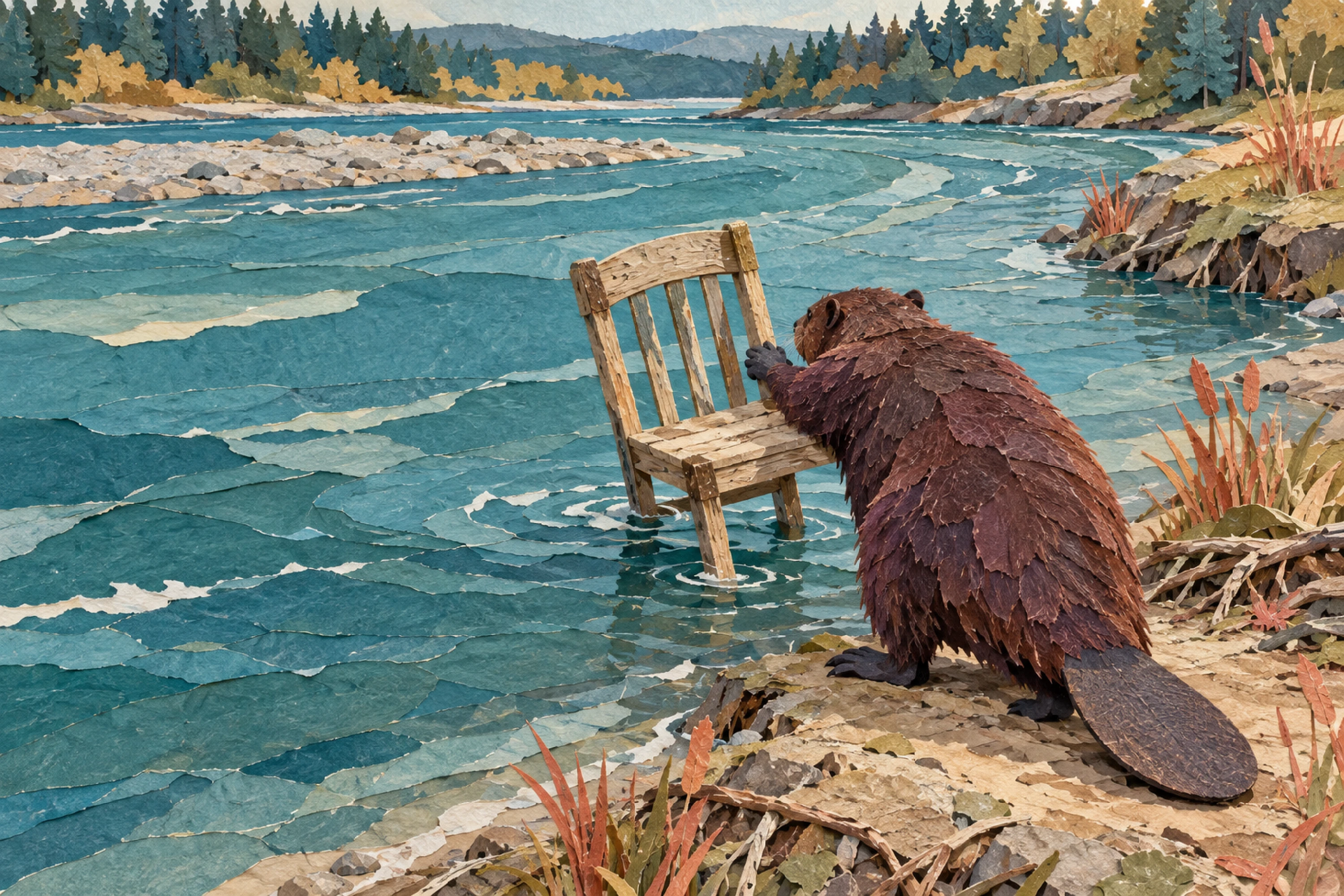
의자를 물에 띄우는 비버
비버가 오래된 나무 의자를 강물로 밀어 보내는 종이 콜라주. 겹친 종이 강물이 넓게 휘어 흐르고 작은 행동이 강둑 한편을 채운다.
이 이미지로 조합하기의자를 물에 띄우는 비버
- 형태 언어
- 넓고 굽은 종이 조각에 소수의 뭉툭한 각진 변화를 더해 포개진 실루엣으로 형태를 구성한다.
- 윤곽선
- 그린 외곽선 없이 종이의 절단면으로 윤곽을 만들고, 분명한 가위 곡선과 부드럽게 찢긴 경계를 번갈아 쓴다.
- 붓질·입자
- 자르기 전에 종이에 안료를 붓으로 바르고 문질러, 반복 무늬 대신 불규칙한 줄무늬와 드문 마른 자국을 남긴다.
- 표면 표현
- 무광 종이층의 겹침과 드러난 섬유, 간간이 들린 가장자리로 명암을 만들고 수작업의 변화를 살린다.
우선순위
겹겹의 오린 종이 구조와 촉각적인 겹침이 분명하게 드러나게 한다.
피할 표현과 결과 확인
이 예시의 실제 생성 프롬프트
MODULE OWNERSHIP
subject: Subject count, type, stable proportions and landmarks, resting face geometry, hair shape, physical materials, garment construction and permanent marks. No emotion, movement, color assignment or rendering recipe.
expression: Facial soft-tissue displacement and pupil direction, muscle coordination, regional intensity, asymmetry and onset/peak/release. No head/body pose, stable appearance, skin color or rendering.
gesture: Head/neck/body/limb orientation, joint movement, support, contact and pose-caused occlusion using existing anatomy. No eye/pupil movement, emotion, identity, props inventory or camera.
props: Prop count, type, construction, physical material and scale relative to the subject. Holding/contact belongs to gesture, position to composition, color to palette.
scene: Environment elements, terrain, backdrop/floor presence and structural detail. No canvas positions, camera, lighting, assigned colors or render texture.
camera: Projection, focal-length impression, camera elevation/yaw/roll, viewing distance and crop. No actor pose, world placement, lighting or canvas aspect ratio.
composition: Normalized 0-100% canvas positions, scale in frame, depth/overlap, focal hierarchy and margins. No joint pose, camera projection, rendering, subject/prop inventory or emotion.
palette: Color anchors, hue/saturation/value ranges, colors assigned to parts and approximate color coverage. No illumination direction, shading algorithm, physical material or layout.
lighting: Light-source direction/softness/intensity, ambient illumination, physical shadow direction/length and highlight position. Absence of directional illumination is allowed. No shading technique, palette or material changes.
style: Reusable form abstraction, contour weight/taper/edge quality, medium and mark scale/density/direction, surface rendering and tonal transition technique. No fixed subject proportions, anatomy, identity, expression, pose, palette, light-source direction, camera or layout.
output: Image count, aspect ratio, size, file/alpha requirements and global lettering/logo/watermark restrictions. No background scenery, crop, style, identity or pose.

SUBJECT
inventory: One adult beaver, actor A.
geometry: A stocky body, small rounded ears, broad muzzle and flattened paddle tail establish the beaver's silhouette.
resting-face: Small eyes sit above a broad muzzle with a blunt nose and short mouth seam.
appearance: Dense fur covers the body; the tough tail has a faint surface pattern. No clothing or permanent marks.

PRIORITY


AVOID


CHECK


EXPRESSION — ACTOR A
brows: If brows are concealed, leave their displacement unprescribed.
lids: If eyelids are concealed, leave their displacement unprescribed.
cheeks: The visible muzzle edge stays relaxed without cheek bunching.
nose: Visible nasal tissue remains relaxed without wrinkling.
mouth: Show no visible mouth opening or lip tension; concealed mouth details remain unprescribed.
jaw: The visible jaw contour remains at rest without a downward drop.
gaze: If pupil direction is unreadable, leave it unprescribed.
coordination: Keep the visible muzzle relaxed; hidden facial channels require no invented acting.
timing: Hold a neutral resting instant with no facial transition.

PRIORITY


AVOID


CHECK


GESTURE
head: The muzzle points toward the chair, with the neck continuing the forward bend of the back.
torso: Lean forward from a low crouch in the final moment of pushing the chair away.
limbs: Both forepaws extend in a final push while the hind feet remain widely planted.
contact: Forepaws touch the chair's back rail; hind feet and the resting tail brace against the bank.

PRIORITY


AVOID


CHECK


PROPS
inventory: One salvaged wooden dining chair, slightly taller than the beaver.
construction: A plank seat, open slatted back and four simple legs show worn wood and a few repaired joints.

PRIORITY


AVOID


CHECK


SCENE
inventory: A quiet river bend with a low earthen bank, exposed roots, scattered reeds and a gravel bar.
structure: The bank shelves gently into the river; broad currents bend around the gravel bar, with small launch ripples.

PRIORITY


AVOID


CHECK


CAMERA
projection: Use gently compressed illustrated perspective with little wide-angle distortion.
viewpoint: View from moderately above and behind the beaver, leaving most of its face hidden; keep the camera level.
crop: Include the whole beaver and chair in an environmental view, with the river continuing beyond the frame.

PRIORITY


AVOID


CHECK


COMPOSITION
placement: Group the beaver and chair near the lower-right third; their contact is the focal point within the broad river bend.
depth: The beaver overlaps the near bank and part of the chair rail; the chair extends into open water beyond it.
spacing: Leave generous water across the left half, with widely spaced current shapes and a distant gravel bar.

PRIORITY


AVOID


CHECK


PALETTE
colors: Build a restrained palette of petrol teal, oatmeal, aubergine and faded coral.
assignment: Use teal for river bands, oatmeal for banks and chair, aubergine for the beaver, and coral for sparse reeds.
balance: Teal and oatmeal dominate, with one substantial dark animal shape and small coral interruptions.

PRIORITY


AVOID


CHECK


LIGHTING
sources: Soft daylight enters from the upper right, supported by even ambient illumination.
shadows: Gentle shadows fall toward the lower left; contact shadows remain narrow and soft.
highlights: Subtle highlights touch upper-right-facing edges without glossy glare.

PRIORITY


AVOID


CHECK


STYLE GUIDE
form-language: Construct forms from nested paper silhouettes, combining broad curved pieces with a few blunt angular interruptions.
contour: Let cut edges define contours without drawn outlines; alternate decisive scissor curves with softly torn boundaries.
mark-making: Brush and rub pigment onto paper before cutting, leaving irregular streaks and sparse dry marks rather than repeated texture.
surface-rendering: Build tones through overlapping matte paper layers, visible fibers and occasional lifted edges; retain handmade variation.

PRIORITY
Make layered cut-paper construction and tactile overlaps unmistakable.

AVOID


CHECK


OUTPUT
format: One finished image, landscape 3:2, 3000 × 2000 pixels, opaque PNG.
restrictions: No lettering, logos or watermarks.

PRIORITY


AVOID


CHECK


FINAL INTEGRATION
style + lighting: Apply the lighting's contact shadows at paper overlaps to reveal the assembly while preserving the illustrated scene's coherence.
모델명은 이미지 출처 정보 기준입니다. 같은 프롬프트를 사용해도 결과는 달라질 수 있습니다.