이미지 편집인물스타일 가이드
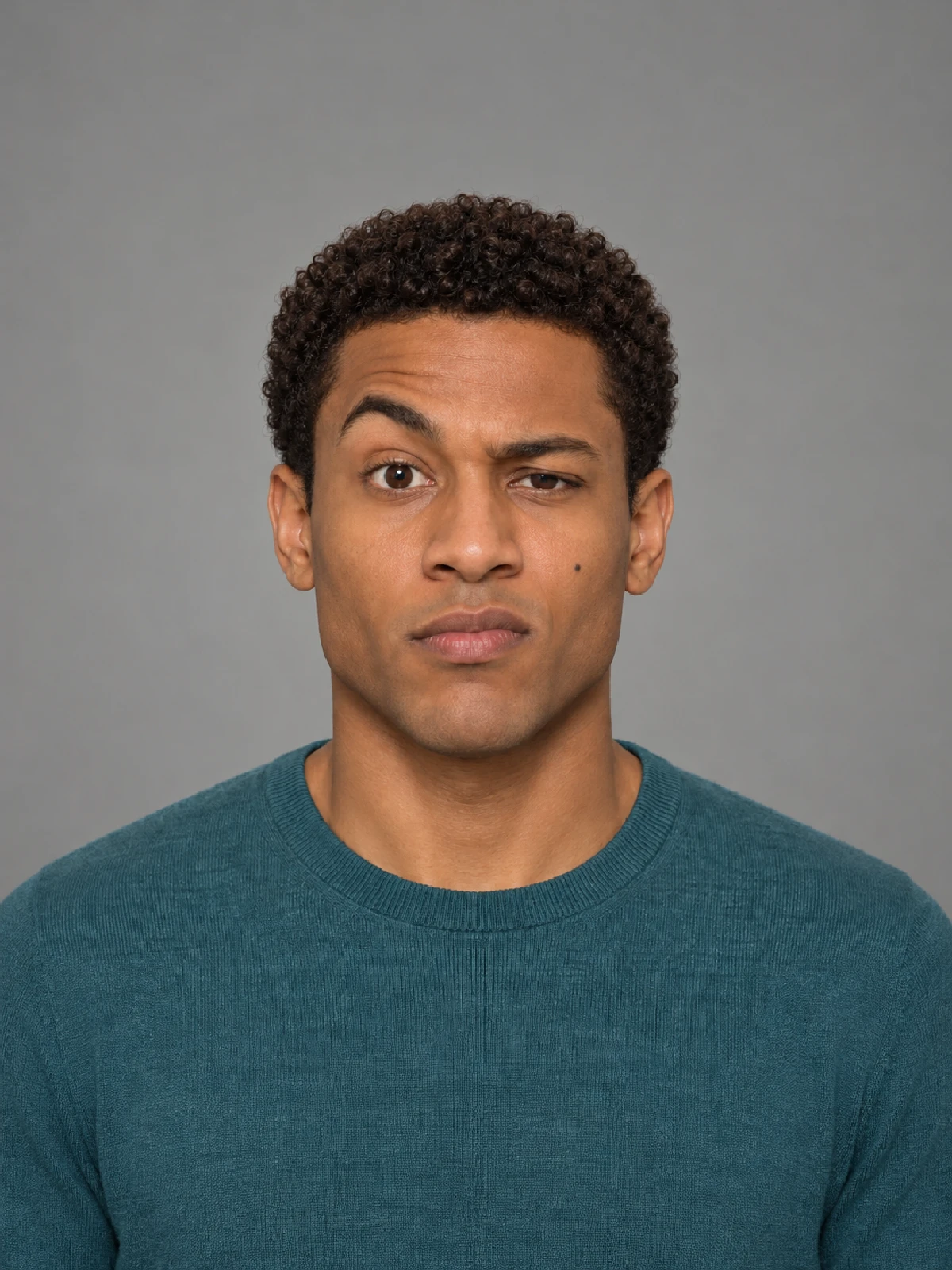
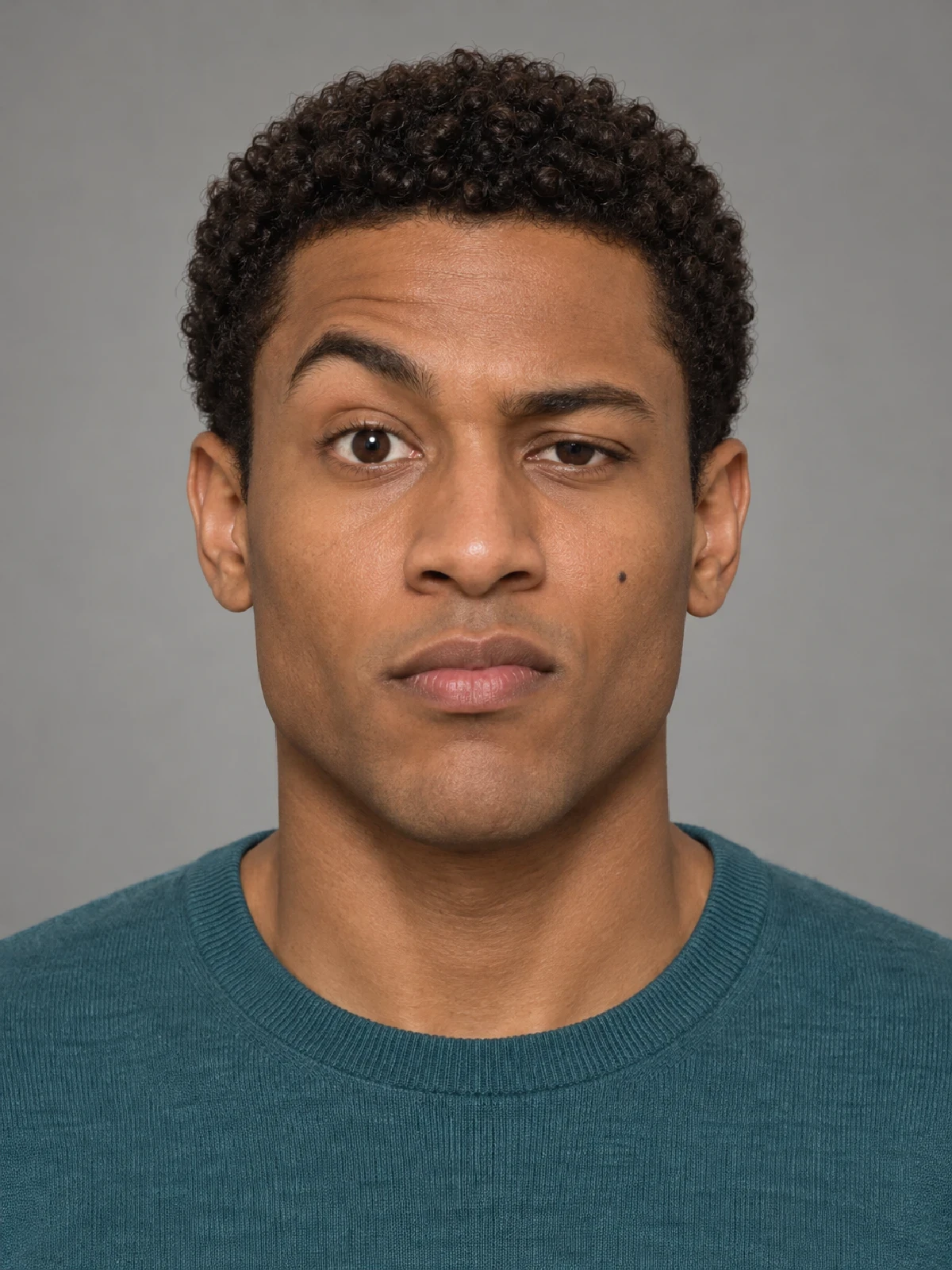
의심하는 성인 · 엇갈린 눈썹과 입술 긴장
한쪽 눈썹 상승과 반대쪽 눈꺼풀·입술 압축을 함께 보여 주는 사진 인물 초상. 얼굴 부위별 비대칭 조절을 분명하게 드러낸다.
이 이미지로 조합하기의심하는 성인 · 엇갈린 눈썹과 입술 긴장
- 형태 언어
- 기하학적 캐리커처 없이 사진식 묘사를 쓴다. 큰 곡면 입체·각진 접합부·구멍·주름을 드러난 크기로 유지한다. 연결 형태마다 경계 상자의 짧은 폭을 S로 삼고 너비 1%S 이상의 구조 특징을 보존한다. 더 작은 표면 요철은 확대된 장식 형태가 되지 않고 부차적으로 남는다.
- 윤곽선
- 외곽 윤곽선·내부 먹선·가늘어지는 그래픽 경계를 그리지 않는다. 인접 표면값으로 경계를 드러내고 실제 가림 전이는 연결 형태 짧은 폭의 0.2–0.5% 안에 둔다. 겹친 가장자리·후광·일정한 어두운 덧선 없이 연속 실루엣과 가는 구조 주름을 보존한다.
- 붓질·입자
- 채색이나 판각 자국 없이 광학적인 사진 세부를 쓴다. 미세하고 불규칙한 재료 요철의 크기는 연결 형태 짧은 폭의 0.3–0.6%이며 반복 덧무늬가 아니라 국소적으로 불규칙하다. 섬유 세부는 기존 표면 곡률을 따르고 매끈한 영역에는 해칭·점찍기·붓점·인공 필름입자가 없다.
- 표면 표현
- 연속적이고 양자화하지 않은 불투명 톤 보간을 쓴다. 넓은 표면 전이는 해당 평면 너비의 5–15%에 걸치고 실제 가림 경계는 좁게 유지한다. 입자 덧무늬 없이 낮은 대비의 불규칙 재료 요철을 남긴다. 평면 톤 띠·포스터화·밀랍 같은 매끈화·반투명 채색 얼룩은 제외한다.
우선순위
드러난 재료 요철과 연속적인 사진 톤을 쓴다.
피할 표현과 결과 확인
삽화 윤곽선·밀랍 같은 피부·양자화한 톤 띠를 피한다.
연속 표면이 그린 윤곽선 없이 미세 요철을 유지한다.
이 예시의 실제 생성 프롬프트
MODULE OWNERSHIP
subject: Subject count, type, stable proportions and landmarks, resting face geometry, hair shape, physical materials, garment construction and permanent marks. No emotion, movement, color assignment or rendering recipe.
expression: Facial soft-tissue displacement and pupil direction, muscle coordination, regional intensity, asymmetry and onset/peak/release. No head/body pose, stable appearance, skin color or rendering.
gesture: Head/neck/body/limb orientation, joint movement, support, contact and pose-caused occlusion using existing anatomy. No eye/pupil movement, emotion, identity, props inventory or camera.
props: Prop count, type, construction, physical material and scale relative to the subject. Holding/contact belongs to gesture, position to composition, color to palette.
scene: Environment elements, terrain, backdrop/floor presence and structural detail. No canvas positions, camera, lighting, assigned colors or render texture.
camera: Projection, focal-length impression, camera elevation/yaw/roll, viewing distance and crop. No actor pose, world placement, lighting or canvas aspect ratio.
composition: Normalized 0-100% canvas positions, scale in frame, depth/overlap, focal hierarchy and margins. No joint pose, camera projection, rendering, subject/prop inventory or emotion.
palette: Color anchors, hue/saturation/value ranges, colors assigned to parts and approximate color coverage. No illumination direction, shading algorithm, physical material or layout.
lighting: Light-source direction/softness/intensity, ambient illumination, physical shadow direction/length and highlight position. Absence of directional illumination is allowed. No shading technique, palette or material changes.
style: Reusable form abstraction, contour weight/taper/edge quality, medium and mark scale/density/direction, surface rendering and tonal transition technique. No fixed subject proportions, anatomy, identity, expression, pose, palette, light-source direction, camera or layout.
output: Image count, aspect ratio, size, file/alpha requirements and global lettering/logo/watermark restrictions. No background scenery, crop, style, identity or pose.

SUBJECT
inventory: Use exactly one original adult human, A, with ordinary bilateral anatomy. Distinguishing anchors are a close curled hair cap, a broad angular jaw and one cheek mole. Anatomical left and right always mean A's own sides; there is no second person, creature or duplicate face.
geometry: Let H be crown-to-chin height. Head width is 0.68–0.74H, standing anatomical height 7.0–7.5H and shoulder width 1.8–2.0H. Hip-joint center spacing is 1.1–1.3H. Neck length from chin underside to sternal notch is 0.35–0.45H; retain ordinary bilateral proportions without enlarged extremities.
geometry: For A, shoulder-joint center to elbow and elbow to wrist each measure 0.9–1.1H; hip-joint center to sole measures 3.5–3.8H. Wrist crease to middle-finger tip is 0.45–0.55H and heel to longest toe is 0.8–0.9H. Corresponding left and right segments share these ranges.
resting-face: A's resting eye width E is 0.18–0.20 of head width. Almond-eye centers lie 0.48–0.52H below the crown; inner gap is 0.9–1.1E and aperture 0.40–0.50E. Straight brows are centered over each eye, 1.1–1.3E long and 0.12–0.16E thick, with their lower edges 0.25–0.35E above the upper lids.
resting-face: A's nose base is 1.0–1.2E wide and brow-to-base length 1.4–1.6E, with a straight bridge and rounded tip projecting 0.50–0.65E beyond the alar base. Closed lips span 1.9–2.1E with level corners, a shallow central notch and curved lower edge. Upper/lower thicknesses are 0.12–0.16E/0.18–0.22E; mouth center is 0.40–0.50E below nose base.
resting-face: A's angular jaw is 80–90% of head width at its angles, narrowing to a flat chin. Oval ears span brow to nose-base height, are 0.6–0.8E wide and project 0.15–0.25E beyond head sides. The even hairline lies 1.5–1.8E above brows without a central peak or shaved notch. Skin has fine pores without scars.
appearance: A has one close hair cap of contiguous short curls, rising 0.12–0.18H above the skull, without a part or facial hair. One permanent round mole lies on the anatomical-left cheek, one resting eye width lateral to the nostril and 0.6 widths below the lower lid; its diameter is 0.08–0.12 eye widths.
appearance: A wears one fine-knit cotton pullover with wrist-length sleeves and hem at the hip-joint level, plus one pair of plain twill trousers. The pullover has one ribbed crewneck, two shoulder seams and two side seams; trousers have one waistband and one fly seam. Feet are bare. Garment fasteners, patches, inscriptions and additional permanent skin marks are absent.

PRIORITY
Preserve the curled cap, angular jaw and single left-cheek mole.

AVOID
Avoid extra moles, facial hair or altered resting eye spacing.

CHECK
One adult retains all three stable identifying anchors.

EXPRESSION — ACTOR A
brows: Raise the anatomical-right brow's medial end by 0.10–0.15 resting eye widths and lateral end by 0.35–0.45 widths. Keep the left brow within 0.03 widths of rest. Preserve inward spacing within 5% of rest; the right outer arch is visibly higher without an inward frown.
lids: Raise the right upper lid 0.05–0.10 resting eye widths while its lower lid stays within 0.02 widths of rest. Lower the left upper lid 0.10–0.15 widths and raise its lower lid 0.03–0.06 widths. Both eyes remain open, with the left aperture visibly narrower.
cheeks: Compress the anatomical-left cheek inward by 0.02–0.04 resting mouth widths, making its existing nasolabial crease more pronounced without lifting the cheek. The right cheek stays within 0.01 mouth widths of rest; neither cheek pushes upward into a smiling lower-lid curve.
nose: Keep both nostril openings and alar positions at rest within 5% of resting nostril width. The nasal base and upper-lip center remain within 0.02 resting mouth widths of rest; do not add nose wrinkling, flare or central upper-lip lift.
mouth: Move the anatomical-left corner inward 0.04–0.06 resting mouth widths; keep its vertical displacement and the right corner within 0.01 widths of rest. Compress left lip thickness to 60–75% of rest while the right stays within 10%. Lips remain closed; teeth and tongue are concealed.
jaw: Keep the mandible closed with zero opening and lateral displacement within 0.02 resting mouth widths. Masseters remain released without a clenching bulge; the chin stays unpuckered. Local lip compression does not pull the whole jaw upward or sideways.
gaze: Place both pupil centers at their sockets' horizontal midpoints within 0.05 resting eye widths and at resting vertical level within 0.03 widths. Both pupils share a forward target despite unequal lid apertures; preserve matched direction without inward convergence.
coordination: Activate right frontalis, left orbicularis oculi and left orbicularis oris together. Keep corrugators, smile elevators and masseters released. The raised right arch opposes left-side lid and lip compression; do not spread either action into a bilateral smile or frown.
timing: Show the apex after the right brow rise and left lid-and-lip compression have reached their specified displacements. Hold this single visible state without residual motion or release; no region receives a second intensity multiplier or an intermediate position.

PRIORITY
Keep the raised brow opposite the compressed lid and lip.

AVOID
Avoid bilateral surprise, a half-smile or jaw clenching.

CHECK
Right brow rise and left compression remain visibly independent.

GESTURE
head: A's head faces world forward with yaw 0° ±5°, pitch 0° ±4° and roll 0° ±3°. The neck's sternal-notch-to-jaw axis remains upright within 5° of world vertical, without forward jutting or side bending; retain the same orientation through the depicted instant.
torso: Keep torso and pelvis upright, facing world forward within 5° of yaw. Shoulder and pelvic lines remain level within 5°, with torso bend and pelvic pitch within 5° of neutral standing. Balance the body above the midpoint between its supporting soles without a unilateral hip shift.
limbs: For both arms, zero is straight down beside the torso, palms inward and hands aligned with forearms. Shoulder flexion, abduction and axial rotation stay within 5°; elbows flex 5–10°. Wrist flexion and deviation stay within 10°. Four-finger joints flex 15–25°; thumbs flex 0–10°, abduct 10–20° and remain unopposed. Retain these states outside the visible area.
limbs: For both legs, zero is upright straight legs with toes world-forward. Hip flexion, abduction and rotation stay within 5°, knees flex 5–10°, and ankle dorsiflexion is 0–5° with roll within 5°. Toe axes face world forward ±5°; foot-center spacing is 0.9–1.1 times hip-joint center spacing. Apply these states to viewer-left and viewer-right chains even outside the view.
contact: Both existing plantar or sole support surfaces rest fully on the floor and share the body's load without lifted heels or toes. Palms face the thighs with a noncontact gap of 0.05–0.10 hand lengths; hands touch neither face nor clothing. No additional support contacts occur, and the body does not lean against the backdrop.

PRIORITY
Keep head, torso and support at an unchanged upright baseline.

AVOID
Avoid a head tilt, shoulder shrug or hand-to-face contact.

CHECK
Head, torso and bilateral support retain upright resting alignment.

PROPS
inventory: The prop inventory is exactly zero. Include no loose accessory, display stand, removable ornament, independent container or accompanying object.
construction: No prop construction has a target because no separate physical item is included. Do not introduce accessory folds, attachments, fasteners or support hardware.

PRIORITY
Maintain the explicit zero-prop inventory.

AVOID
Avoid loose accessories or a separate display stand.

CHECK
No independent accessory or display object is present.

SCENE
inventory: Use exactly one continuous studio sweep containing a floor and upright backdrop as connected environmental surfaces. Furniture, fixtures, plants, windows, doors, terrain and decorative objects are absent; include no separate architectural element.
structure: The horizontal floor curves continuously into the upright backdrop with a bend radius of 0.5–1.0 standing body heights. Both surfaces extend beyond the depicted area without exposed edges. There are no seams, panels, relief, tiles or repeated structural divisions.

PRIORITY
Keep one continuous, undivided studio sweep.

AVOID
Avoid visible fixtures, backdrop seams or decorative scenery.

CHECK
One seamless environmental surface contains floor and backdrop.

CAMERA
projection: Use ordinary perspective with a 100–120 mm full-frame focal-length impression. Facial depth produces modest size differences without wide-angle enlargement; retain perspective rather than orthographic flattening, with no artificial depth exaggeration.
viewpoint: View along world forward at yaw 0° ±3°, eye-level elevation 0° ±3° and roll 0° ±2°. Aim at the eye-line midpoint from 6–8 crown-to-chin heights away. Keep both eyes and both mouth corners equally resolved, without selective near-eye focus.
crop: Retain the complete crown, both ears and chin. The lower edge crosses the chest 0.15–0.75 crown-to-chin heights below the sternal notch; lateral edges may cut through shoulders or upper arms. Do not crop through the face, ears or hair cap.

PRIORITY
Resolve both facial sides equally in a frontal chest portrait.

AVOID
Avoid wide-angle facial distortion or one-eye focus falloff.

CHECK
The complete head and both facial sides remain readable.

COMPOSITION
placement: Use top-left normalized 0–100% coordinates. Place the center of the visible head envelope at x=50%, y=35%, allowing 5 percentage points of displacement. Existing environmental surfaces cover the remaining canvas. Use one borderless panel without inset images.
depth: A has sole focal priority and precedes the environmental surfaces in depth. Preserve intrinsic self-occlusion; no independently placed element may obscure the focal silhouette. The existing floor-to-backdrop continuity remains behind it without a competing focal boundary.
spacing: Measure the head envelope from its uppermost silhouette point to chin: height 50% ±5 percentage points of canvas height, strictly 45–55%. Derive width and A's remaining silhouette by one uniform scale. Keep the envelope inside a 5% edge inset; the remaining silhouette may intersect side and bottom edges. Containment must not relax the height range.

PRIORITY
Preserve the 45–55% head height and standalone centered placement.

AVOID
Avoid oversized head occupancy, competing panels or external silhouette obstructions.

CHECK
Head height is 45–55%; its envelope stays within the 5% edge inset.

PALETTE
colors: Use skin #B98266, brown #3C2C26, teal #385B5D, gray #8B8C87, ivory #ECE7DF, lip #955E58 and iris #604C38. Permit continuous mixtures among these anchors for all derived shades and boundaries. Keep dominant regional hues within their assigned families; add no extra hue family.
assignment: Assign skin to flesh and nails; brown to hair, brows, pupils, mole and oral interiors; lip to vermilion; iris to irises; ivory to sclerae and teeth; teal to the pullover; brown to trousers; gray to floor and backdrop. Seams inherit their garment family; resolved boundaries inherit adjoining region families.
balance: Coverage follows actual region areas and closes to approximately 100% through the seven families and permitted mixtures. Newly exposed or occluded portions retain their parent assignment. There is no independent accent family, contour-color family or unrelated reflected hue.

PRIORITY
Keep regional color identities through all derived shades.

AVOID
Avoid colored light accents or unrelated background hues.

CHECK
Every visible region and boundary belongs to an assigned family.

LIGHTING
sources: Use one broad rectangular source along world forward, yaw 0° ±5° and elevation 20–30°. Its apparent angular width is 45–60°. Uniform ambient illumination is 45–55% of key strength; include no secondary directional source, rim light or lower reflector.
shadows: Cast shadows travel world-backward and downward. Visible facial shadows reach 0.3–0.5 nose-base widths with penumbrae 0.2–0.4 widths broad. Contact shadows stay at real junctions and fade within 10–20% of the contacted component's short span; neither facial side receives a hard dark division.
highlights: Use broad highlights across forehead, nose bridge and upper cheeks, spanning 1–2 resting eye widths at 1.15–1.30 times adjacent lit-skin brightness. Each eye has one upper-central catchlight, 0.12–0.18 iris diameters wide. No sharp cheek glare or luminous rim is present.

PRIORITY
Keep broad frontal illumination readable on both facial sides.

AVOID
Avoid a hard split, multiple catchlights or strong rim light.

CHECK
Soft facial shadows and one catchlight per eye agree with one source.

STYLE GUIDE
form-language: Use photographic description without geometric caricature. Retain major curved volumes, angular junctions, openings and folds at their resolved sizes. For each connected form, let S be its shorter bounding-box span; preserve structural features at least 1%S wide, while finer surface relief remains subordinate rather than becoming enlarged decorative shapes.
contour: Draw no exterior outline, interior ink stroke or tapered graphic edge. Resolve boundaries through adjacent surface values, keeping true occlusion transitions within 0.2–0.5% of each connected form's short span. Preserve continuous silhouettes and fine structural creases without doubled edges, halos or uniform dark tracing.
mark-making: Use optical photographic detail with no painted or engraved marks. Fine irregular material relief occupies 0.3–0.6% of each connected form's short span and remains locally irregular, not a repeated overlay. Fibrous detail follows existing surface curvature; smooth regions stay free of hatching, stipple, brush dabs and artificial film grain.
surface-rendering: Use continuous, unquantized opaque tonal interpolation. Broad surface transitions span 5–15% of the local plane width, while actual occlusion edges remain narrow. Retain subdued irregular material relief without a grain overlay. Exclude flat tonal bands, posterization, waxlike smoothing and translucent painted patches.

PRIORITY
Use continuous photographic tones with resolved material relief.

AVOID
Avoid illustrated outlines, waxy skin or quantized tonal bands.

CHECK
Continuous surfaces retain fine relief without drawn outlines.

OUTPUT
format: Deliver exactly one raster image, 1200 × 1600 pixels, with a 3:4 aspect ratio, encoded as PNG. Use fully opaque pixels with no alpha transparency; export no mockup, contact sheet or supplementary image.
restrictions: Include no lettering, numbers, logos, signatures or watermarks anywhere in the image. Add no company name, slogan, annotations, interface elements or export labels; deliver only the finished image.

PRIORITY
Deliver one opaque PNG at the specified dimensions.

AVOID
Avoid typography, commercial logos or supplemental mockups.

CHECK
One opaque 1200 × 1600 PNG contains no lettering.

FINAL INTEGRATION
expression + gesture + camera: The upright frontal presentation projects anatomical-right brow elevation mainly to viewer-left and anatomical-left lid and lip compression to viewer-right. Matched pupil direction and unchanged head pose keep the regional asymmetry independently readable.
subject + camera + composition: Apply one framing scale to A uniformly. Resolve the standalone head center and contained height together with the existing neck proportions and permitted chest-edge interval. Preserve the complete head envelope and anatomical proportions while allowing shoulder intersections.
expression + lighting + style + palette: Broad frontal light reveals unequal lid apertures and localized lip compression without a hard shadow division. Continuous photographic transitions use permitted anchor mixtures, preserving facial relief rather than replacing muscle displacement with drawn marks.
subject + composition + palette + style: Edit the failed image: retain the curls, angular jaw, single left-cheek mole, assigned colors and photographic surfaces. Reduce the oversized head occupancy by uniformly scaling A to the composition target and restoring surrounding space. No mark-length, cap or surface correction is needed.
expression + composition + lighting + style: Preserve the readable viewer-left brow rise and viewer-right narrowed lid during the edit. The subtler viewer-right lip tension must remain legible at the restored scale through the unchanged inward-corner and lip-thinning targets, soft illumination and photographic relief.
모델명은 이미지 출처 정보 기준입니다. 같은 프롬프트를 사용해도 결과는 달라질 수 있습니다.