텍스트 → 이미지캐릭터스타일 가이드
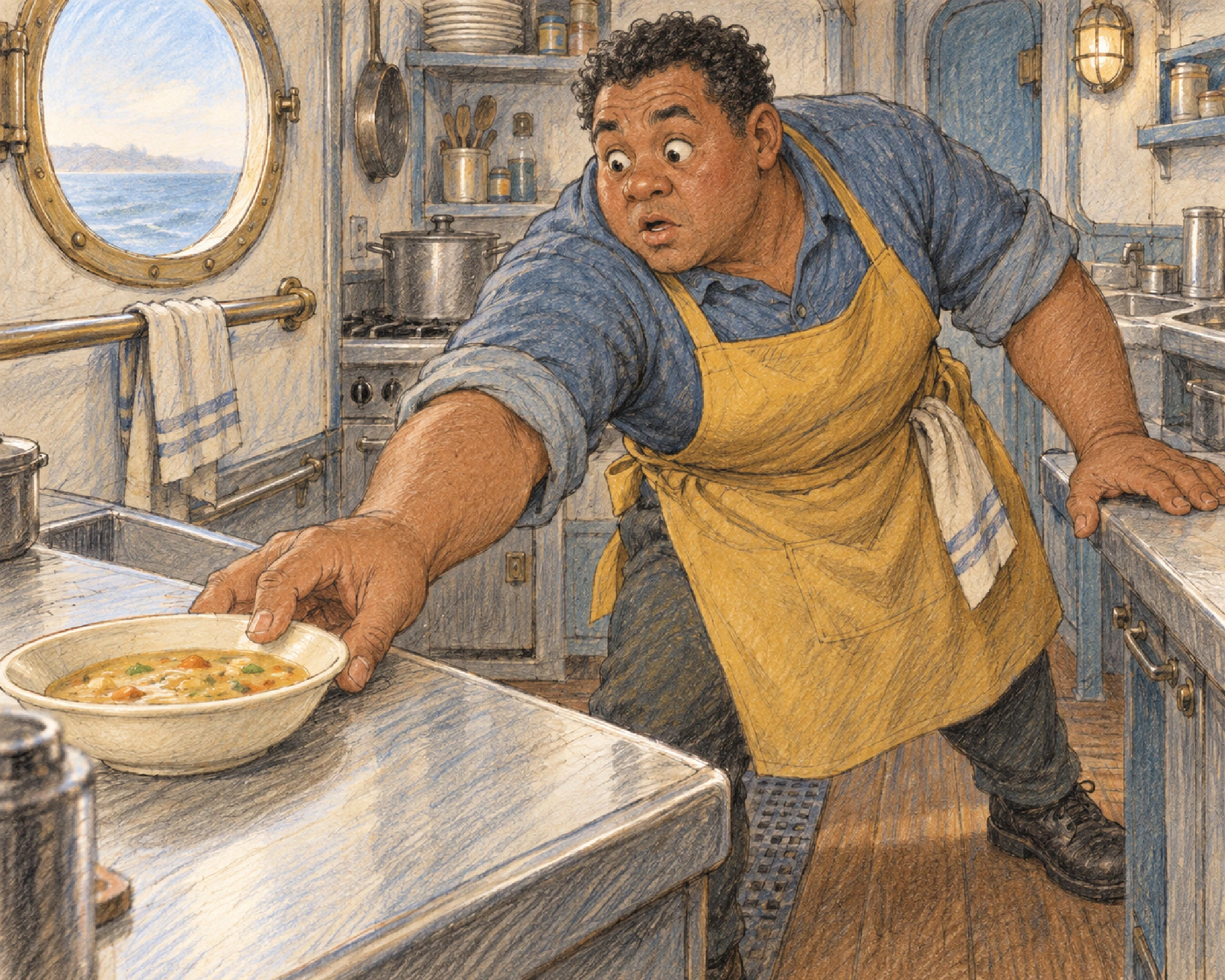
미끄러지는 국그릇을 잡는 선상 요리사
좁은 배의 주방에서 미끄러지는 국그릇을 붙잡는 요리사. 겹치는 조리대와 몸의 움직임을 거친 연필선과 성긴 색연필 층으로 담은 생동감 있는 완성 일러스트.
이 이미지로 조합하기미끄러지는 국그릇을 잡는 선상 요리사
- 형태 언어
- 형태를 묵직한 덩어리와 탄력 있는 곡선으로 줄이고 정교한 기하학적 대칭보다 생동하는 불규칙성을 남긴다.
- 윤곽선
- 압력 변화, 간헐적인 이중선, 형태가 읽히는 곳의 열린 끊김을 가진 탐색적인 흑연 윤곽선을 쓴다.
- 붓질·입자
- 빠른 흑연 해칭 위에 느슨한 색연필 쓸기 자국을 겹치고 각 부분에 따라 획의 길이와 방향이 자연스럽게 달라지게 한다.
- 표면 표현
- 종이 결이 보이는 불균일한 반투명 색층을 쌓고 성긴 겹침 획과 문지른 흑연으로 명암 전환을 부드럽게 한다.
우선순위
스케치북 드로잉의 눈에 보이는 속도감과 마찰감을 유지한다.
피할 표현과 결과 확인
균일하게 정리된 윤곽선과 완전히 막힌 불투명 채움을 피한다.
선과 색이 하나의 일관된 드로잉 언어 안에서 자연스러운 변화를 유지한다.
이 예시의 실제 생성 프롬프트
MODULE OWNERSHIP
subject: Subject count, type, stable proportions and landmarks, resting face geometry, hair shape, physical materials, garment construction and permanent marks. No emotion, movement, color assignment or rendering recipe.
expression: Facial soft-tissue displacement and pupil direction, muscle coordination, regional intensity, asymmetry and onset/peak/release. No head/body pose, stable appearance, skin color or rendering.
gesture: Head/neck/body/limb orientation, joint movement, support, contact and pose-caused occlusion using existing anatomy. No eye/pupil movement, emotion, identity, props inventory or camera.
props: Prop count, type, construction, physical material and scale relative to the subject. Holding/contact belongs to gesture, position to composition, color to palette.
scene: Environment elements, terrain, backdrop/floor presence and structural detail. No canvas positions, camera, lighting, assigned colors or render texture.
camera: Projection, focal-length impression, camera elevation/yaw/roll, viewing distance and crop. No actor pose, world placement, lighting or canvas aspect ratio.
composition: Normalized 0-100% canvas positions, scale in frame, depth/overlap, focal hierarchy and margins. No joint pose, camera projection, rendering, subject/prop inventory or emotion.
palette: Color anchors, hue/saturation/value ranges, colors assigned to parts and approximate color coverage. No illumination direction, shading algorithm, physical material or layout.
lighting: Light-source direction/softness/intensity, ambient illumination, physical shadow direction/length and highlight position. Absence of directional illumination is allowed. No shading technique, palette or material changes.
style: Reusable form abstraction, contour weight/taper/edge quality, medium and mark scale/density/direction, surface rendering and tonal transition technique. No fixed subject proportions, anatomy, identity, expression, pose, palette, light-source direction, camera or layout.
output: Image count, aspect ratio, size, file/alpha requirements and global lettering/logo/watermark restrictions. No background scenery, crop, style, identity or pose.

SUBJECT
inventory: A is one original adult ferry cook; no other people or animals appear.
geometry: A has a broad, sturdy build, a short neck, substantial hands, and a rounded rectangular head.
resting-face: The resting face has straight brows, wide-set almond eyes, a broad nose, and a full lower lip.
appearance: Short cropped curls, a woven shirt with rolled cuffs, a bib apron, and closed work shoes define A.

PRIORITY
Keep the sturdy cook recognizable through the broad head and substantial hands.

AVOID
Avoid a generic slender fashion figure.

CHECK
The cook's construction remains coherent wherever visible.

EXPRESSION — ACTOR A
brows: Both brows lift, with a slightly quicker rise on the bowl-facing side.
lids: Upper lids open wider while lower lids retain light tension.
cheeks: Cheeks stay largely relaxed, without a smile-driven lift.
nose: The nose remains unwrinkled, with only a small nostril opening.
mouth: Lips part into a small uneven oval, as if an exclamation has just begun.
jaw: The jaw releases slightly without a large drop.
gaze: Both pupils focus on the bowl.
coordination: The alert upper face leads the smaller mouth response.
timing: Capture the first readable instant of surprise before full alarm.

PRIORITY
Make the sudden recognition readable through the upper face.

AVOID
Avoid a screaming mouth or uniformly maximal facial tension.

CHECK
The gaze and facial response belong to one brief interruption.

GESTURE
head: A turns the head downward toward the reaching hand, keeping the neck connected to the shoulder sweep.
torso: The torso bends sideways across the work surface, with the shoulders advancing ahead of the hips.
limbs: One arm reaches across the body; the other bends to brace. A visible foot plants firmly beneath the body.
contact: The reaching fingers catch the near rim to stop the bowl's slide; the opposite palm presses against the counter.

PRIORITY
Unite the reaching arm and braced body into one quick recovery.

AVOID
Avoid detached hands or an unsupported sideways lean.

CHECK
The two visible contacts explain the body's balance.

PROPS
inventory: One shallow soup bowl contains a small serving of thick soup; no other separate props are needed.
construction: The bowl is glazed ceramic with a broad open rim, sized to fit comfortably between A's hands.

PRIORITY
Give the bowl an immediately readable open rim.

AVOID
Avoid decorative tableware that distracts from the incident.

CHECK
The bowl reads as practical galley tableware.

SCENE
inventory: A compact ferry galley contains a work counter, inset stove, wall shelf, handrail, porthole, and floor.
structure: Rounded wall junctions and a raised counter lip establish a cramped working cabin; minor fittings may vary.

PRIORITY
Make the galley feel compact and actively used.

AVOID
Avoid a spacious domestic kitchen.

CHECK
The porthole and fitted surfaces establish the ferry setting.

CAMERA
projection: Use natural perspective with a moderately wide focal-length impression.
viewpoint: View from slightly above counter height at a three-quarter yaw, with no camera roll.
crop: Use an environmental full-figure crop; cabin edges may leave the frame.

PRIORITY
Keep the reaching action and working space legible together.

AVOID
Avoid extreme wide-angle distortion.

CHECK
The crop includes enough of the figure to explain the action.

COMPOSITION
placement: A occupies the right half; the bowl anchors the lower-left area. The face and reaching hand lead attention.
depth: The foreground counter overlaps the lower body; the apron sits behind the arm, with cabin fittings farther back.
spacing: Leave breathing room around the face and catching hand while letting peripheral forms crowd the edges.

PRIORITY
Build a clear visual passage from face through hand to bowl.

AVOID
Avoid tangencies that merge the hand with the counter edge.

CHECK
Overlaps enrich the narrative without burying its focal contact.

PALETTE
colors: Use graphite gray, mustard yellow, muted sea blue, warm sienna, and paper cream.
assignment: Assign mustard to the apron, sea blue to the shirt and cabin accents, sienna to skin, and cream to the bowl.
balance: Paper cream and muted neutrals dominate; mustard provides the strongest warm accent.

PRIORITY
Let mustard carry the character's main color identity.

AVOID
Avoid equally saturated colors across every cabin surface.

CHECK
The warm character separates clearly from the quieter cabin colors.

LIGHTING
sources: Broad, soft daylight enters from the porthole side, supported by gentle cabin ambient light.
shadows: Short, soft shadows fall away from the porthole beneath the bowl, hands, and counter lip.
highlights: Keep modest highlights on the window-facing cheek, knuckles, and bowl rim.

PRIORITY
Use soft side light to clarify the catching contact.

AVOID
Avoid theatrical spotlights or sharp competing shadows.

CHECK
Visible highlights and shadows agree with the porthole light.

STYLE GUIDE
form-language: Reduce forms to weighty blocks and elastic curves, retaining lively irregularities rather than polished geometric symmetry.
contour: Use searching graphite contours with pressure changes, occasional doubled edges, and open breaks where forms remain clear.
mark-making: Layer loose colored-pencil sweeps over quick graphite hatching; let stroke length and direction vary naturally with each passage.
surface-rendering: Build uneven translucent color layers with visible paper tooth; soften tonal turns through sparse overlapping strokes and rubbed graphite.

PRIORITY
Preserve the visible speed and friction of sketchbook drawing.

AVOID
Avoid uniformly cleaned outlines and sealed opaque fills.

CHECK
Line and color retain natural variation within one coherent drawing language.

OUTPUT
format: One finished image, landscape 5:4, 2000 × 1600 pixels, opaque PNG.
restrictions: No lettering, logos, signatures, or watermarks.

PRIORITY
Deliver one complete illustration.

AVOID
Avoid reference sheets or multiple panels.

CHECK
The export matches the requested image format.

FINAL INTEGRATION
expression + gesture: Facial acting and bodily action should feel like simultaneous parts of one interrupted task.
composition + style: The drawing's looseness should support the focal hierarchy without requiring uniform detail.
모델명은 이미지 출처 정보 기준입니다. 같은 프롬프트를 사용해도 결과는 달라질 수 있습니다.