텍스트 → 이미지카페 · 브랜드스타일 가이드
동네 찻집 · 음각 잎 엠블럼
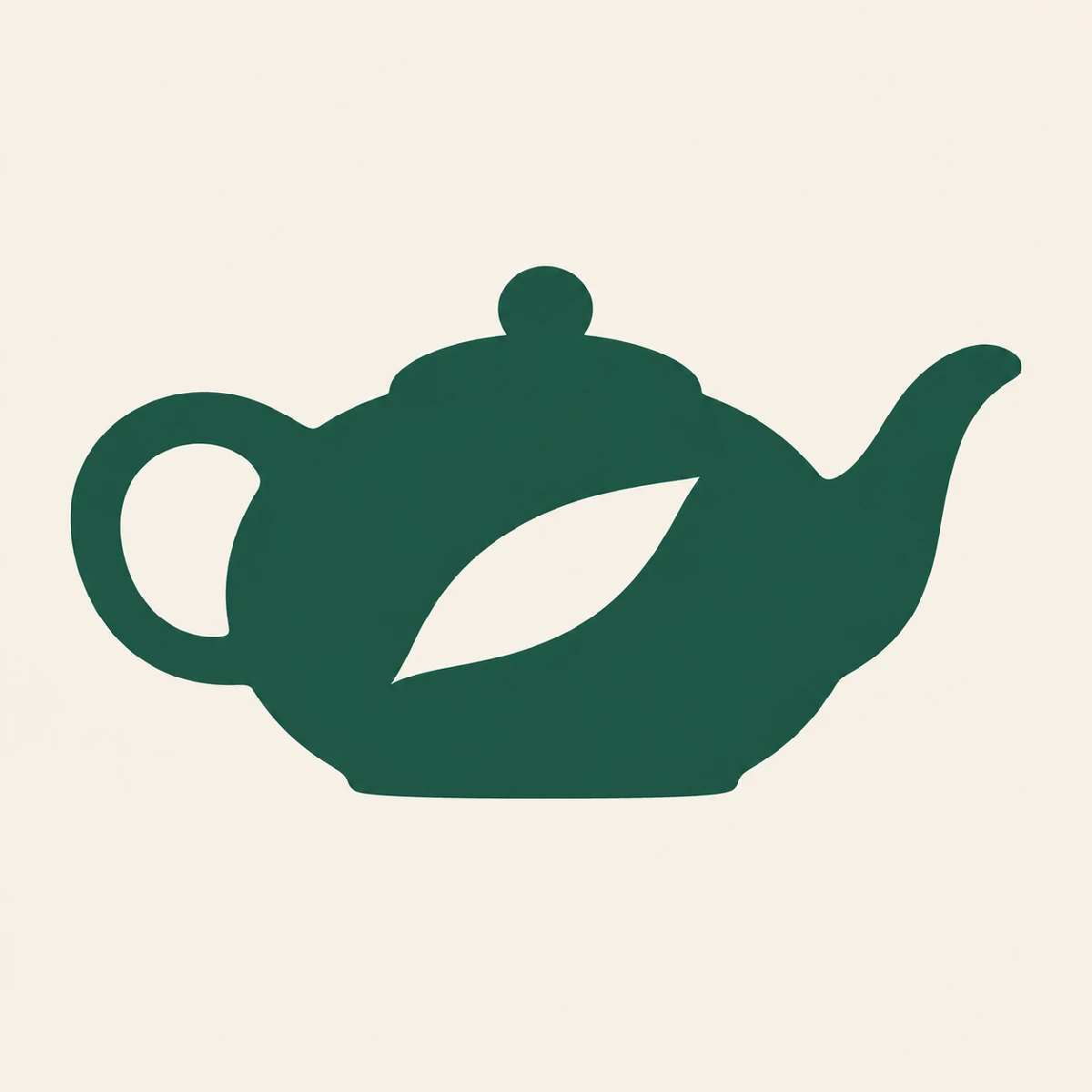
하나로 연결된 찻주전자 실루엣 안에 잎 모양 여백을 남겨, 바탕이 두 번째 상징으로 읽히는 브랜드 마크.
동네 찻집 · 음각 잎 엠블럼
- 형태 언어
- 알아볼 수 있는 형태를 연결된 채움 덩어리와 의도적으로 만든 빈 구멍으로 단순화한다. 주요 실루엣 특징과 개구부는 남기고 각 연결 형태 너비의 3%보다 작은 세부는 생략한다. 넓은 볼록 곡선을 쓰며 뾰족한 끝은 좁아지는 구멍에만 남기고 장식적인 물결은 넣지 않는다.
- 윤곽선
- 외곽선과 내부 선을 그리지 않고 채움 영역의 경계만 사용한다. 곡선 경계는 연속으로, 연결은 매끄럽게, 의도한 뾰족한 끝은 날카롭게 유지한다. 각 연결 형태 너비의 0.2% 이하인 좁은 래스터 안티앨리어싱만 허용하며 어긋난 선, 가늘어지는 잉크선과 이중 경계는 없다.
- 붓질·입자
- 붓, 펜, 입자, 해칭과 점찍기 흔적이 전혀 없는 깨끗한 디지털 종이 오리기 방식을 사용한다. 보통 표시 크기에서 채운 내부와 빈 구멍은 모두 무늬 없이 유지한다. 표면 모티프를 반복하지 않고 완전한 채움 영역의 경계만 보이게 한다.
- 표면 표현
- 실체 덩어리와 빈 바탕에 각각 하나씩, 정확히 두 평면 명도 등급을 사용한다. 각 등급 내부는 균일하고 급격한 경계에는 래스터 안티앨리어싱만 적용한다. 닫힌 구멍 전체는 빈 바탕 등급을 따르며 그라데이션, 양각, 입자와 중간 내부 명도 띠는 금지한다.
우선순위
닫힌 여백이 의도한 두 번째 형태로 읽히게 한다.
피할 표현과 결과 확인
평평한 채움 영역을 윤곽선 그림으로 바꾸지 않는다.
축소해도 실체와 깨끗한 빈 구멍이 구분된다.
이 예시의 실제 생성 프롬프트
MODULE OWNERSHIP
subject: Subject count, type, stable proportions and landmarks, resting face geometry, hair shape, physical materials, garment construction and permanent marks. No emotion, movement, color assignment or rendering recipe.
expression: Facial soft-tissue displacement and pupil direction, muscle coordination, regional intensity, asymmetry and onset/peak/release. No head/body pose, stable appearance, skin color or rendering.
gesture: Head/neck/body/limb orientation, joint movement, support, contact and pose-caused occlusion using existing anatomy. No eye/pupil movement, emotion, identity, props inventory or camera.
props: Prop count, type, construction, physical material and scale relative to the subject. Holding/contact belongs to gesture, position to composition, color to palette.
scene: Environment elements, terrain, backdrop/floor presence and structural detail. No canvas positions, camera, lighting, assigned colors or render texture.
camera: Projection, focal-length impression, camera elevation/yaw/roll, viewing distance and crop. No actor pose, world placement, lighting or canvas aspect ratio.
composition: Normalized 0-100% canvas positions, scale in frame, depth/overlap, focal hierarchy and margins. No joint pose, camera projection, rendering, subject/prop inventory or emotion.
palette: Color anchors, hue/saturation/value ranges, colors assigned to parts and approximate color coverage. No illumination direction, shading algorithm, physical material or layout.
lighting: Light-source direction/softness/intensity, ambient illumination, physical shadow direction/length and highlight position. Absence of directional illumination is allowed. No shading technique, palette or material changes.
style: Reusable form abstraction, contour weight/taper/edge quality, medium and mark scale/density/direction, surface rendering and tonal transition technique. No fixed subject proportions, anatomy, identity, expression, pose, palette, light-source direction, camera or layout.
output: Image count, aspect ratio, size, file/alpha requirements and global lettering/logo/watermark restrictions. No background scenery, crop, style, identity or pose.

SUBJECT
inventory: Create exactly one original graphic emblem, identifier S: a teapot with one body, one lid, one lid knob, one spout and one loop handle. Its two enclosed openings are the handle counter and one leaf-shaped body knockout. No additional motifs exist.
geometry: Use body width B as the baseline. The low oval body is 0.55–0.65B high, with a flat base 0.45–0.55B wide. Center a shallow domed lid 0.45–0.55B wide and 0.08–0.12B high on the upper shoulder. Its rounded knob is 0.08–0.12B wide and high. Keep shoulder, lid and knob continuously connected.
geometry: The left handle projects 0.20–0.25B beyond the body, is 0.40–0.50B high and is centered at body midheight; two bridges are each 0.08–0.12B thick. The rising right spout projects 0.25–0.35B, joins the upper-right shoulder through a neck 0.15–0.20B thick and ends in a rounded tip 0.65–0.75B above the flat base.
geometry: The loop handle band has a uniform thickness of 0.06–0.08B, measured perpendicular to its curved centerline. Keep one closed, uninterrupted handle counter without subdivisions.
geometry: Center one curved lanceolate leaf cavity inside the body. Its length is 0.40–0.46B, widest span 0.16–0.20B, and long axis rises 30–40 degrees toward the right. Both ends taper to points; retain a solid band at least 0.10B wide around it. Add no vein or separate stem.
appearance: S is a designed graphic mark without a physical substrate. All teapot parts belong to one uninterrupted solid mass; its two cavities remain open. There are no surface decorations, inscriptions, material joints, wear marks or additional attached pieces.

PRIORITY
Preserve the connected teapot mass and both distinct enclosed cavities.

AVOID
Do not split the lid, handle or spout into detached symbols.

CHECK
One teapot and one pointed leaf cavity are recognizable without decoration.

GESTURE
head: S has no head or neck articulation; head yaw, pitch, roll and neck flexion have no existing control targets. No separate head-bearing segment receives an articulated orientation.
torso: Orient the entire planar mark with its intrinsic flat-base axis horizontal, in-plane rotation 0 degrees with a 3-degree tolerance. Torso and pelvis joints have no targets; apply no out-of-plane tilt or whole-mark bending.
limbs: S has no articulated limb or digit targets; shoulder, elbow, wrist, hip, knee, ankle and finger rotations are inapplicable. No joint displacement or articulated limb pose is applied.
contact: The planar mark has no physical support surface or load-bearing contact target. No palm, sole, grasp or resting contact is applied; this is an unsupported graphic orientation rather than a physical contact pose.

PRIORITY
Keep the intrinsic base axis horizontal within the stated rotation range.

AVOID
Do not rotate the whole mark onto a diagonal base axis.

CHECK
The flat-base axis is horizontal and no physical contact pose is depicted.

PROPS
inventory: The prop inventory is exactly zero. Include no separate cup, saucer, packaging, sign, supporting stand or accessory; no removable or carried item is assigned to the prop inventory.
construction: With zero props, there is no prop construction target. Introduce no accessory materials, seams, fasteners, attachments or distinguishing marks that would create an additional item.

PRIORITY
Keep the accessory inventory completely empty.

AVOID
Do not add a mockup object or branded packaging.

CHECK
No separate accessory is visible anywhere.

SCENE
inventory: Use exactly one plain, continuous backdrop as the entire environment. Include no floor, tabletop, wall, landscape, building, vegetation or decorative environmental element.
structure: The backdrop has no structural divisions: no horizon, corners, surface junctions, architectural openings or repeated elements. It remains one uninterrupted field with no environmental depth cues.

PRIORITY
Maintain a single uninterrupted environmental field.

AVOID
Do not introduce a tabletop or presentation wall.

CHECK
The environment contains no structural boundary.

CAMERA
projection: Use orthographic projection perpendicular to the graphic plane. Omit focal-length perspective entirely; parallel features do not converge, and no near-to-far enlargement occurs.
viewpoint: View the graphic plane along its normal: yaw and elevation are each 0 degrees with a 3-degree tolerance, and roll is 0 degrees with a 2-degree tolerance. Viewing distance introduces no foreshortening.
crop: Show the complete graphic subject, including the outer handle curve, spout tip, lid knob and flat base. Do not cut through any exterior extremity or enclosed opening.

PRIORITY
Keep the complete planar mark free of foreshortening.

AVOID
Do not use an angled mockup or close crop.

CHECK
Every exterior extremity and both cavities remain visible.

COMPOSITION
placement: With top-left coordinates from 0–100%, center S at (50%, 50%) with a 5-percentage-point tolerance. Target complete silhouette width at 80% of canvas width, with a 10-point tolerance; derive height by uniform scaling.
depth: Use one graphic plane over the continuous backdrop. S is the sole focal element; its enclosed openings expose the underlying field. No independently placed element may overlap or obstruct its silhouette.
spacing: Contain the complete silhouette within 5% edge margins. Uniform-scale containment takes precedence over nominal fill if the silhouette changes. Keep the remaining field empty; use no border or panel divisions.

PRIORITY
Preserve a comfortably contained complete silhouette.

AVOID
Do not enlarge separate components independently.

CHECK
The complete mark fits without touching an image edge.

PALETTE
colors: Use two anchors only: deep green #204F42 and warm ivory #F5F0E7. Permit mixtures between these anchors at their shared boundaries; prohibit independent additional hues and unrelated value variants.
assignment: Assign deep green to every solid region of S, including all attachments and exterior boundaries. Assign warm ivory to the backdrop, handle counter and leaf cavity. No part receives an independent accent color.
balance: Color coverage follows the actual solid and open region areas: all solid area is green and all remaining area is ivory. These assignments together cover 100% of the image, including permitted boundary mixtures.

PRIORITY
Keep both cavities identical in color to the backdrop.

AVOID
Do not color the leaf cavity as a separate object.

CHECK
Only the two anchors and their boundary mixtures appear.

LIGHTING
sources: Treat the artwork as deliberately unlit flat graphics. Use zero physical light sources and zero directional ambient gradients; illumination does not vary across any solid or open region.
shadows: Cast shadows and contact shadows are absent everywhere. No attachment, cavity edge or exterior boundary produces a directional shadow, depth darkening or shadow extension.
highlights: Physical highlights are absent on every region. Include no reflective stripe, bright rim, illuminated edge or localized hotspot; all regions retain uniform illumination.

PRIORITY
Maintain directionless, uniform illumination throughout.

AVOID
Do not add bevel lighting or an embossed shadow.

CHECK
No physical highlight or shadow is visible.

STYLE GUIDE
form-language: Reduce recognizable forms to connected filled masses and deliberately shaped negative cavities. Retain major silhouette landmarks and openings; omit details smaller than 3% of each connected form's width. Use broad convex curves, with pointed terminals reserved for tapered cavities and no decorative scalloping.
contour: Use filled-area boundaries without exterior or interior outline strokes. Keep curved boundaries continuous, joins smooth and intentional pointed tips sharp. Allow a narrow raster antialias fringe no wider than 0.2% of the connected form's width; add no offset outline, tapering ink stroke or doubled edge.
mark-making: Use a clean digital cut-paper graphic method with zero visible brush, pen, grain, hatch or stipple marks. Filled interiors and negative cavities remain entirely unmarked at ordinary display scale. Repeat no surface motif; the only visible edges belong to the boundaries of complete filled regions.
surface-rendering: Render exactly two flat tonal classes: one for occupied masses and one for open fields. Each class is internally uniform, with an abrupt boundary softened only by raster antialiasing. Enclosed knockouts use the open-field class throughout; prohibit gradients, bevels, grain and intermediate interior tone bands.

PRIORITY
Make enclosed negative shapes read as deliberate secondary forms.

AVOID
Do not turn flat filled regions into outlined drawings.

CHECK
Solid masses and clean knockouts remain distinct at reduced size.

OUTPUT
format: Deliver exactly one 1200 × 1200 pixel raster image, aspect ratio 1:1, as a PNG file. Use a fully opaque image with no alpha transparency and no additional exported variants.
restrictions: Exclude lettering, numerals, additional logos, signatures and watermarks. Also exclude multiple-image sheets, alternate versions and file-format overlays; supply no captions or identifying labels.

PRIORITY
Export one fully opaque PNG at the specified size and aspect ratio.

AVOID
Do not add a business name or presentation caption.

CHECK
One square PNG has no alpha or unwanted lettering.

FINAL INTEGRATION
subject + palette + style: Render the specified leaf cavity with the open-field tonal class and backdrop assignment, so the leaf reads through absence while the surrounding teapot remains one connected mass.
palette + style: Use the permitted anchor mixtures only for the specified antialiased boundaries; neither flat interior gains an additional tonal class.
모델명은 이미지 출처 정보 기준입니다. 같은 프롬프트를 사용해도 결과는 달라질 수 있습니다.