Text to imageArt stylesStyle guide
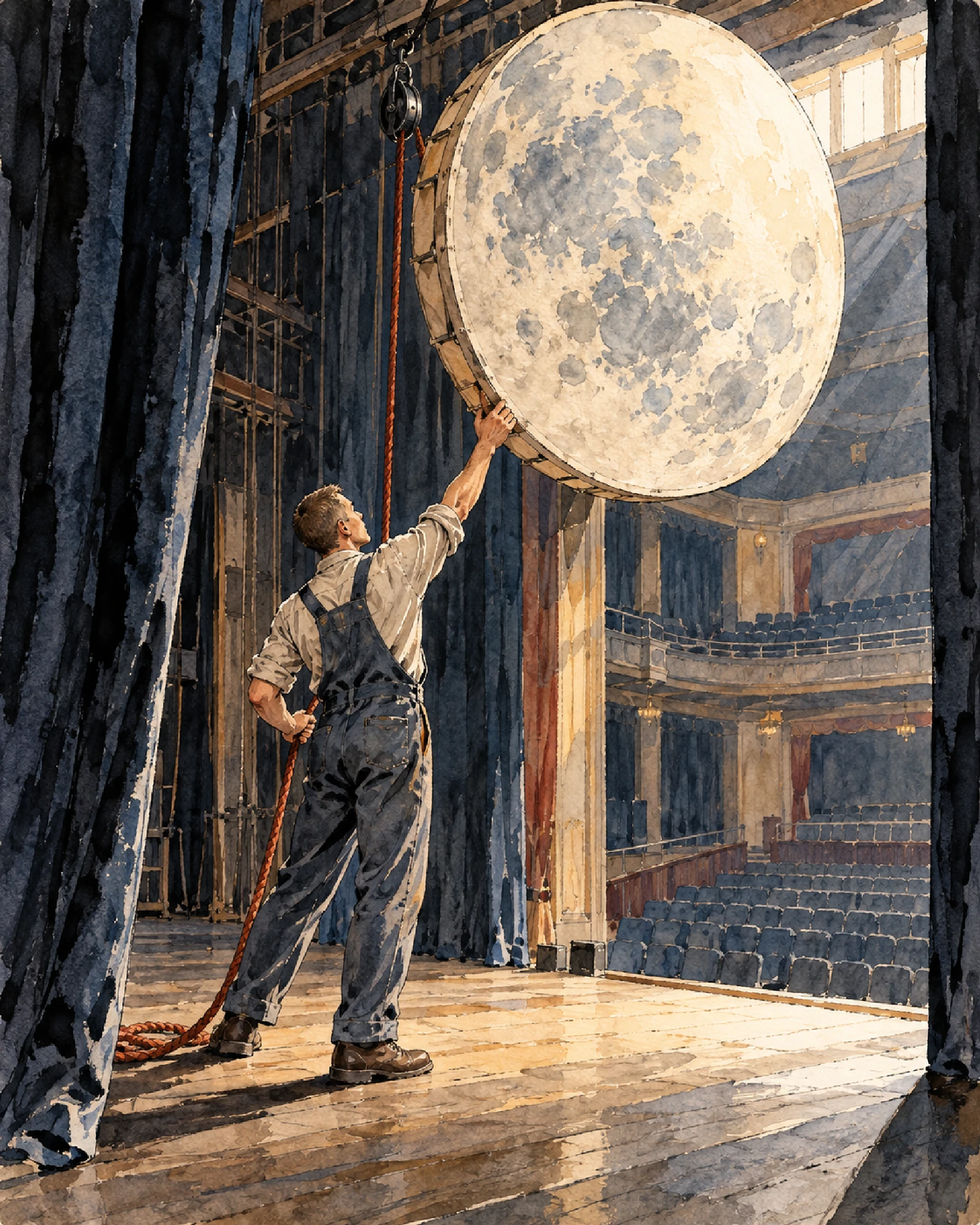
Stagehand Raising a Paper Moon
A stagehand raises an enormous paper moon between the layered wings of an empty theater. Splintered brush lines, spreading ink washes, and generous bare paper connect the depth of the stage to the working gesture.
Remix this referenceStagehand Raising a Paper Moon
- Form language
- Reduce forms to broad, slightly irregular masses; let secondary structures dissolve into suggestive fragments.
- Contour
- Use pressure-changing brush contours that taper, split, and disappear; keep crisp ink edges at selected junctions.
- Mark-making
- Combine long, economical ink strokes with occasional dry-brush skips; allow natural variation in stroke width and spacing.
- Surface rendering
- Float transparent washes into uneven pooled edges, retaining bare paper between tones and soft blooms within broad passages.
Priority
Make editorial ink wash visible through broken brushwork, pooled washes, and exposed paper.
What to avoid & what to check
Exact prompt for this example
MODULE OWNERSHIP
subject: Subject count, type, stable proportions and landmarks, resting face geometry, hair shape, physical materials, garment construction and permanent marks. No emotion, movement, color assignment or rendering recipe.
expression: Facial soft-tissue displacement and pupil direction, muscle coordination, regional intensity, asymmetry and onset/peak/release. No head/body pose, stable appearance, skin color or rendering.
gesture: Head/neck/body/limb orientation, joint movement, support, contact and pose-caused occlusion using existing anatomy. No eye/pupil movement, emotion, identity, props inventory or camera.
props: Prop count, type, construction, physical material and scale relative to the subject. Holding/contact belongs to gesture, position to composition, color to palette.
scene: Environment elements, terrain, backdrop/floor presence and structural detail. No canvas positions, camera, lighting, assigned colors or render texture.
camera: Projection, focal-length impression, camera elevation/yaw/roll, viewing distance and crop. No actor pose, world placement, lighting or canvas aspect ratio.
composition: Normalized 0-100% canvas positions, scale in frame, depth/overlap, focal hierarchy and margins. No joint pose, camera projection, rendering, subject/prop inventory or emotion.
palette: Color anchors, hue/saturation/value ranges, colors assigned to parts and approximate color coverage. No illumination direction, shading algorithm, physical material or layout.
lighting: Light-source direction/softness/intensity, ambient illumination, physical shadow direction/length and highlight position. Absence of directional illumination is allowed. No shading technique, palette or material changes.
style: Reusable form abstraction, contour weight/taper/edge quality, medium and mark scale/density/direction, surface rendering and tonal transition technique. No fixed subject proportions, anatomy, identity, expression, pose, palette, light-source direction, camera or layout.
output: Image count, aspect ratio, size, file/alpha requirements and global lettering/logo/watermark restrictions. No background scenery, crop, style, identity or pose.

SUBJECT
inventory: One adult human stagehand, actor A.
geometry: A has a lanky build, broad hands, and close-cropped hair with a clear nape.
resting-face: A has a straight nose bridge, a softly squared jaw, and thin resting lips.
appearance: A wears cotton bib overalls over a rolled-sleeve shirt and plain leather work shoes.

PRIORITY


AVOID


CHECK


EXPRESSION — ACTOR A
brows: The visible brow draws slightly inward and down.
lids: The visible lids narrow slightly without squeezing shut.
cheeks: The visible cheek carries faint tension without lifting.
nose: The visible nostril stays relaxed without flaring.
mouth: The lips meet with light pressure; the visible corner stays level.
jaw: The jaw sets lightly without a pronounced clench.
gaze: The visible pupil tracks the raised hand at the moon's rim.
coordination: Keep effort subtle and coordinated; leave the hidden far side unprescribed.
timing: Hold a quiet apex of concentration during the lift.

PRIORITY


AVOID


CHECK


GESTURE
head: A lifts the chin toward the raised hand, turning enough to reveal a three-quarter profile.
torso: With the back mostly toward the viewer, the torso stretches upward and slightly sideways.
limbs: One arm reaches overhead while the other bends toward the hip; staggered feet brace the reach.
contact: The upper palm steadies the moon's lower rim while the lower hand draws down the hoisting rope.

PRIORITY


AVOID


CHECK


PROPS
inventory: One circular theatrical moon, taller than A, with one rope-and-pulley hoist.
construction: The moon is paper stretched over a shallow timber frame; a hemp rope runs through a metal pulley.

PRIORITY


AVOID


CHECK


SCENE
inventory: An empty theater with a timber stage, hanging wing curtains, an overhead fly gallery, and stepped seating.
structure: Successive curtain openings connect stage and auditorium; a clerestory runs above the stage.

PRIORITY


AVOID


CHECK


CAMERA
projection: Moderately wide rectilinear perspective, with natural depth and restrained edge distortion.
viewpoint: Look diagonally across the stage from within a wing, slightly above standing eye level, without roll.
crop: Include A's full figure and the complete moon; nearby curtains and overhead rigging continue beyond the crop.

PRIORITY


AVOID


CHECK


COMPOSITION
placement: Place A near 30% canvas width and the moon near 60%; their hand-to-rim junction is the first focal point.
depth: Overlapping curtain edges lead past A and the moon into smaller, receding tiers of empty seats.
spacing: A fills roughly half the frame height; leave a broad quiet opening around the raised arm and above the seats.

PRIORITY


AVOID


CHECK


PALETTE
colors: Use warm ivory, blue-black, smoky blue-gray, and a restrained rusty red.
assignment: Ivory anchors the moon and paper ground; blue-black defines curtains, blue-gray clothes and seats, rusty red the rope.
balance: Keep ivory dominant, darker hues concentrated, and the red accent narrow and muted.

PRIORITY


AVOID


CHECK


LIGHTING
sources: Broad, soft daylight enters from high right through the clerestory, with gentle ambient light in the wings.
shadows: Soft shadows fall toward the lower left, with deeper shade beneath the fly gallery.
highlights: The moon's upper-right rim and A's raised hand receive the clearest light.

PRIORITY


AVOID


CHECK


STYLE GUIDE
form-language: Reduce forms to broad, slightly irregular masses; let secondary structures dissolve into suggestive fragments.
contour: Use pressure-changing brush contours that taper, split, and disappear; keep crisp ink edges at selected junctions.
mark-making: Combine long, economical ink strokes with occasional dry-brush skips; allow natural variation in stroke width and spacing.
surface-rendering: Float transparent washes into uneven pooled edges, retaining bare paper between tones and soft blooms within broad passages.

PRIORITY
Make editorial ink wash visible through broken brushwork, pooled washes, and exposed paper.

AVOID


CHECK


OUTPUT
format: One finished illustration, portrait 4:5, 1600 × 2000 pixels, opaque PNG; no lettering, logos, or watermarks.
restrictions: One finished illustration, portrait 4:5, 1600 × 2000 pixels, opaque PNG; no lettering, logos, or watermarks.

PRIORITY


AVOID


CHECK


FINAL INTEGRATION
gesture + props + composition: Let the prop construction support credible contact while the spatial layers keep the working gesture readable.
Model information comes from image provenance. The same prompt may produce a different result.