Text to imageSpace & architectureStyle guide
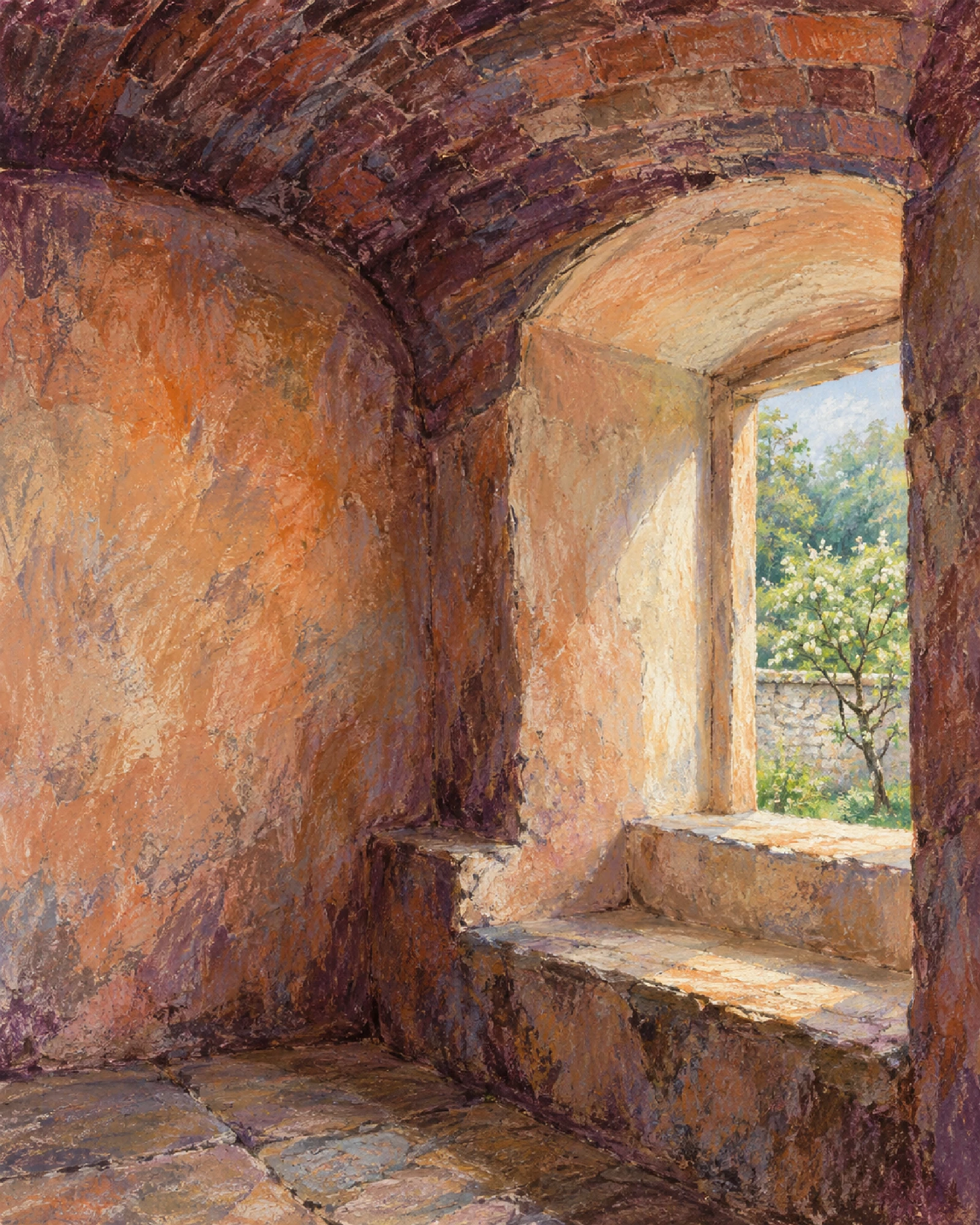
A Window Seat in the Kiln Wall
An intimate view of a window seat recessed into an old kiln wall, with a low vault and deep sill drawn in rubbed and scratched oil pastel.
Remix this referenceA Window Seat in the Kiln Wall
- Form language
- Translate architecture into swelling wedges and gently irregular arcs; preserve convincing connections while allowing handmade variation.
- Contour
- Let broad waxy strokes form soft, interrupted edges, with occasional firm scraped boundaries instead of continuous outlines.
- Mark-making
- Drag oil-pastel sticks sideways, rub selected passages with a cloth, and scratch a few restless lines through the accumulated pigment.
- Surface rendering
- Blend tones through smeared wax veils and broken scumbling; leave occasional raw paper and thick crumbs within the worked surface.
Priority
Keep the dreamlike oil pastel visibly rubbed, layered, and selectively scratched.
What to avoid & what to check
Exact prompt for this example
MODULE OWNERSHIP
subject: Subject count, type, stable proportions and landmarks, resting face geometry, hair shape, physical materials, garment construction and permanent marks. No emotion, movement, color assignment or rendering recipe.
expression: Facial soft-tissue displacement and pupil direction, muscle coordination, regional intensity, asymmetry and onset/peak/release. No head/body pose, stable appearance, skin color or rendering.
gesture: Head/neck/body/limb orientation, joint movement, support, contact and pose-caused occlusion using existing anatomy. No eye/pupil movement, emotion, identity, props inventory or camera.
props: Prop count, type, construction, physical material and scale relative to the subject. Holding/contact belongs to gesture, position to composition, color to palette.
scene: Environment elements, terrain, backdrop/floor presence and structural detail. No canvas positions, camera, lighting, assigned colors or render texture.
camera: Projection, focal-length impression, camera elevation/yaw/roll, viewing distance and crop. No actor pose, world placement, lighting or canvas aspect ratio.
composition: Normalized 0-100% canvas positions, scale in frame, depth/overlap, focal hierarchy and margins. No joint pose, camera projection, rendering, subject/prop inventory or emotion.
palette: Color anchors, hue/saturation/value ranges, colors assigned to parts and approximate color coverage. No illumination direction, shading algorithm, physical material or layout.
lighting: Light-source direction/softness/intensity, ambient illumination, physical shadow direction/length and highlight position. Absence of directional illumination is allowed. No shading technique, palette or material changes.
style: Reusable form abstraction, contour weight/taper/edge quality, medium and mark scale/density/direction, surface rendering and tonal transition technique. No fixed subject proportions, anatomy, identity, expression, pose, palette, light-source direction, camera or layout.
output: Image count, aspect ratio, size, file/alpha requirements and global lettering/logo/watermark restrictions. No background scenery, crop, style, identity or pose.

SUBJECT
inventory: No discrete character or object subjects; architecture belongs to scene.
geometry: No separate subject geometry applies.
resting-face: No faces.
appearance: No separate subject appearance applies.

PRIORITY


AVOID


CHECK


PROPS
inventory: No separate props.
construction: No prop construction applies.

PRIORITY


AVOID


CHECK


SCENE
inventory: A converted kiln chamber with a brick vault, plastered window recess, integral masonry seat, and stone floor.
structure: The low vault thickens around a deeply splayed window with a curved plaster return and worn sill edges; its lower reveal becomes a seat overlooking a walled pear garden.

PRIORITY


AVOID


CHECK


CAMERA
projection: A normal-lens perspective preserves the intimacy and substantial depth of the window reveal.
viewpoint: View from seated eye height inside the chamber, turned obliquely toward the window with a level horizon.
crop: Crop tightly through the vault and near wall, retaining the complete seat recess and only a fragment of floor.

PRIORITY


AVOID


CHECK


COMPOSITION
placement: The window-seat junction is the focus in the lower right; the vault sweeps across the upper frame.
depth: The near wall overlaps one side of the recess; successive reveals lead to the small garden opening beyond.
spacing: Let a broad quiet wall counter the compressed recess; keep the exterior subordinate to the enveloping interior.

PRIORITY


AVOID


CHECK


PALETTE
colors: Smoked aubergine, muted apricot, pale celadon, and a little buttery cream; keep saturation softly restrained.
assignment: Aubergine belongs to brick and deep recesses, apricot to plaster, celadon to the garden, and cream to sill edges.
balance: Apricot and aubergine occupy most of the image; the small celadon opening provides a cool interval.

PRIORITY


AVOID


CHECK


LIGHTING
sources: Soft daylight enters through the window from the right; weak reflected light reaches the chamber.
shadows: The deep reveal casts a broad soft shadow leftward across the seat; the vault remains gently dim.
highlights: A diffuse highlight follows the exposed sill lip and fades along the plaster return.

PRIORITY


AVOID


CHECK


STYLE GUIDE
form-language: Translate architecture into swelling wedges and gently irregular arcs; preserve convincing connections while allowing handmade variation.
contour: Let broad waxy strokes form soft, interrupted edges, with occasional firm scraped boundaries instead of continuous outlines.
mark-making: Drag oil-pastel sticks sideways, rub selected passages with a cloth, and scratch a few restless lines through the accumulated pigment.
surface-rendering: Blend tones through smeared wax veils and broken scumbling; leave occasional raw paper and thick crumbs within the worked surface.

PRIORITY
Keep the dreamlike oil pastel visibly rubbed, layered, and selectively scratched.

AVOID


CHECK


OUTPUT
format: One finished image, 4:5 portrait, 1600 × 2000 pixels, opaque PNG.
restrictions: No lettering, logos, signatures, or watermarks.

PRIORITY


AVOID


CHECK
Model information comes from image provenance. The same prompt may produce a different result.