Text to imageAnimationStyle guide
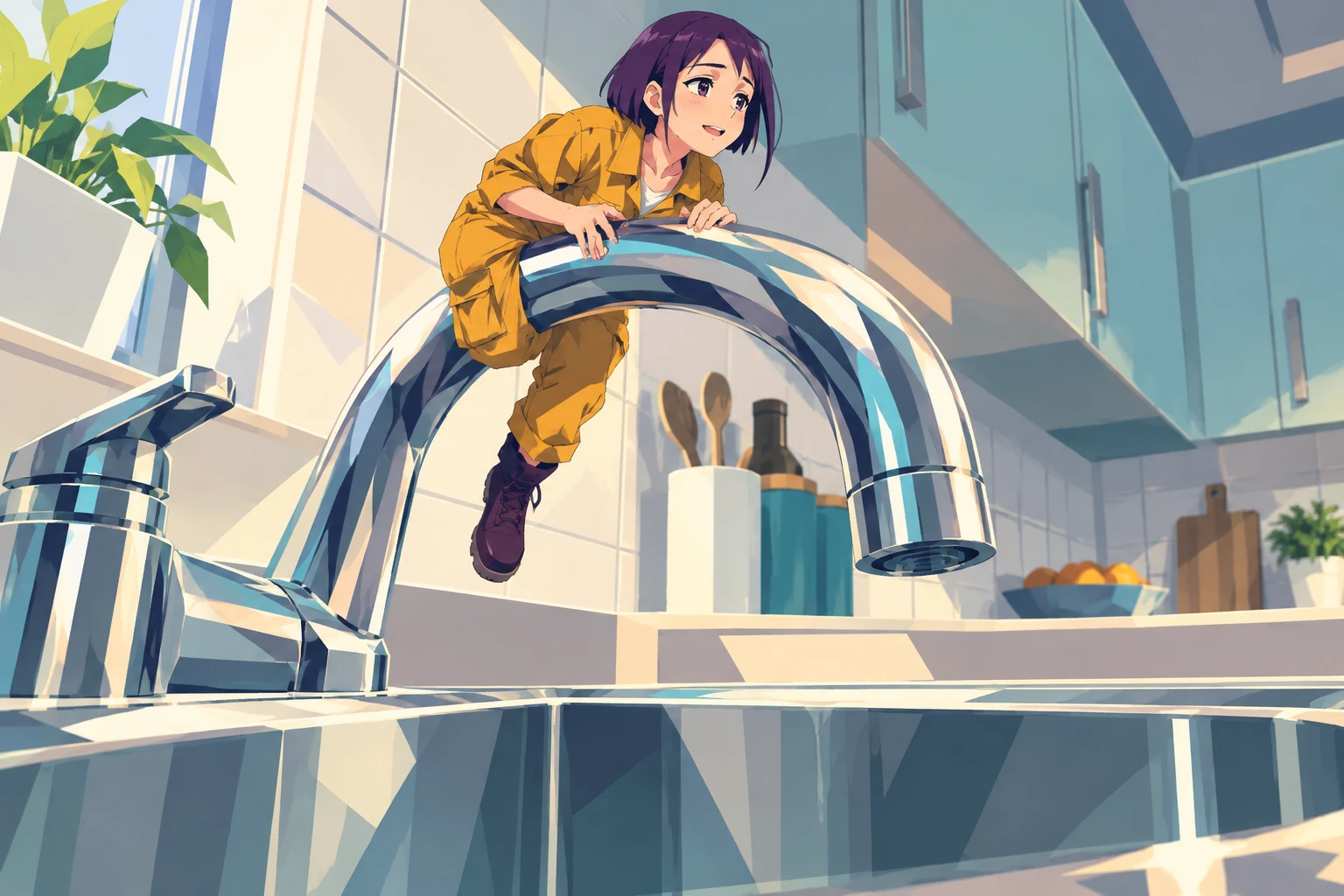
Tiny Woman Atop the Kitchen Tap
A tiny woman pulls herself onto a towering kitchen tap and exhales with relief. The sink below and cabinets beyond turn an ordinary kitchen into an immense place of adventure.
Remix this referenceTiny Woman Atop the Kitchen Tap
- Form language
- Abstract curved and rectilinear forms into interlocking wedges, triangles and angular facets while preserving readable silhouettes.
- Contour
- Alternate heavy exterior accents with thin connecting edges; use short, sharp interior cuts and occasional tapered breaks.
- Mark-making
- Use sparse blade-like strokes and small angular fragments where detail is needed; leave clean planes unmarked and vary strokes naturally.
- Surface rendering
- Build surfaces from a few sharply separated tonal planes instead of gradients; broad smooth fields meet crisp irregular facet boundaries.
Priority
Rendering medium: 2D angular Japanese anime graphic illustration; formal rendering reference: TRIGGER · 2010s · Promare (2019)
What to avoid & what to check
Exact prompt for this example
MODULE OWNERSHIP
subject: Subject count, type, stable proportions and landmarks, resting face geometry, hair shape, physical materials, garment construction and permanent marks. No emotion, movement, color assignment or rendering recipe.
expression: Facial soft-tissue displacement and pupil direction, muscle coordination, regional intensity, asymmetry and onset/peak/release. No head/body pose, stable appearance, skin color or rendering.
gesture: Head/neck/body/limb orientation, joint movement, support, contact and pose-caused occlusion using existing anatomy. No eye/pupil movement, emotion, identity, props inventory or camera.
props: Prop count, type, construction, physical material and scale relative to the subject. Holding/contact belongs to gesture, position to composition, color to palette.
scene: Environment elements, terrain, backdrop/floor presence and structural detail. No canvas positions, camera, lighting, assigned colors or render texture.
camera: Projection, focal-length impression, camera elevation/yaw/roll, viewing distance and crop. No actor pose, world placement, lighting or canvas aspect ratio.
composition: Normalized 0-100% canvas positions, scale in frame, depth/overlap, focal hierarchy and margins. No joint pose, camera projection, rendering, subject/prop inventory or emotion.
palette: Color anchors, hue/saturation/value ranges, colors assigned to parts and approximate color coverage. No illumination direction, shading algorithm, physical material or layout.
lighting: Light-source direction/softness/intensity, ambient illumination, physical shadow direction/length and highlight position. Absence of directional illumination is allowed. No shading technique, palette or material changes.
style: Reusable form abstraction, contour weight/taper/edge quality, medium and mark scale/density/direction, surface rendering and tonal transition technique. No fixed subject proportions, anatomy, identity, expression, pose, palette, light-source direction, camera or layout.
output: Image count, aspect ratio, size, file/alpha requirements and global lettering/logo/watermark restrictions. No background scenery, crop, style, identity or pose.

SUBJECT
inventory: One original miniature adult woman, A; ordinary adult anatomy at an unexpectedly small scale.
geometry: A has a lean adult build, sturdy hands and a blunt bob with one longer temple lock.
resting-face: Her resting face has a broad forehead, shallow brow arches, a short nose and a gently squared chin.
appearance: Woven work coveralls have a folded collar and roomy sleeves; ankle boots have rubber soles. No permanent marks.

PRIORITY


AVOID


CHECK


EXPRESSION — ACTOR A
brows: Brow centers settle from a raised position, with one brow still slightly higher.
lids: Upper lids relax downward; lower lids retain a slight upward press.
cheeks: Cheeks lift gently without bunching tightly beneath the eyes.
nose: Nostrils relax after exertion; the bridge remains uncreased.
mouth: Lips part in a small exhale, with one corner lifting into a tired smile.
jaw: The jaw loosens into a narrow opening rather than dropping widely.
gaze: Pupils look beyond the tap toward the distant counter edge.
coordination: Relaxing brows and jaw accompany a restrained cheek lift; the smile remains slightly uneven.
timing: Capture the release just after the effort, before the mouth closes again.

PRIORITY


AVOID


CHECK


GESTURE
head: A lifts her chin slightly and turns her head toward the open kitchen, leaving her face readable.
torso: Her torso folds over the tap crown, shoulders beginning to rise as she pulls herself onto it.
limbs: Both elbows bend; one knee draws against the curved neck while the other boot hangs below.
contact: Her palms and forearms brace on the tap crown; the drawn-up knee supplies a second point of support.

PRIORITY


AVOID


CHECK


PROPS
inventory: No separate props.
construction: No prop construction applies.

PRIORITY


AVOID


CHECK


SCENE
inventory: A domestic kitchen with an inset sink, a tall curved tap, tiled splashback and fitted cabinets.
structure: The steel tap arches above a deep steel basin; the counter continues toward cabinet doors and simple tile joints.

PRIORITY


AVOID


CHECK


CAMERA
projection: Use perspective with a moderately wide focal-length impression, giving nearby fixtures a strong sense of volume.
viewpoint: View from just below the tap crown at a three-quarter yaw; keep the camera roll level.
crop: Frame an environmental close view with all of A visible; let the basin rim and cabinet run continue beyond the crop.

PRIORITY


AVOID


CHECK


COMPOSITION
placement: Place A near 40% across and 35% down; the tap arc dominates the middle-right and the basin occupies the lower field.
depth: A's face and hands lead, followed by the tap arch; overlapping counter edges carry the eye into the distant cabinets.
spacing: Keep A about one-third of frame height, with open space around her face and a broad uninterrupted basin below.

PRIORITY


AVOID


CHECK


PALETTE
colors: Anchor the image in saturated turquoise, warm saffron, deep plum and pale cream, with restrained peach accents.
assignment: Use saffron for coveralls, plum for hair and boots, peach for skin, icy turquoise for steel and cream for tiles.
balance: Cool pale fields occupy most of the image; the concentrated warm garment and dark accents provide a compact counterweight.

PRIORITY


AVOID


CHECK


LIGHTING
sources: Broad soft daylight enters from upper left, with gentle ambient illumination throughout the kitchen.
shadows: Cast shadows fall toward lower right; short contact shadows gather beneath A's arms and supporting knee.
highlights: Place broad highlights along the tap's upper-left arc and smaller highlights on the raised cheek and knuckles.

PRIORITY


AVOID


CHECK


STYLE GUIDE
form-language: Abstract curved and rectilinear forms into interlocking wedges, triangles and angular facets while preserving readable silhouettes.
contour: Alternate heavy exterior accents with thin connecting edges; use short, sharp interior cuts and occasional tapered breaks.
mark-making: Use sparse blade-like strokes and small angular fragments where detail is needed; leave clean planes unmarked and vary strokes naturally.
surface-rendering: Build surfaces from a few sharply separated tonal planes instead of gradients; broad smooth fields meet crisp irregular facet boundaries.

PRIORITY
Rendering medium: 2D angular Japanese anime graphic illustration; formal rendering reference: TRIGGER · 2010s · Promare (2019)

AVOID


CHECK


OUTPUT
format: One finished image, landscape 3:2, 1536 × 1024 pixels, opaque PNG.
restrictions: No lettering, logos or watermarks.

PRIORITY


AVOID


CHECK


FINAL INTEGRATION
subject + scene + composition: Let the character and familiar kitchen structures establish the scale surprise through their visible relationship.
expression + gesture: Coordinate the facial release with the final effort of gaining support so the moment feels lived rather than posed.
lighting + style: Translate the physical illumination into the chosen tonal planes while keeping its direction legible.
Art direction
트리거 / TRIGGER · 2010s · 프로메어(2019) / Promare (2019) ↗- Abstract form surfaces into wedges, triangles and angular facets
- Strong exterior weight contrast with short sharp interior cuts
- Small angular facets and sharp marks, with no marks in clean planes
- A small set of sharply separated tonal planes in place of gradients
Model information comes from image provenance. The same prompt may produce a different result.