Text to imageComicsStyle guide
Hermit Crab in a Bus Shell
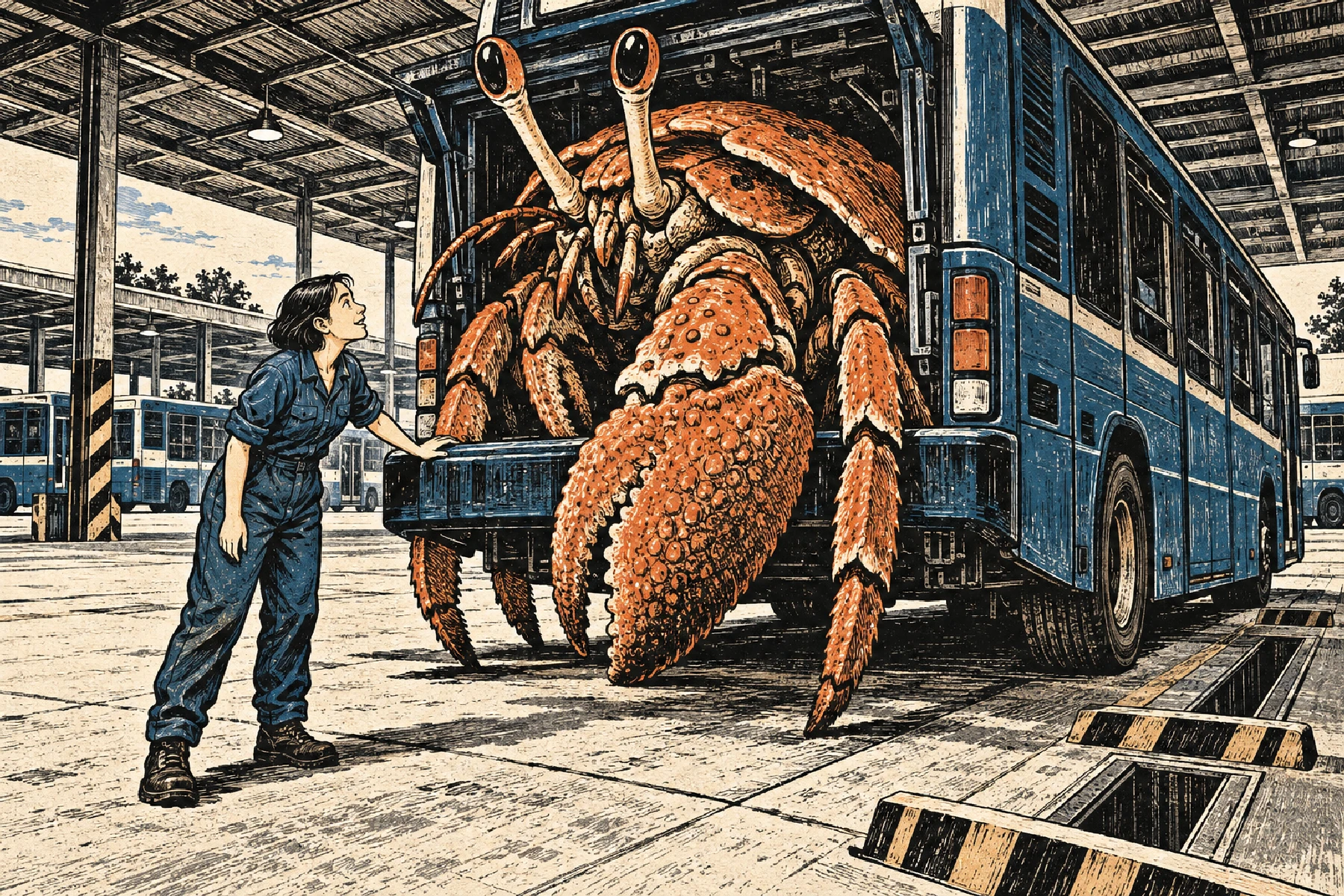
At a bus depot, a mechanic rests a hand on a bumper and examines an enormous hermit crab using the bus as its home. Rough woodcut lines and deep ink masses give their encounter a bold graphic-novel presence.
Remix this referenceHermit Crab in a Bus Shell
- Form language
- Reduce complex forms into interlocking angular masses and generous cutaway shapes; let small details vary within this carved vocabulary.
- Contour
- Use thick, irregular ink edges with abrupt gouged breaks and tapered internal cuts rather than uniformly closed outlines.
- Mark-making
- Build passages from lively clusters of short gouge strokes and occasional long splinters, changing their rhythm with the forms.
- Surface rendering
- Set dense ink masses against exposed paper; broken carved hatching mediates tones, with uneven ink bite and slight color-block misregistration.
Priority
Rendering medium: woodcut graphic-novel comic illustration with carved relief-print marks.
What to avoid & what to check
Exact prompt for this example
MODULE OWNERSHIP
subject: Subject count, type, stable proportions and landmarks, resting face geometry, hair shape, physical materials, garment construction and permanent marks. No emotion, movement, color assignment or rendering recipe.
expression: Facial soft-tissue displacement and pupil direction, muscle coordination, regional intensity, asymmetry and onset/peak/release. No head/body pose, stable appearance, skin color or rendering.
gesture: Head/neck/body/limb orientation, joint movement, support, contact and pose-caused occlusion using existing anatomy. No eye/pupil movement, emotion, identity, props inventory or camera.
props: Prop count, type, construction, physical material and scale relative to the subject. Holding/contact belongs to gesture, position to composition, color to palette.
scene: Environment elements, terrain, backdrop/floor presence and structural detail. No canvas positions, camera, lighting, assigned colors or render texture.
camera: Projection, focal-length impression, camera elevation/yaw/roll, viewing distance and crop. No actor pose, world placement, lighting or canvas aspect ratio.
composition: Normalized 0-100% canvas positions, scale in frame, depth/overlap, focal hierarchy and margins. No joint pose, camera projection, rendering, subject/prop inventory or emotion.
palette: Color anchors, hue/saturation/value ranges, colors assigned to parts and approximate color coverage. No illumination direction, shading algorithm, physical material or layout.
lighting: Light-source direction/softness/intensity, ambient illumination, physical shadow direction/length and highlight position. Absence of directional illumination is allowed. No shading technique, palette or material changes.
style: Reusable form abstraction, contour weight/taper/edge quality, medium and mark scale/density/direction, surface rendering and tonal transition technique. No fixed subject proportions, anatomy, identity, expression, pose, palette, light-source direction, camera or layout.
output: Image count, aspect ratio, size, file/alpha requirements and global lettering/logo/watermark restrictions. No background scenery, crop, style, identity or pose.

SUBJECT
inventory: Two subjects: A, an adult woman mechanic; B, an enormous hermit crab taller than A.
geometry: A has a compact, sturdy build; B has a broad carapace, stalked eyes, unequal claws and a soft curled abdomen.
resting-face: A has a broad forehead, rounded nose tip and wide-set eyes; B has simple crab mouthparts beneath its eye stalks.
appearance: A wears woven coveralls and work boots, with short hair tucked behind her ears; B has a ridged chitin exoskeleton.

PRIORITY


AVOID


CHECK


EXPRESSION — ACTOR A
brows: One brow rises slightly while the other stays relaxed.
lids: Upper lids lift gently; lower lids remain loose.
cheeks: Cheeks remain relaxed without a smile lift.
nose: Nostrils stay relaxed, with no wrinkling at the bridge.
mouth: Lips part slightly, with one corner barely lifted.
jaw: The jaw releases just enough to separate the lips.
gaze: Pupils turn toward the crab's nearer eye stalk.
coordination: The brow lift leads; the slight mouth opening follows without tension.
timing: Catch the onset of attentive curiosity before a larger reaction develops.

PRIORITY


AVOID


CHECK


EXPRESSION — ACTOR B
brows: No brow movement applies.
lids: No eyelid movement applies.
cheeks: No cheek displacement applies.
nose: No nasal movement applies.
mouth: The small mouthparts stay together without fluttering.
jaw: Mandibles remain at rest without spreading.
gaze: No pupil-direction control applies to B's compound eyes.
coordination: Mouthparts and mandibles rest together without humanlike facial contractions.
timing: Hold the settled neutral state at its quiet apex.

PRIORITY


AVOID


CHECK


GESTURE
head: A tips her head upward toward B; B extends its eye stalks beyond the bus opening.
torso: A leans forward from the hips; B's forebody emerges while its curled abdomen remains inside the bus.
limbs: A bends one elbow toward the bumper, her free arm hanging loose; B plants its walking legs and lowers its claws.
contact: A's palm rests on the bumper; B supports the bus on its back, with its feet grounded on the depot pavement.

PRIORITY


AVOID


CHECK


PROPS
inventory: One full-size city bus serves as B's shelter; its bumper reaches roughly A's waist.
construction: The bus has a steel body, glazed windows and rubber tires; an open rear engine bay reveals a hollow interior.

PRIORITY


AVOID


CHECK


SCENE
inventory: A bus depot with a concrete apron, maintenance canopy, inspection trench and empty parking bays.
structure: Steel columns and repeated roof beams support the canopy; pavement joints and wheel stops retain ordinary depot dimensions.

PRIORITY


AVOID


CHECK


CAMERA
projection: Use perspective with a moderately wide lens impression and restrained edge distortion.
viewpoint: View from A's chest height, obliquely across the bus's rear quarter, with a level horizon.
crop: Use a wide environmental view containing A's full figure, B's exposed body and the complete bus silhouette.

PRIORITY


AVOID


CHECK


COMPOSITION
placement: A occupies the lower-left third; the bus and B span the middle and right, with the eye regions forming the focus.
depth: A overlaps the near bumper; B bridges the bus opening and foreground, with depot bays receding behind.
spacing: Leave room above the eye stalks and an open pavement wedge beside A; keep the scale comparison unobstructed.

PRIORITY


AVOID
No panel divisions.

CHECK


PALETTE
colors: Use ink black, warm ivory, muted petrol blue and a restrained burnt-orange accent.
assignment: Assign petrol blue to the bus and coveralls, burnt orange to B, and ivory to A's skin and the depot's pale surfaces.
balance: Ivory and black dominate; blue provides a broad secondary field, while orange remains a compact warm accent.

PRIORITY


AVOID


CHECK


LIGHTING
sources: Broad daylight enters from the open left side of the canopy, with gentle ambient fill beneath the roof.
shadows: Bus, legs and canopy columns cast broad shadows toward the right; contact shadows gather beneath the crab.
highlights: Light catches the left-facing carapace ridges, A's brow and the upper edge of the bumper.

PRIORITY


AVOID


CHECK


STYLE GUIDE
form-language: Reduce complex forms into interlocking angular masses and generous cutaway shapes; let small details vary within this carved vocabulary.
contour: Use thick, irregular ink edges with abrupt gouged breaks and tapered internal cuts rather than uniformly closed outlines.
mark-making: Build passages from lively clusters of short gouge strokes and occasional long splinters, changing their rhythm with the forms.
surface-rendering: Set dense ink masses against exposed paper; broken carved hatching mediates tones, with uneven ink bite and slight color-block misregistration.

PRIORITY
Rendering medium: woodcut graphic-novel comic illustration with carved relief-print marks.

AVOID


CHECK


OUTPUT
format: One finished image, landscape 3:2, 1800 × 1200 pixels, opaque PNG.
restrictions: No lettering, dialogue balloons, logos or watermarks.

PRIORITY


AVOID


CHECK
Model information comes from image provenance. The same prompt may produce a different result.