Text to imageIllustrationStyle guide
Giant Crab Under the Car-Wash Brushes
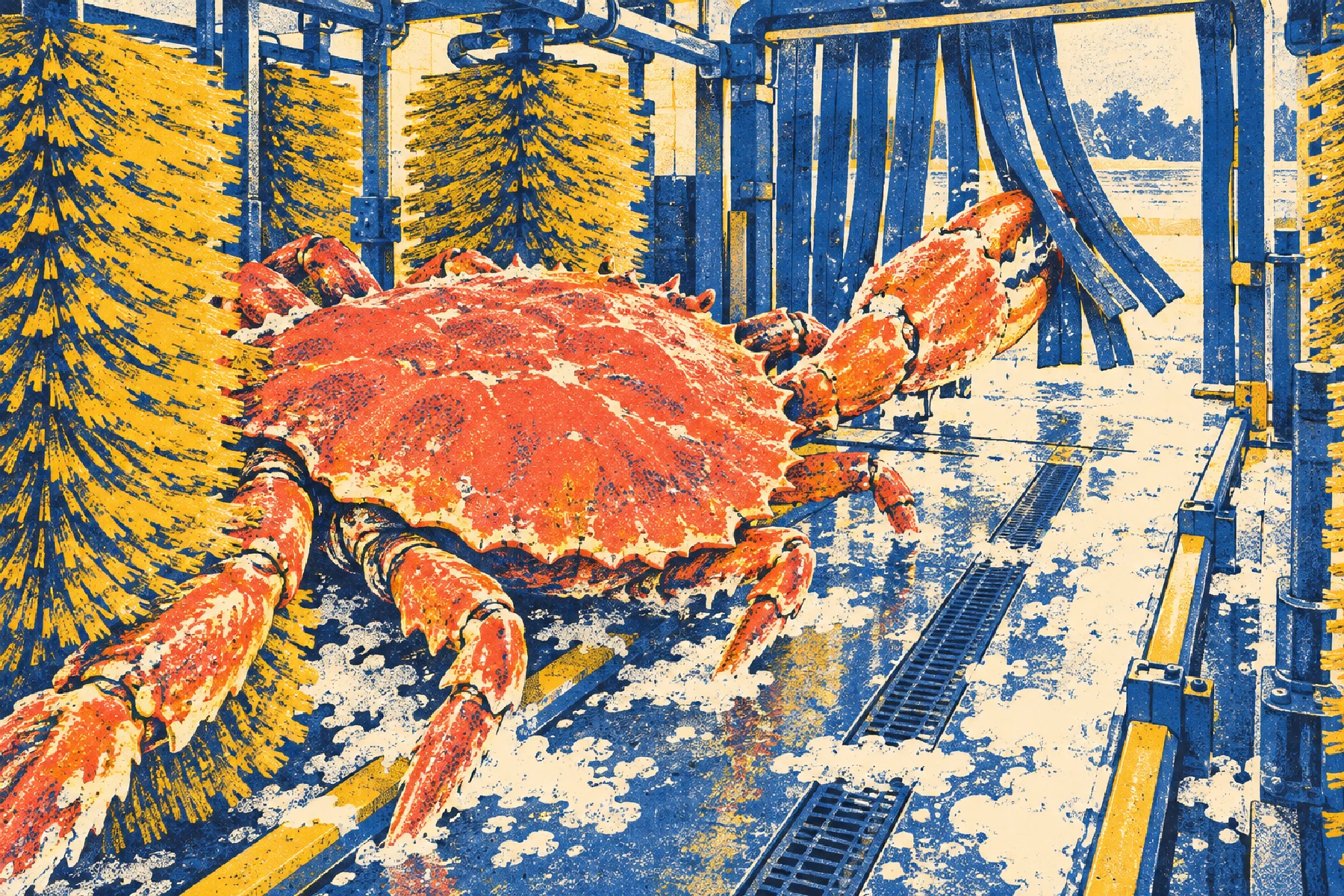
A giant crab sidles between car-wash brushes, parting the exit curtain with one claw. Grainy riso impressions and playful registration offsets animate the encounter between shell and machinery.
Remix this referenceGiant Crab Under the Car-Wash Brushes
- Form language
- Reduce volumes to interlocking, slightly lopsided cut-stencil shapes; keep small structural accents selective.
- Contour
- Use blunt, irregular ink edges and occasional broken contour strokes; let some boundaries emerge from overlapping plates.
- Mark-making
- Build riso grain from uneven stencil speckle and loose directional hatch clusters, allowing natural changes in mark density.
- Surface rendering
- Layer translucent ink impressions with grainy tonal breaks, unprinted paper gaps and playful registration offsets at broad edges.
Priority
Make riso grain and independently shifted ink plates visibly define the finished print.
What to avoid & what to check
Exact prompt for this example
MODULE OWNERSHIP
subject: Subject count, type, stable proportions and landmarks, resting face geometry, hair shape, physical materials, garment construction and permanent marks. No emotion, movement, color assignment or rendering recipe.
expression: Facial soft-tissue displacement and pupil direction, muscle coordination, regional intensity, asymmetry and onset/peak/release. No head/body pose, stable appearance, skin color or rendering.
gesture: Head/neck/body/limb orientation, joint movement, support, contact and pose-caused occlusion using existing anatomy. No eye/pupil movement, emotion, identity, props inventory or camera.
props: Prop count, type, construction, physical material and scale relative to the subject. Holding/contact belongs to gesture, position to composition, color to palette.
scene: Environment elements, terrain, backdrop/floor presence and structural detail. No canvas positions, camera, lighting, assigned colors or render texture.
camera: Projection, focal-length impression, camera elevation/yaw/roll, viewing distance and crop. No actor pose, world placement, lighting or canvas aspect ratio.
composition: Normalized 0-100% canvas positions, scale in frame, depth/overlap, focal hierarchy and margins. No joint pose, camera projection, rendering, subject/prop inventory or emotion.
palette: Color anchors, hue/saturation/value ranges, colors assigned to parts and approximate color coverage. No illumination direction, shading algorithm, physical material or layout.
lighting: Light-source direction/softness/intensity, ambient illumination, physical shadow direction/length and highlight position. Absence of directional illumination is allowed. No shading technique, palette or material changes.
style: Reusable form abstraction, contour weight/taper/edge quality, medium and mark scale/density/direction, surface rendering and tonal transition technique. No fixed subject proportions, anatomy, identity, expression, pose, palette, light-source direction, camera or layout.
output: Image count, aspect ratio, size, file/alpha requirements and global lettering/logo/watermark restrictions. No background scenery, crop, style, identity or pose.

SUBJECT
inventory: One enormous shore crab; no other animals or people appear.
geometry: A broad, low carapace has a scalloped rim, stout paired claws and jointed walking legs.
resting-face: Natural crab mouthparts and short eyestalks have no human facial features.
appearance: Hard chitin bears shallow ridges and worn claw tips; minor shell irregularities may vary naturally.

PRIORITY


AVOID


CHECK


GESTURE
head: The head stays integrated with the shell, with no independent neck gesture.
torso: The crab sidles through the bay with its carapace slightly banked against a yielding brush.
limbs: One claw reaches sideways to part the exit strips; visible walking legs spread and brace.
contact: Brush bristles bend across the shell, rubber strips drape over the raised claw, and feet bear on the lane.

PRIORITY


AVOID


CHECK


PROPS
inventory: No separate props.
construction: No prop construction applies.

PRIORITY


AVOID


CHECK


SCENE
inventory: An automatic car wash contains vertical brush rollers, a wash arch, rubber exit strips and a wet lane with scattered foam.
structure: An ordinary car-width frame, wheel guides and a drainage grate establish the familiar working setting.

PRIORITY


AVOID


CHECK


CAMERA
projection: Use moderate perspective with a normal-lens impression and clearly receding wash-bay structure.
viewpoint: Look downward from an elevated rear three-quarter viewpoint, far enough away to include the surrounding machinery.
crop: Include the complete shell and working claw; the face is out of view, while the nearest machinery may crop.

PRIORITY


AVOID


CHECK


COMPOSITION
placement: The shell dominates the lower-left half; the reaching claw leads toward an open upper-right exit.
depth: A foreground roller overlaps the shell edge; the crab interrupts the repeated frames receding behind it.
spacing: Make the shell nearly span the vehicle lane; reserve breathing room at the exit around the separated strips.

PRIORITY


AVOID


CHECK


PALETTE
colors: Use warm paper cream, vivid coral, mustard yellow and deep cobalt as a compact ink palette.
assignment: Assign coral to the crab, mustard to brush masses, cobalt to machinery and floor accents, and cream to foam.
balance: Let coral and exposed cream occupy broad areas, with smaller yellow passages and concentrated dark blue.

PRIORITY


AVOID


CHECK


LIGHTING
sources: Broad, soft daylight enters through the exit, with subdued ambient illumination inside the bay.
shadows: Short, soft shadows extend toward the entrance beneath the crab and machinery.
highlights: Restrained highlights sit on the exit-facing shell ridge, claw edge and wet floor.

PRIORITY


AVOID


CHECK


STYLE GUIDE
form-language: Reduce volumes to interlocking, slightly lopsided cut-stencil shapes; keep small structural accents selective.
contour: Use blunt, irregular ink edges and occasional broken contour strokes; let some boundaries emerge from overlapping plates.
mark-making: Build riso grain from uneven stencil speckle and loose directional hatch clusters, allowing natural changes in mark density.
surface-rendering: Layer translucent ink impressions with grainy tonal breaks, unprinted paper gaps and playful registration offsets at broad edges.

PRIORITY
Make riso grain and independently shifted ink plates visibly define the finished print.

AVOID


CHECK


OUTPUT
format: Deliver one finished landscape illustration, 3:2 aspect ratio, 1800 × 1200 pixels, opaque PNG.
restrictions: Include no lettering, logos or watermarks.

PRIORITY


AVOID


CHECK
Model information comes from image provenance. The same prompt may produce a different result.