Text to imageCharacterStyle guide
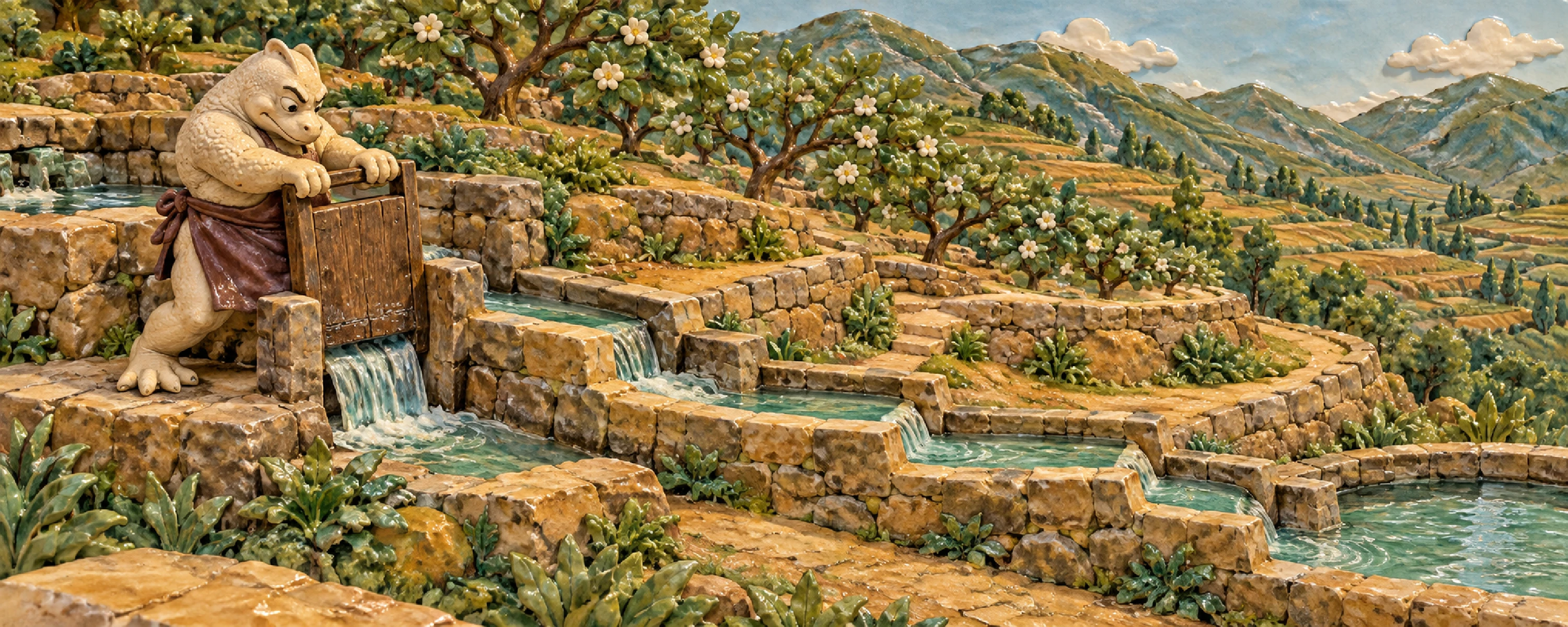
A Ridge-Backed Keeper Opening the Orchard Sluice
A small ridge-backed keeper lifts a sluice board. Across a ceramic relief, glaze-filled channels wind through orchard terraces toward a distant receiving pool.
Remix this referenceA Ridge-Backed Keeper Opening the Orchard Sluice
- Form language
- Build forms as gently swollen low-relief volumes with shallow incised separations; allow coherent handmade asymmetry.
- Contour
- Use rounded rolled edges interrupted by occasional crisp knife-cut rims; let relief boundaries replace drawn outlines.
- Mark-making
- Retain selective thumb hollows and dragged modeling-tool strokes that follow each form, varying naturally in depth and spacing.
- Surface rendering
- Let translucent glaze gather in recesses, thin over satin crests, and reveal clay at selected edges; tonal changes follow modeled swelling.
Priority
Make modeled ceramic relief and variable glaze depth visibly define the illustration.
What to avoid & what to check
Exact prompt for this example
MODULE OWNERSHIP
subject: Subject count, type, stable proportions and landmarks, resting face geometry, hair shape, physical materials, garment construction and permanent marks. No emotion, movement, color assignment or rendering recipe.
expression: Facial soft-tissue displacement and pupil direction, muscle coordination, regional intensity, asymmetry and onset/peak/release. No head/body pose, stable appearance, skin color or rendering.
gesture: Head/neck/body/limb orientation, joint movement, support, contact and pose-caused occlusion using existing anatomy. No eye/pupil movement, emotion, identity, props inventory or camera.
props: Prop count, type, construction, physical material and scale relative to the subject. Holding/contact belongs to gesture, position to composition, color to palette.
scene: Environment elements, terrain, backdrop/floor presence and structural detail. No canvas positions, camera, lighting, assigned colors or render texture.
camera: Projection, focal-length impression, camera elevation/yaw/roll, viewing distance and crop. No actor pose, world placement, lighting or canvas aspect ratio.
composition: Normalized 0-100% canvas positions, scale in frame, depth/overlap, focal hierarchy and margins. No joint pose, camera projection, rendering, subject/prop inventory or emotion.
palette: Color anchors, hue/saturation/value ranges, colors assigned to parts and approximate color coverage. No illumination direction, shading algorithm, physical material or layout.
lighting: Light-source direction/softness/intensity, ambient illumination, physical shadow direction/length and highlight position. Absence of directional illumination is allowed. No shading technique, palette or material changes.
style: Reusable form abstraction, contour weight/taper/edge quality, medium and mark scale/density/direction, surface rendering and tonal transition technique. No fixed subject proportions, anatomy, identity, expression, pose, palette, light-source direction, camera or layout.
output: Image count, aspect ratio, size, file/alpha requirements and global lettering/logo/watermark restrictions. No background scenery, crop, style, identity or pose.

SUBJECT
inventory: Actor A is one original bipedal orchard sluice keeper.
geometry: A pear-shaped torso, broad spade-shaped feet, and a low continuous crown-to-shoulder ridge define the keeper.
resting-face: Close-set oval eyes sit above a short broad muzzle, small nostrils, and a naturally straight mouth.
appearance: Pebbled hide contrasts with a smooth crown ridge; a wrap-front canvas apron is tied at the waist, with no hair or permanent marks.

PRIORITY


AVOID


CHECK


EXPRESSION — ACTOR A
brows: Inner brows draw gently together without a deep scowl.
lids: Upper lids lower slightly and lower lids firm.
cheeks: The cheek pads tighten subtly beside the mouth.
nose: Nostrils remain relaxed, without a nose wrinkle.
mouth: Lips press together, with one corner drawn slightly inward.
jaw: The jaw holds firmly closed without jutting.
gaze: Pupils angle down toward the opening beneath the sluice board.
coordination: Firm lips carry the effort while the eye region stays controlled.
timing: Hold the apex of facial effort.

PRIORITY


AVOID


CHECK


GESTURE
head: The head tips down toward the sluice opening, with the neck following the torso.
torso: The torso leans back slightly as the keeper lifts upward.
limbs: Bent elbows lift together; staggered feet and a flexed forward knee brace the pull.
contact: Both hands grip the board's top handle while both feet remain planted on the landing.

PRIORITY


AVOID


CHECK


PROPS
inventory: One removable wooden sluice board, approximately the height of the keeper's torso.
construction: A broad solid plank has an integral top handle and worn lower corners.

PRIORITY


AVOID


CHECK


SCENE
inventory: A hillside irrigation garden contains a spring chamber, stone sluice with a masonry landing, stepped channels, orchard terraces, and a receiving pool.
structure: Channels connect small terrace basins through notched retaining walls; a continuous hillside ridge supplies the backdrop.

PRIORITY


AVOID


CHECK


CAMERA
projection: Use an orthographic impression.
viewpoint: Look slightly downward and nearly frontally, without roll.
crop: Show the full keeper and the complete channel journey in a wide environmental view.

PRIORITY


AVOID


CHECK


COMPOSITION
placement: The keeper anchors the left third; the water route carries attention across the broad middle to the pool at far right.
depth: Overlapping terrace ledges establish depth; the raised board remains aligned with the sluice throat behind the hands.
spacing: Keep the keeper substantial but surrounded by landscape; open gaps between channel bends make the route easy to follow.

PRIORITY


AVOID


CHECK


PALETTE
colors: Use celadon, honey ochre, warm ivory, muted plum, and iron brown, with a broad middle-value range.
assignment: Assign celadon to water and foliage, ochre to terraces, ivory to the keeper, plum to the apron, and iron brown to the board.
balance: Ochre dominates the land; celadon links the waterways, while ivory and plum remain concentrated character accents.

PRIORITY


AVOID


CHECK


LIGHTING
sources: A broad light from upper left grazes the raised surfaces, supported by soft ambient illumination.
shadows: Short, soft-edged shadows fall to the lower right of raised rims and projecting forms.
highlights: Broad highlights sit on upper-left crests, with small brighter reflections on the water surfaces.

PRIORITY


AVOID


CHECK


STYLE GUIDE
form-language: Build forms as gently swollen low-relief volumes with shallow incised separations; allow coherent handmade asymmetry.
contour: Use rounded rolled edges interrupted by occasional crisp knife-cut rims; let relief boundaries replace drawn outlines.
mark-making: Retain selective thumb hollows and dragged modeling-tool strokes that follow each form, varying naturally in depth and spacing.
surface-rendering: Let translucent glaze gather in recesses, thin over satin crests, and reveal clay at selected edges; tonal changes follow modeled swelling.

PRIORITY
Make modeled ceramic relief and variable glaze depth visibly define the illustration.

AVOID


CHECK


OUTPUT
format: One finished image, 5:2 aspect ratio, 3000 × 1200 pixels, opaque PNG.
restrictions: No lettering, logos, signatures, or watermarks.

PRIORITY


AVOID


CHECK


FINAL INTEGRATION
expression + gesture: Synchronize A's facial apex with the lifting stage when the opening beneath the board first becomes clear.
Model information comes from image provenance. The same prompt may produce a different result.