Text to imagePortraitStyle guide
A Tiny Listener Inside a Piano
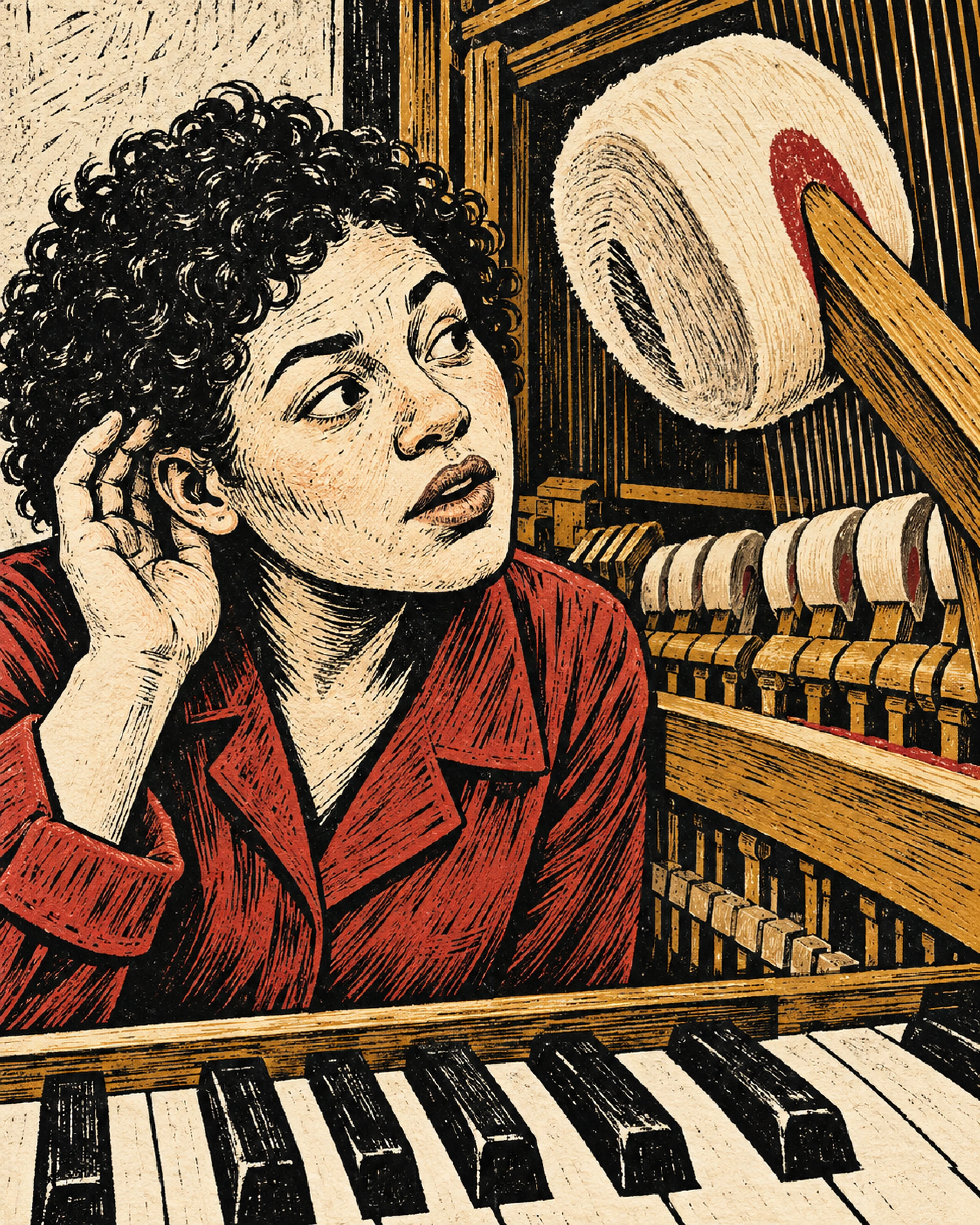
A miniature woman listens inside an open upright piano. Bold linocut carving frames her curious face between hammers and keys larger than her head.
Remix this referenceA Tiny Listener Inside a Piano
- Form language
- Reduce forms to interlocking bold masses, retaining small irregularities where adjoining shapes meet.
- Contour
- Use blunt cut edges interrupted by tapered gouges; let occasional boundaries merge into shared ink masses.
- Mark-making
- Carve rhythmic curved strokes and short wedges in uneven families, allowing natural changes in pressure and spacing.
- Surface rendering
- Build tone through carved openings in solid ink, with slight inking skips and imperfect overlaps between printed colors.
Priority
The finished image must visibly read as bold linocut with rhythmic carved marks.
What to avoid & what to check
Exact prompt for this example
MODULE OWNERSHIP
subject: Subject count, type, stable proportions and landmarks, resting face geometry, hair shape, physical materials, garment construction and permanent marks. No emotion, movement, color assignment or rendering recipe.
expression: Facial soft-tissue displacement and pupil direction, muscle coordination, regional intensity, asymmetry and onset/peak/release. No head/body pose, stable appearance, skin color or rendering.
gesture: Head/neck/body/limb orientation, joint movement, support, contact and pose-caused occlusion using existing anatomy. No eye/pupil movement, emotion, identity, props inventory or camera.
props: Prop count, type, construction, physical material and scale relative to the subject. Holding/contact belongs to gesture, position to composition, color to palette.
scene: Environment elements, terrain, backdrop/floor presence and structural detail. No canvas positions, camera, lighting, assigned colors or render texture.
camera: Projection, focal-length impression, camera elevation/yaw/roll, viewing distance and crop. No actor pose, world placement, lighting or canvas aspect ratio.
composition: Normalized 0-100% canvas positions, scale in frame, depth/overlap, focal hierarchy and margins. No joint pose, camera projection, rendering, subject/prop inventory or emotion.
palette: Color anchors, hue/saturation/value ranges, colors assigned to parts and approximate color coverage. No illumination direction, shading algorithm, physical material or layout.
lighting: Light-source direction/softness/intensity, ambient illumination, physical shadow direction/length and highlight position. Absence of directional illumination is allowed. No shading technique, palette or material changes.
style: Reusable form abstraction, contour weight/taper/edge quality, medium and mark scale/density/direction, surface rendering and tonal transition technique. No fixed subject proportions, anatomy, identity, expression, pose, palette, light-source direction, camera or layout.
output: Image count, aspect ratio, size, file/alpha requirements and global lettering/logo/watermark restrictions. No background scenery, crop, style, identity or pose.

SUBJECT
inventory: One miniature adult woman, actor A; no other figures.
geometry: Ordinary adult construction, with a compact neck, broad shoulders and substantial hands.
resting-face: A rounded square face, broad cheekbones, a straight broad nose and slightly unequal ears.
appearance: Close clustered curls and a cotton work jacket with an overlapping front and turned cuffs; no permanent marks.

PRIORITY


AVOID


CHECK


EXPRESSION — ACTOR A
brows: One inner brow lifts slightly higher than the other.
lids: Upper lids lift gently; the nearer lower lid tightens a little.
cheeks: Cheeks stay relaxed, without a smile-driven lift.
nose: The nose remains unwrinkled and the nostrils relaxed.
mouth: Lips part narrowly at the center, with level corners.
jaw: The jaw releases only enough to support the small lip opening.
gaze: Both pupils turn toward the nearby felt hammer.
coordination: Asymmetric brow interest leads; the lower face remains quiet.
timing: Hold the apex of a quiet discovery, before any smile develops.

PRIORITY


AVOID


CHECK


GESTURE
head: Incline the head toward the hammer while keeping the neck comfortably extended.
torso: The upper torso leans slightly sideways toward the mechanism.
limbs: Raise the nearer forearm, with fingers curved loosely behind the ear; the other arm hangs beside the torso.
contact: The cupped hand lightly touches the ear rim without covering the cheek or eye.

PRIORITY


AVOID


CHECK


PROPS
inventory: No separate props.
construction: No prop construction applies.

PRIORITY


AVOID


CHECK


SCENE
inventory: An open upright piano in a modest practice room with a plaster wall.
structure: Expose felt hammers, wooden action rails, vertical strings and part of the keyboard beneath the removed front panel.

PRIORITY


AVOID


CHECK


CAMERA
projection: Natural perspective with a moderate portrait-lens impression.
viewpoint: View from her eye level in a gentle three-quarter view, with no camera roll.
crop: Close bust crop: raised hand, recognizable piano interior and a sliver of plaster wall; the other arm is outside frame.

PRIORITY


AVOID


CHECK


COMPOSITION
placement: The face dominates left of center; an oversized hammer occupies the upper right, with keys crossing the lower edge.
depth: The hammer is larger than her head; foreground keys overlap the bust while strings recede behind her.
spacing: Read the face first, then the scale reversal; leave an open interval between her profile and the hammer.

PRIORITY


AVOID


CHECK


PALETTE
colors: Use ink black, warm ivory, muted brick red and a restrained mustard accent.
assignment: Ivory carries the face and felt; brick red belongs to the jacket, mustard to the wood, and black to hair and recesses.
balance: Black and ivory dominate; the jacket supplies the broad color accent, with mustard appearing sparingly.

PRIORITY


AVOID


CHECK


LIGHTING
sources: Broad soft daylight enters from the upper left, with subdued room ambience.
shadows: The brow, nose and hammer cast short shadows downward and to the right.
highlights: Light gathers on the left forehead, cheek ridge and exposed hammer crown.

PRIORITY


AVOID


CHECK


STYLE GUIDE
form-language: Reduce forms to interlocking bold masses, retaining small irregularities where adjoining shapes meet.
contour: Use blunt cut edges interrupted by tapered gouges; let occasional boundaries merge into shared ink masses.
mark-making: Carve rhythmic curved strokes and short wedges in uneven families, allowing natural changes in pressure and spacing.
surface-rendering: Build tone through carved openings in solid ink, with slight inking skips and imperfect overlaps between printed colors.

PRIORITY
The finished image must visibly read as bold linocut with rhythmic carved marks.

AVOID


CHECK


OUTPUT
format: One finished image, 4:5 aspect ratio, 2400 × 3000 pixels, opaque PNG.
restrictions: No lettering, logos or watermarks.

PRIORITY


AVOID


CHECK


FINAL INTEGRATION
expression + scene + composition: Keep the listening performance legible while the surrounding mechanism establishes the reversal of scale.
Model information comes from image provenance. The same prompt may produce a different result.