Text to imageComicsStyle guide
Stagehand Steadying a Crescent Moon
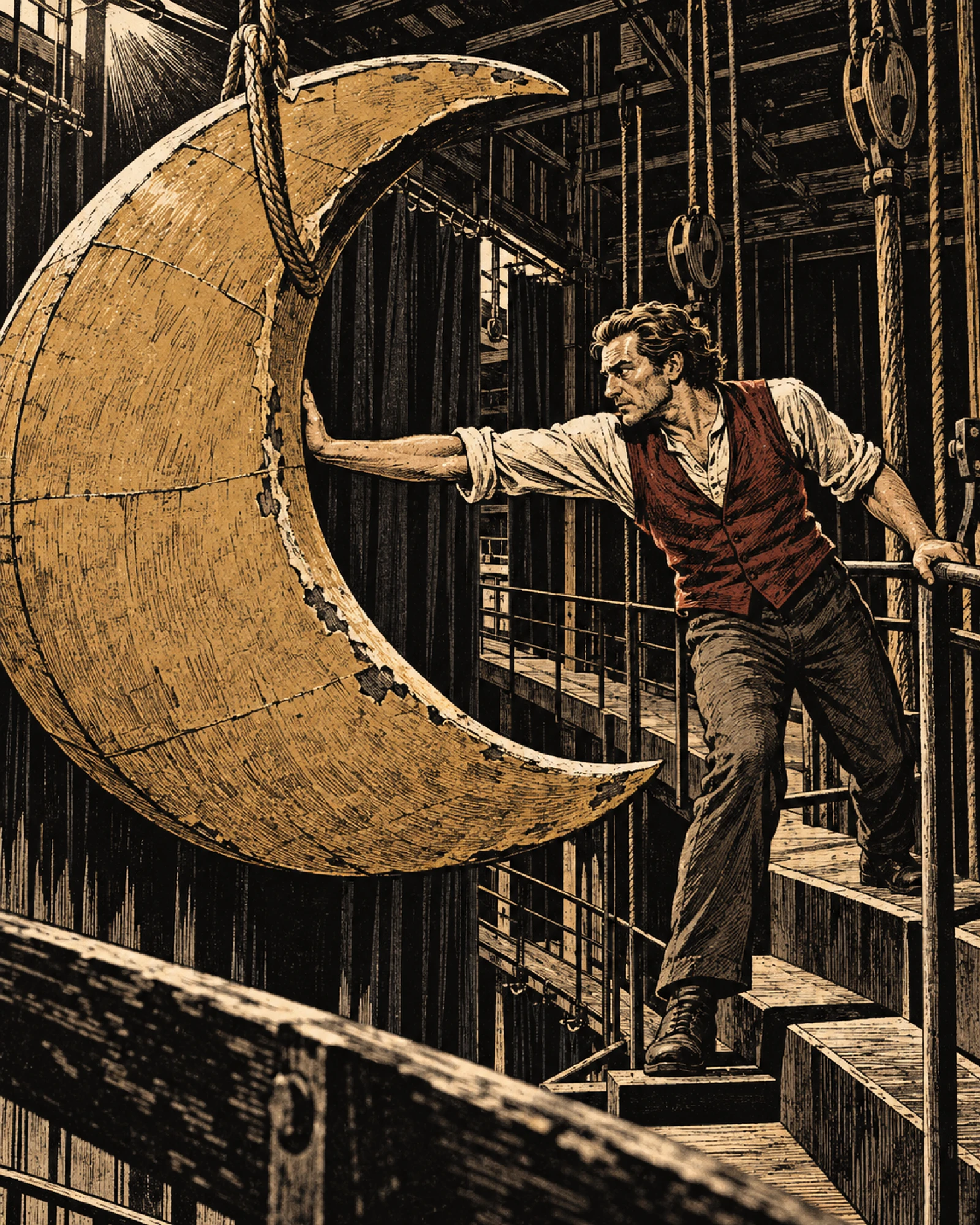
A stagehand steadies a suspended crescent amid layered backstage walkways. Deep ink masses and rough carved lines give the comic illustration its tension.
Remix this referenceStagehand Steadying a Crescent Moon
- Form language
- Build forms from interlocking blunt wedges and broad curved planes; simplify small details while allowing irregular silhouettes.
- Contour
- Use heavy ink boundaries with chipped edges and abrupt tapering; let selected contours merge into solid masses.
- Mark-making
- Carve unequal gouge strokes in loose directional clusters, alternating broad cuts with a few sharp slivers; vary marks naturally.
- Surface rendering
- Resolve tone through dense ink masses and exposed-paper cuts, with uneven ink bite and occasional broken overprinted passages.
Priority
Rendering medium: woodcut graphic-novel comic illustration printed in relief ink on paper.
What to avoid & what to check
Exact prompt for this example
MODULE OWNERSHIP
subject: Subject count, type, stable proportions and landmarks, resting face geometry, hair shape, physical materials, garment construction and permanent marks. No emotion, movement, color assignment or rendering recipe.
expression: Facial soft-tissue displacement and pupil direction, muscle coordination, regional intensity, asymmetry and onset/peak/release. No head/body pose, stable appearance, skin color or rendering.
gesture: Head/neck/body/limb orientation, joint movement, support, contact and pose-caused occlusion using existing anatomy. No eye/pupil movement, emotion, identity, props inventory or camera.
props: Prop count, type, construction, physical material and scale relative to the subject. Holding/contact belongs to gesture, position to composition, color to palette.
scene: Environment elements, terrain, backdrop/floor presence and structural detail. No canvas positions, camera, lighting, assigned colors or render texture.
camera: Projection, focal-length impression, camera elevation/yaw/roll, viewing distance and crop. No actor pose, world placement, lighting or canvas aspect ratio.
composition: Normalized 0-100% canvas positions, scale in frame, depth/overlap, focal hierarchy and margins. No joint pose, camera projection, rendering, subject/prop inventory or emotion.
palette: Color anchors, hue/saturation/value ranges, colors assigned to parts and approximate color coverage. No illumination direction, shading algorithm, physical material or layout.
lighting: Light-source direction/softness/intensity, ambient illumination, physical shadow direction/length and highlight position. Absence of directional illumination is allowed. No shading technique, palette or material changes.
style: Reusable form abstraction, contour weight/taper/edge quality, medium and mark scale/density/direction, surface rendering and tonal transition technique. No fixed subject proportions, anatomy, identity, expression, pose, palette, light-source direction, camera or layout.
output: Image count, aspect ratio, size, file/alpha requirements and global lettering/logo/watermark restrictions. No background scenery, crop, style, identity or pose.

SUBJECT
inventory: One middle-aged male stagehand, actor A.
geometry: A lean adult build with broad palms and a long, recognizably human silhouette.
resting-face: A rectangular face with a broad nose, deep-set eyes, straight brows and a narrow upper lip.
appearance: Swept-back wavy hair; a canvas waistcoat over a collarless shirt with folded cuffs, work trousers and ankle boots.

PRIORITY


AVOID


CHECK


EXPRESSION — ACTOR A
brows: Brows draw inward and slightly downward.
lids: Lower lids tighten beneath attentive, moderately open eyes.
cheeks: Cheeks tense subtly without lifting into a smile.
nose: Nostrils widen slightly; the bridge stays unwrinkled.
mouth: Lips press together, with one corner pulled slightly sideways.
jaw: Jaw firms without an exaggerated clench.
gaze: Pupils track the crescent's inner rim.
coordination: Concentrated upper-face tension leads the quieter, compressed mouth.
timing: Hold the apex of concentration, with a slight unevenness at the mouth.

PRIORITY


AVOID


CHECK


GESTURE
head: The neck extends forward and the chin turns toward the pressing hand.
torso: The torso leans into the effort while the hips counterbalance backward.
limbs: One arm extends with a soft elbow; the other bends behind him. Feet brace apart on the landing and its step.
contact: The hoist rope supports the crescent. The extended palm presses its inner rim; the other hand grips the rail.

PRIORITY


AVOID


CHECK


PROPS
inventory: One theatrical crescent as tall as the stagehand and one thick hoist rope.
construction: The crescent has canvas stretched over a timber frame, with a chipped rim; the rope is twisted hemp.

PRIORITY


AVOID


CHECK


SCENE
inventory: A theater fly tower with narrow catwalks, safety rails, hanging curtains and fixed pulley assemblies.
structure: A short stair joins staggered landings; open gaps reveal crossbeams and successive curtain bays beneath the roof.

PRIORITY


AVOID


CHECK


CAMERA
projection: Moderately wide perspective with convincing depth and restrained lens distortion.
viewpoint: Look diagonally across the catwalk from just below the stagehand's chest height, without camera roll.
crop: An environmental full-figure view includes both crescent tips and cuts through peripheral architecture.

PRIORITY


AVOID


CHECK


COMPOSITION
placement: The crescent fills the left half; A occupies the right third. Their palm-to-rim junction is the primary focus.
depth: A cropped foreground beam overlaps the lower edge; the main action precedes receding rails and curtain bays. The rail hides part of one shin.
spacing: Keep an open pocket inside the crescent around the reaching arm, with denser overlaps toward the outer margins.

PRIORITY


AVOID
No panel divisions or dialogue balloons.

CHECK


PALETTE
colors: Soot black and warm ivory dominate, supported by muted ochre and a small oxidized-red accent.
assignment: Use ochre for the crescent, red for the waistcoat, ivory for face and shirt, and black with ochre for the theater.
balance: Large dark areas outweigh the pale accents; keep chromatic passages subdued and the red scarce.

PRIORITY


AVOID


CHECK


LIGHTING
sources: A broad work light from upper left supplies a strong soft-edged key, with weak ambient fill.
shadows: Rails and beams cast long, softened shadows downward and right; the deep bays remain dim.
highlights: Light catches upper-left-facing edges of the crescent, the pressing hand and the brow ridge.

PRIORITY


AVOID


CHECK


STYLE GUIDE
form-language: Build forms from interlocking blunt wedges and broad curved planes; simplify small details while allowing irregular silhouettes.
contour: Use heavy ink boundaries with chipped edges and abrupt tapering; let selected contours merge into solid masses.
mark-making: Carve unequal gouge strokes in loose directional clusters, alternating broad cuts with a few sharp slivers; vary marks naturally.
surface-rendering: Resolve tone through dense ink masses and exposed-paper cuts, with uneven ink bite and occasional broken overprinted passages.

PRIORITY
Rendering medium: woodcut graphic-novel comic illustration printed in relief ink on paper.

AVOID


CHECK


OUTPUT
format: One finished image, portrait 4:5, 1600 × 2000 pixels, opaque PNG.
restrictions: No lettering, logos or watermarks.

PRIORITY


AVOID


CHECK


FINAL INTEGRATION
gesture + composition: Let the contact read clearly through the layered setting.
lighting + style: Translate the physical light into the medium's carved tonal vocabulary.
Model information comes from image provenance. The same prompt may produce a different result.