Text to imageIllustrationStyle guide
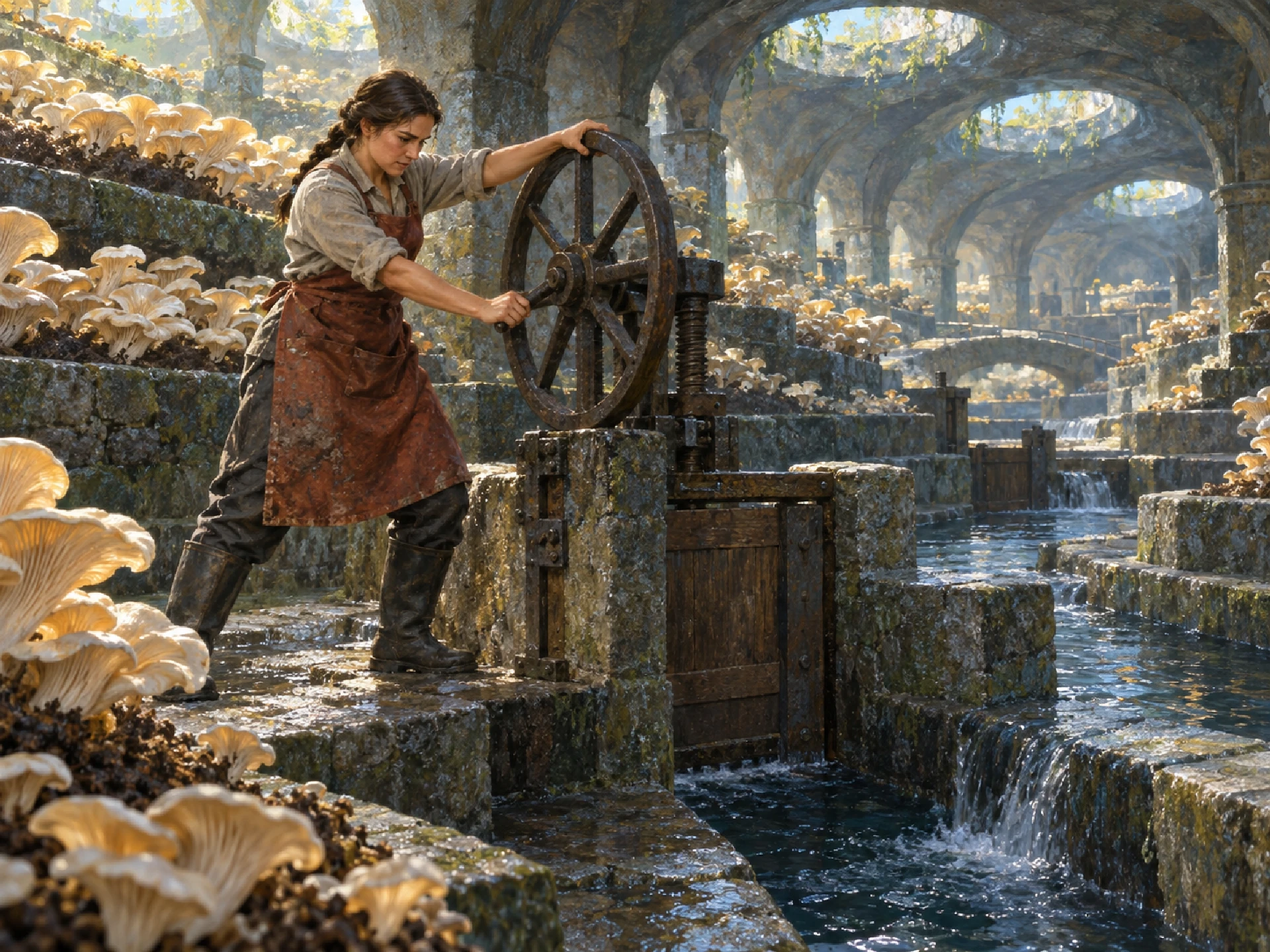
Sluice Wheel in the Mushroom Hall
A worker turns a sluice wheel inside an underground growing hall layered with enormous mushroom shelves and water channels. Soft continuous tones and translucent brushwork give the damp interior a luminous painterly presence.
Remix this referenceSluice Wheel in the Mushroom Hall
- Form language
- Simplify forms into swelling masses and flowing plane changes; retain enough irregularity for a hand-shaped, living world.
- Contour
- Let most boundaries emerge from adjacent tones; use occasional tapered brush edges and soft lost edges instead of uniform outlines.
- Mark-making
- Combine broad curved brush passes with smaller broken strokes; vary their pressure and length naturally within a coherent painted language.
- Surface rendering
- Build continuous tones through translucent oil-like layers over opaque underpainting, allowing gentle scumbles and luminous transitions.
Priority
Keep the luminous continuous-tone painting visibly brush-made.
What to avoid & what to check
Exact prompt for this example
MODULE OWNERSHIP
subject: Subject count, type, stable proportions and landmarks, resting face geometry, hair shape, physical materials, garment construction and permanent marks. No emotion, movement, color assignment or rendering recipe.
expression: Facial soft-tissue displacement and pupil direction, muscle coordination, regional intensity, asymmetry and onset/peak/release. No head/body pose, stable appearance, skin color or rendering.
gesture: Head/neck/body/limb orientation, joint movement, support, contact and pose-caused occlusion using existing anatomy. No eye/pupil movement, emotion, identity, props inventory or camera.
props: Prop count, type, construction, physical material and scale relative to the subject. Holding/contact belongs to gesture, position to composition, color to palette.
scene: Environment elements, terrain, backdrop/floor presence and structural detail. No canvas positions, camera, lighting, assigned colors or render texture.
camera: Projection, focal-length impression, camera elevation/yaw/roll, viewing distance and crop. No actor pose, world placement, lighting or canvas aspect ratio.
composition: Normalized 0-100% canvas positions, scale in frame, depth/overlap, focal hierarchy and margins. No joint pose, camera projection, rendering, subject/prop inventory or emotion.
palette: Color anchors, hue/saturation/value ranges, colors assigned to parts and approximate color coverage. No illumination direction, shading algorithm, physical material or layout.
lighting: Light-source direction/softness/intensity, ambient illumination, physical shadow direction/length and highlight position. Absence of directional illumination is allowed. No shading technique, palette or material changes.
style: Reusable form abstraction, contour weight/taper/edge quality, medium and mark scale/density/direction, surface rendering and tonal transition technique. No fixed subject proportions, anatomy, identity, expression, pose, palette, light-source direction, camera or layout.
output: Image count, aspect ratio, size, file/alpha requirements and global lettering/logo/watermark restrictions. No background scenery, crop, style, identity or pose.

SUBJECT
inventory: One adult woman, actor A, working as the hall's caretaker.
geometry: An ordinary adult build with sturdy forearms, broad palms and a softly rectangular face.
resting-face: Straight brows, gently hooded eyes, a broad nose tip and a wide mouth with an even resting line.
appearance: A short braid, woven work shirt, heavy canvas apron and rubber boots; small wear marks may vary naturally.

PRIORITY


AVOID


CHECK


EXPRESSION — ACTOR A
brows: The inner brows draw slightly together and downward.
lids: Upper lids narrow mildly; lower lids remain gently firm.
cheeks: Cheeks stay close to rest, with slight tension beside the mouth.
nose: The nose stays relaxed, without flaring or wrinkling.
mouth: Lips press lightly together, with one corner a little tighter.
jaw: The jaw is lightly set without pronounced clenching.
gaze: Pupils attend to the wheel's upper rim.
coordination: Brow tension leads; the restrained mouth supports concentrated effort.
timing: Hold the apex of a sustained effort, with the facial tension settled.

PRIORITY


AVOID


CHECK


GESTURE
head: The neck extends slightly forward and the chin dips toward the working hands.
torso: The torso leans into the turn, with a modest twist through the shoulders.
limbs: One arm reaches high while the other draws down; staggered feet brace on the landing.
contact: Both hands wrap the wheel rim; fingers disappear naturally behind it, and both boots bear weight.

PRIORITY


AVOID


CHECK


PROPS
inventory: One fixed sluice wheel, roughly shoulder-wide relative to A.
construction: A cast-iron ring with radial spokes and a short axle connecting to the gate mechanism.

PRIORITY


AVOID


CHECK


SCENE
inventory: An underground mushroom-growing hall with stone terraces, shallow channels, a sluice gate and roof openings.
structure: Broad oyster-like mushroom fans grow from stepped beds; a wooden gate divides the channels beside a stone landing. The stone surfaces are damp.

PRIORITY


AVOID


CHECK


CAMERA
projection: Natural perspective with a moderately wide lens impression and gentle convergence.
viewpoint: View obliquely across the hall from just above standing eye level, with no roll.
crop: A medium-wide view includes A's full figure and cuts through the nearest growing beds.

PRIORITY


AVOID


CHECK


COMPOSITION
placement: A occupies the left third; the wheel sits nearer the middle, while the hall opens across the right half.
depth: Foreground beds overlap the landing; channels weave past the focal group into successive distant terraces.
spacing: The hands and wheel form the primary focus; keep a clear opening around that gesture and spacious depth beyond it.

PRIORITY


AVOID


CHECK


PALETTE
colors: Use slate teal, deep indigo, warm ivory, amber and restrained russet as the main anchors.
assignment: Stone is slate teal, water indigo, mushrooms ivory and amber; the apron is russet, skin warm tan and iron charcoal.
balance: Muted cool midvalues dominate, balanced by generous pale tones and a few richer warm accents.

PRIORITY


AVOID


CHECK


LIGHTING
sources: Broad daylight enters from high left through the roof openings, with soft ambient light throughout the hall.
shadows: Soft shadows extend toward the right; deeper shelter remains beneath the mushroom shelves and gate.
highlights: Upper-left edges catch highlights, with small reflected glints on stone, water and the wheel rim.

PRIORITY


AVOID


CHECK


STYLE GUIDE
form-language: Simplify forms into swelling masses and flowing plane changes; retain enough irregularity for a hand-shaped, living world.
contour: Let most boundaries emerge from adjacent tones; use occasional tapered brush edges and soft lost edges instead of uniform outlines.
mark-making: Combine broad curved brush passes with smaller broken strokes; vary their pressure and length naturally within a coherent painted language.
surface-rendering: Build continuous tones through translucent oil-like layers over opaque underpainting, allowing gentle scumbles and luminous transitions.

PRIORITY
Keep the luminous continuous-tone painting visibly brush-made.

AVOID


CHECK


OUTPUT
format: One finished illustration, landscape 4:3, 1920 × 1440 pixels, PNG with an opaque alpha channel.
restrictions: No lettering, logos or watermarks.

PRIORITY


AVOID


CHECK


FINAL INTEGRATION
expression + gesture: Facial effort and bodily effort should feel like the same sustained action.
composition + lighting + style: Spatial clarity, illumination and painted edge variation should work together to sustain depth and readability.
Model information comes from image provenance. The same prompt may produce a different result.