Text to imageCafe & brandStyle guide
Umbrellas Outside the Repair Shop
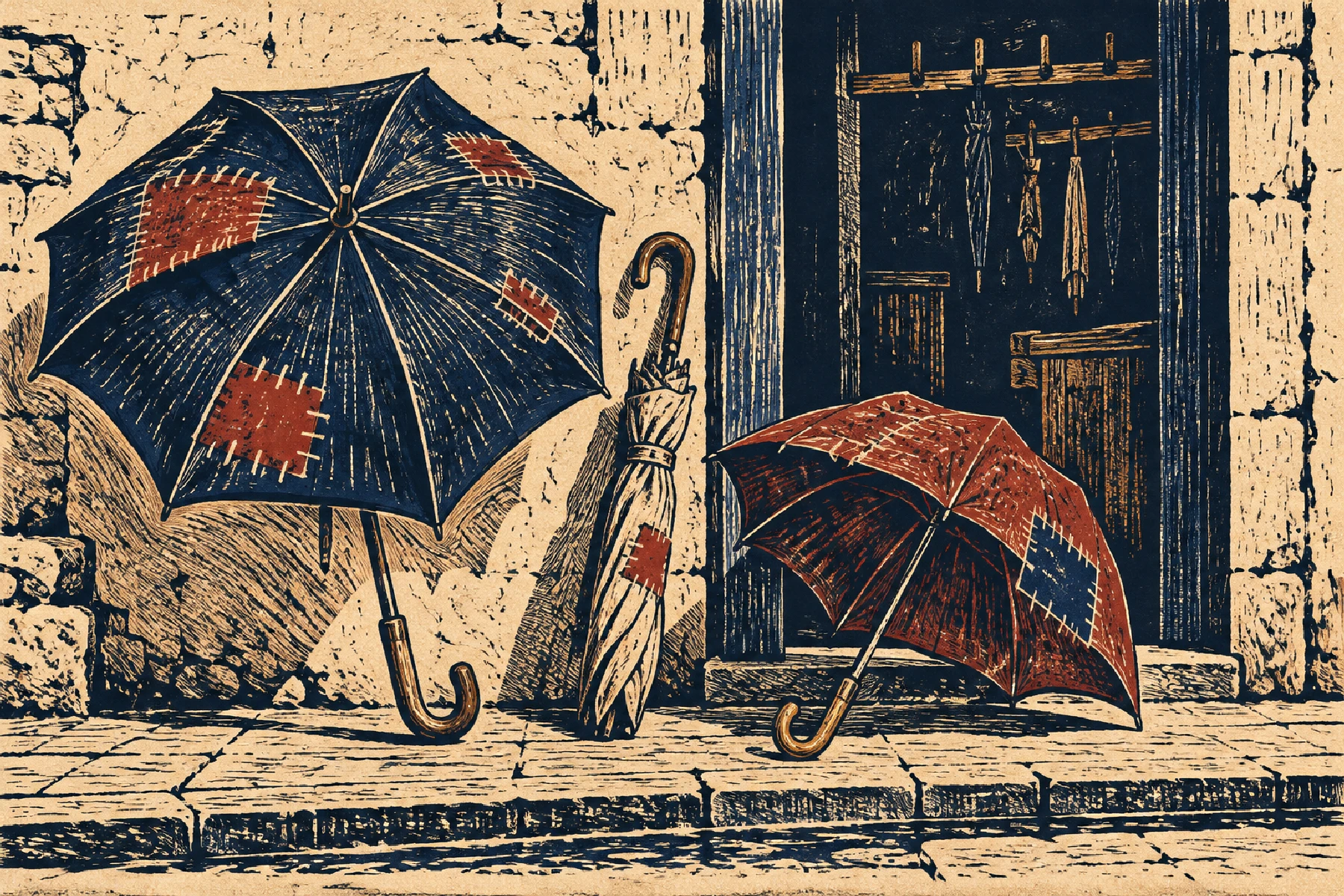
Three patched umbrellas dry outside a small workshop. Bold linocut and generous breathing room give a repair brand a memorable image of objects worth keeping.
Remix this referenceUmbrellas Outside the Repair Shop
- Form language
- Reduce forms to interlocking solid masses and generous cutout gaps; retain uneven, handmade curvature rather than geometric perfection.
- Contour
- Use heavy, slightly scalloped edges interrupted by tapered gouge cuts; let occasional edge breaks reveal the pressure of carving.
- Mark-making
- Group carved strokes into turning rhythmic arcs, varying their lengths and intervals naturally instead of distributing uniform hatching.
- Surface rendering
- Combine dense ink fields with bitten edges and small paper gaps; build middle tones through open cut patterns and uneven ink transfer.
Priority
Bold linocut with carved rhythmic marks.
What to avoid & what to check
Exact prompt for this example
MODULE OWNERSHIP
subject: Subject count, type, stable proportions and landmarks, resting face geometry, hair shape, physical materials, garment construction and permanent marks. No emotion, movement, color assignment or rendering recipe.
expression: Facial soft-tissue displacement and pupil direction, muscle coordination, regional intensity, asymmetry and onset/peak/release. No head/body pose, stable appearance, skin color or rendering.
gesture: Head/neck/body/limb orientation, joint movement, support, contact and pose-caused occlusion using existing anatomy. No eye/pupil movement, emotion, identity, props inventory or camera.
props: Prop count, type, construction, physical material and scale relative to the subject. Holding/contact belongs to gesture, position to composition, color to palette.
scene: Environment elements, terrain, backdrop/floor presence and structural detail. No canvas positions, camera, lighting, assigned colors or render texture.
camera: Projection, focal-length impression, camera elevation/yaw/roll, viewing distance and crop. No actor pose, world placement, lighting or canvas aspect ratio.
composition: Normalized 0-100% canvas positions, scale in frame, depth/overlap, focal hierarchy and margins. No joint pose, camera projection, rendering, subject/prop inventory or emotion.
palette: Color anchors, hue/saturation/value ranges, colors assigned to parts and approximate color coverage. No illumination direction, shading algorithm, physical material or layout.
lighting: Light-source direction/softness/intensity, ambient illumination, physical shadow direction/length and highlight position. Absence of directional illumination is allowed. No shading technique, palette or material changes.
style: Reusable form abstraction, contour weight/taper/edge quality, medium and mark scale/density/direction, surface rendering and tonal transition technique. No fixed subject proportions, anatomy, identity, expression, pose, palette, light-source direction, camera or layout.
output: Image count, aspect ratio, size, file/alpha requirements and global lettering/logo/watermark restrictions. No background scenery, crop, style, identity or pose.

SUBJECT
inventory: Three repaired everyday umbrellas: two open and one furled; no people or animals.
geometry: Broad segmented canopies have slender ribs and curved handles; the furled umbrella makes a narrow tapered bundle.
resting-face: No faces or facial geometry apply.
appearance: Woven covers carry conspicuous sewn patches; metal ribs and wooden handles show modest wear. Patch shapes may vary.

PRIORITY


AVOID


CHECK


PROPS
inventory: No separate props.
construction: No prop construction applies.

PRIORITY


AVOID


CHECK


SCENE
inventory: A small repair-shop frontage, a recessed doorway, built-in drying pegs and a shallow pavement drainage channel.
structure: An irregular masonry wall surrounds the deep door recess; a plain lintel and continuous pavement establish the modest street setting.

PRIORITY


AVOID


CHECK


CAMERA
projection: Use a restrained perspective with a normal-lens impression and little depth exaggeration.
viewpoint: Look almost straight toward the frontage from slightly above handle height, with a level horizon.
crop: A medium-wide view includes all three umbrellas and a strip of pavement; the building continues beyond the frame.

PRIORITY


AVOID


CHECK


COMPOSITION
placement: Place the largest canopy near 30% width, the smaller canopy low beside the doorway, and the furled umbrella between them.
depth: The large patched canopy leads, the smaller canopy overlaps its lower edge, and the recessed doorway supplies a quieter third layer.
spacing: Keep the right third spacious; alternate broad canopy shapes with narrow handles and generous wall intervals.

PRIORITY


AVOID


CHECK


PALETTE
colors: Use midnight blue, brick red and warm flax, with strong dark-light separation and restrained saturation.
assignment: Midnight blue covers the main canopy and doorway; brick red marks repairs and the smaller canopy; flax fills the wall and pavement.
balance: Let flax occupy the largest share, blue form substantial anchors, and red remain a smaller recurring accent.

PRIORITY


AVOID


CHECK


LIGHTING
sources: Broad daylight enters from the upper left with soft ambient light inside the doorway.
shadows: Umbrella shadows fall down and right across the wall; the doorway retains the deepest physical shadow.
highlights: Keep broad light-facing areas on upper canopy curves and small highlights along exposed handle bends.

PRIORITY


AVOID


CHECK


STYLE GUIDE
form-language: Reduce forms to interlocking solid masses and generous cutout gaps; retain uneven, handmade curvature rather than geometric perfection.
contour: Use heavy, slightly scalloped edges interrupted by tapered gouge cuts; let occasional edge breaks reveal the pressure of carving.
mark-making: Group carved strokes into turning rhythmic arcs, varying their lengths and intervals naturally instead of distributing uniform hatching.
surface-rendering: Combine dense ink fields with bitten edges and small paper gaps; build middle tones through open cut patterns and uneven ink transfer.

PRIORITY
Bold linocut with carved rhythmic marks.

AVOID


CHECK


OUTPUT
format: Deliver one opaque PNG, landscape 3:2, at 1800 × 1200 pixels.
restrictions: No lettering, logos or watermarks.

PRIORITY


AVOID


CHECK


FINAL INTEGRATION
subject + style: Translate the repair landmarks into the carving vocabulary while preserving their everyday credibility.
composition + style: Let the carved rhythms connect separated forms without consuming the breathing room.
Model information comes from image provenance. The same prompt may produce a different result.