Text to imageLandscapeStyle guide
Small Plowed Field · Receding Furrow Spacing
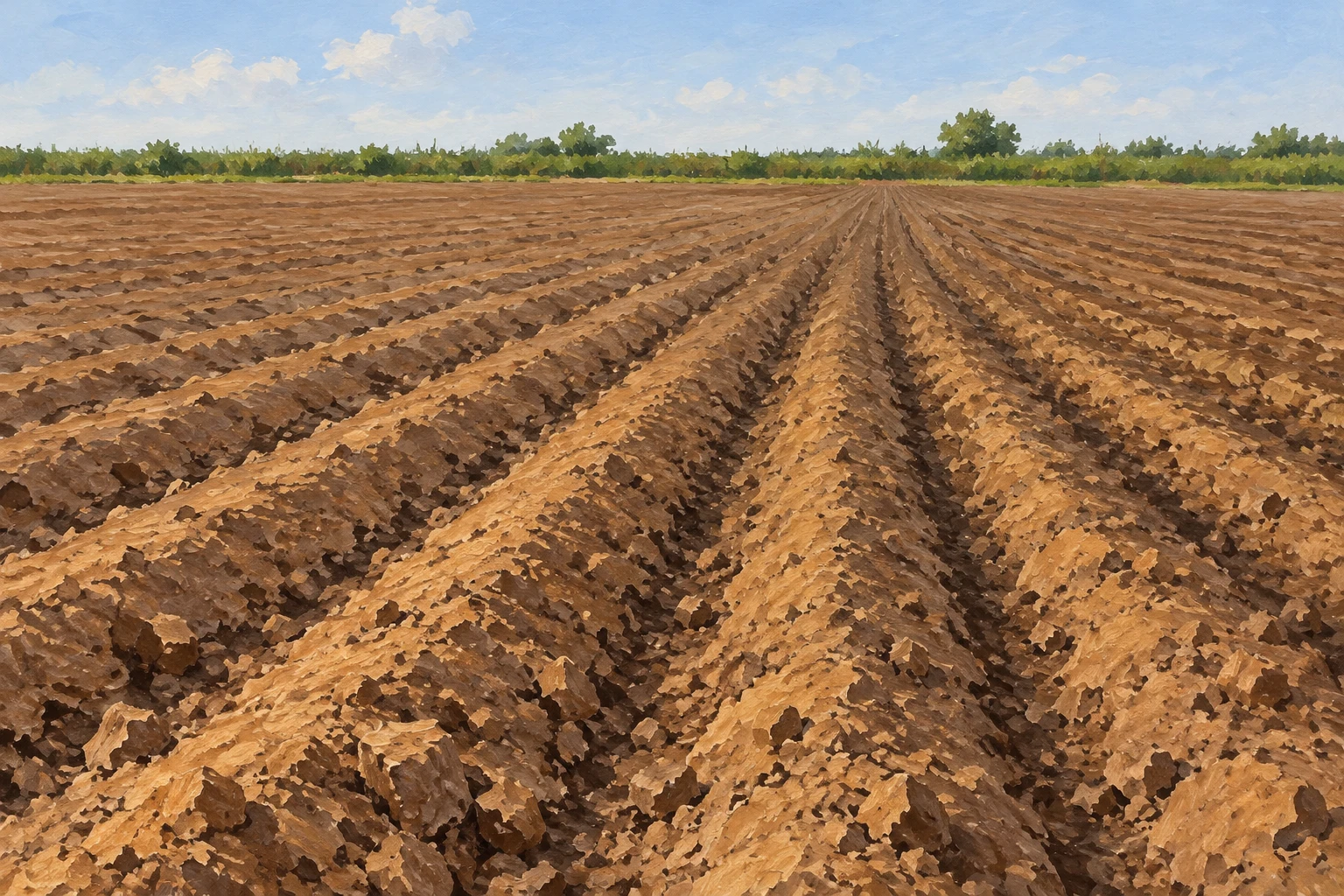
Wide, distinct foreground furrows narrow and gather in the distance to give a flat field readable depth.
Small Plowed Field · Receding Furrow Spacing
- Shape & line
- Draw the furrow crests as gently irregular continuous paths: separate them broadly at the bottom edge, then progressively narrow their apparent widths and gaps as they converge toward the same distant region.
- Color & light
- Light the field from the upper-left image side. Paint each ridge's left-facing slope warm ochre and its right-facing slope muted brown, with a darker narrow groove immediately to the right of the crest; repeat this light-and-shadow order into the distance.
- Texture & material
- Use matte, opaque gouache patches to suggest rough soil. Show a few clearly separated angular clods in the foreground, reduce them to smaller broken marks in the middle distance, and merge them into quiet tonal bands near the boundary.
- Composition
- Let the field occupy most of the frame and keep the grassy boundary low and simple. Preserve visible groove gaps in the foreground, compress them near the horizon, and keep the sky smooth so the changing furrow spacing carries the depth.
Priority
Make the progressive narrowing of furrow widths and gaps the clearest depth cue.
What to avoid & what to check
Avoid equally spaced screen-parallel stripes or distant soil clods as large as foreground clods.
Check that the furrows converge consistently and both their spacing and soil marks diminish toward the grassy boundary.
Exact prompt for this example
SUBJECT
One small, flat, freshly plowed brown field with parallel soil ridges and grooves extending away from the viewer toward a single low grassy boundary.

COMPOSITION
View the field from a low standing viewpoint in a wide landscape frame. Furrows enter across the bottom edge and recede toward a shared vanishing region slightly right of center. Place the grassy boundary near the upper third, with a narrow strip of pale sky above it.

STYLE GUIDE
1. Shape & line
Draw the furrow crests as gently irregular continuous paths: separate them broadly at the bottom edge, then progressively narrow their apparent widths and gaps as they converge toward the same distant region.

2. Color & light
Light the field from the upper-left image side. Paint each ridge's left-facing slope warm ochre and its right-facing slope muted brown, with a darker narrow groove immediately to the right of the crest; repeat this light-and-shadow order into the distance.

3. Texture & material
Use matte, opaque gouache patches to suggest rough soil. Show a few clearly separated angular clods in the foreground, reduce them to smaller broken marks in the middle distance, and merge them into quiet tonal bands near the boundary.

4. Composition
Let the field occupy most of the frame and keep the grassy boundary low and simple. Preserve visible groove gaps in the foreground, compress them near the horizon, and keep the sky smooth so the changing furrow spacing carries the depth.

PRIORITY
Preserve the requested identity, count, action, composition and output settings. Apply the style rules within those constraints; a style reference must not replace the subject or layout. Within the style: Make the progressive narrowing of furrow widths and gaps the clearest depth cue.

AVOID
Avoid equally spaced screen-parallel stripes or distant soil clods as large as foreground clods.

OUTPUT
One landscape image in a 3:2 aspect ratio, rendered as a naturalistic opaque gouache study, with no text, labels, border, or watermark.

SELF-CHECK
Check that the furrows converge consistently and both their spacing and soil marks diminish toward the grassy boundary.
Model information comes from image provenance. The same prompt may produce a different result.