Text to imageSpace & architectureStyle guide
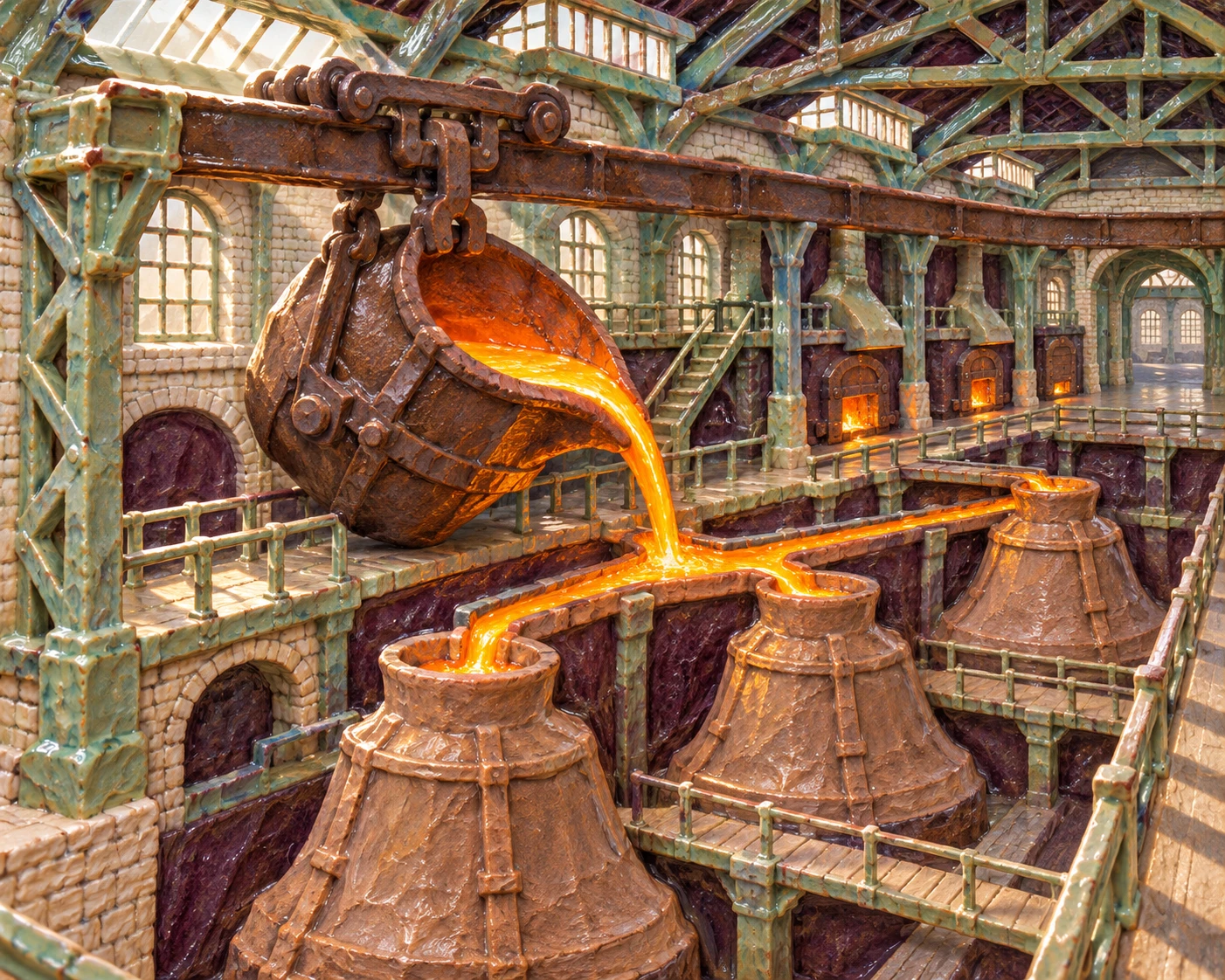
A Bell Foundry During a Pour
Casting channels, bell molds and a gantry overlap inside a foundry, expressed through hand-modeled ceramic relief and pooled glaze.
Remix this referenceA Bell Foundry During a Pour
- Form language
- Translate forms into hand-pressed ceramic relief, using broad shallow planes and rounded raised masses with slight handmade irregularity.
- Contour
- Define boundaries with rolled clay lips and shallow incised grooves; vary their softness instead of adding uniform drawn outlines.
- Mark-making
- Let broad modeling-tool sweeps and occasional thumb impressions remain legible, with looser marks across less articulated passages.
- Surface rendering
- Use pooled glaze in recesses, thin translucent washes over ridges and occasional exposed clay; tonal changes follow uneven glaze depth.
Priority
Make modeled relief depth and irregular glaze pooling visibly define the ceramic illustration.
What to avoid & what to check
Exact prompt for this example
MODULE OWNERSHIP
subject: Subject count, type, stable proportions and landmarks, resting face geometry, hair shape, physical materials, garment construction and permanent marks. No emotion, movement, color assignment or rendering recipe.
expression: Facial soft-tissue displacement and pupil direction, muscle coordination, regional intensity, asymmetry and onset/peak/release. No head/body pose, stable appearance, skin color or rendering.
gesture: Head/neck/body/limb orientation, joint movement, support, contact and pose-caused occlusion using existing anatomy. No eye/pupil movement, emotion, identity, props inventory or camera.
props: Prop count, type, construction, physical material and scale relative to the subject. Holding/contact belongs to gesture, position to composition, color to palette.
scene: Environment elements, terrain, backdrop/floor presence and structural detail. No canvas positions, camera, lighting, assigned colors or render texture.
camera: Projection, focal-length impression, camera elevation/yaw/roll, viewing distance and crop. No actor pose, world placement, lighting or canvas aspect ratio.
composition: Normalized 0-100% canvas positions, scale in frame, depth/overlap, focal hierarchy and margins. No joint pose, camera projection, rendering, subject/prop inventory or emotion.
palette: Color anchors, hue/saturation/value ranges, colors assigned to parts and approximate color coverage. No illumination direction, shading algorithm, physical material or layout.
lighting: Light-source direction/softness/intensity, ambient illumination, physical shadow direction/length and highlight position. Absence of directional illumination is allowed. No shading technique, palette or material changes.
style: Reusable form abstraction, contour weight/taper/edge quality, medium and mark scale/density/direction, surface rendering and tonal transition technique. No fixed subject proportions, anatomy, identity, expression, pose, palette, light-source direction, camera or layout.
output: Image count, aspect ratio, size, file/alpha requirements and global lettering/logo/watermark restrictions. No background scenery, crop, style, identity or pose.

SUBJECT
inventory: No character subjects.
geometry: No character proportions or anatomical landmarks apply.
resting-face: No faces or facial geometry apply.
appearance: No character appearance or garments apply.

PRIORITY


AVOID


CHECK


PROPS
inventory: One industrial crucible and three large bell casting molds, substantial enough to require a gantry.
construction: The iron crucible has a broad pouring lip; refractory clay molds have flared bell bodies and open funnel necks.

PRIORITY


AVOID


CHECK


SCENE
inventory: A brick foundry hall contains a casting trench, raised walkways, an upper access gallery, a spanning gantry, furnace bays and roof monitors.
structure: Molten metal pours into branching casting channels; narrow walkway bridges connect the work bays across the trench.

PRIORITY


AVOID


CHECK


CAMERA
projection: Use gently compressed architectural perspective with a normal-lens impression.
viewpoint: Look diagonally downward from an elevated viewpoint, with no camera roll.
crop: Frame a substantial interior section, cropping the nearest beam and floor edge while retaining the roof structure.

PRIORITY


AVOID


CHECK


COMPOSITION
placement: Place the pouring junction near 60% width and 60% height; the crucible occupies the upper left and molds stagger below.
depth: The pour is the focal point; overlapping gantry, crucible rim and mold shoulders lead into successive furnace bays.
spacing: Alternate dense equipment overlaps with open trench intervals; retain a clear glimpse through the farthest bay.

PRIORITY


AVOID


CHECK


PALETTE
colors: Use celadon, iron brown, warm ivory and deep aubergine, with concentrated orange-yellow accents.
assignment: Architecture is celadon and ivory; equipment is iron brown; recesses are aubergine; molten passages are orange-yellow.
balance: Restrained architectural colors occupy most of the image; vivid accents remain concentrated in the casting network.

PRIORITY


AVOID


CHECK


LIGHTING
sources: Soft daylight descends from upper-left roof openings, supplemented by stronger local illumination from the molten metal.
shadows: Broad architectural shadows fall toward the lower right; close overlaps cast short, distinct contact shadows.
highlights: Highlights catch upper-left relief ridges and lower edges facing the molten channels.

PRIORITY


AVOID


CHECK


STYLE GUIDE
form-language: Translate forms into hand-pressed ceramic relief, using broad shallow planes and rounded raised masses with slight handmade irregularity.
contour: Define boundaries with rolled clay lips and shallow incised grooves; vary their softness instead of adding uniform drawn outlines.
mark-making: Let broad modeling-tool sweeps and occasional thumb impressions remain legible, with looser marks across less articulated passages.
surface-rendering: Use pooled glaze in recesses, thin translucent washes over ridges and occasional exposed clay; tonal changes follow uneven glaze depth.

PRIORITY
Make modeled relief depth and irregular glaze pooling visibly define the ceramic illustration.

AVOID


CHECK


OUTPUT
format: One finished image.
restrictions: One finished image, 5:4 aspect ratio, 2500 × 2000 pixels, opaque PNG; no lettering, logos or watermarks.

PRIORITY


AVOID


CHECK
Model information comes from image provenance. The same prompt may produce a different result.