Text to imageArt stylesStyle guide
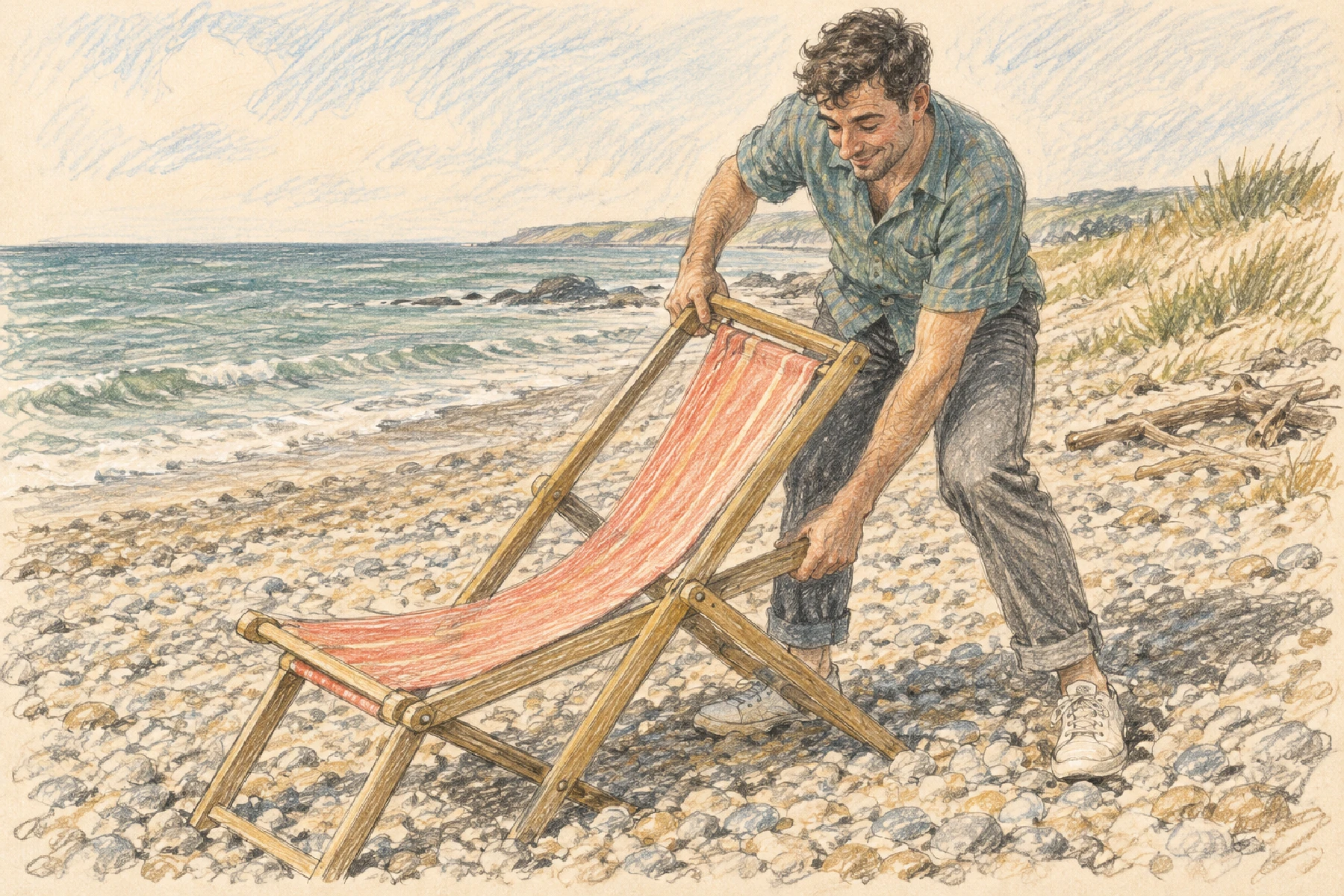
Man Unfolding a Deckchair
A man suppresses a laugh while wrestling a folding deckchair on a pebble beach. Overlapping arms and chair rails become a lively finished sketchbook illustration through rough pencil lines and loose colored-pencil layers.
Remix this referenceMan Unfolding a Deckchair
- Form language
- Reduce forms to lopsided wedges, loose arcs and open planes; retain useful irregularities and let minor shapes vary naturally.
- Contour
- Use searching graphite contours with broken edges, occasional doubled lines and pressure-darkened turns; avoid uniformly sealed outlines.
- Mark-making
- Lay colored pencil in loose oblique strokes over rough graphite; alternate broad side strokes with quick pointed scratches and leave breathing gaps.
- Surface rendering
- Build tones through uneven hatching and translucent dry scumbles; allow paper tooth, modest graphite smears and unfinished edges to remain visible.
Priority
Make rough pencil and colored-pencil sketchbook drawing visibly define the finished image.
What to avoid & what to check
Exact prompt for this example
MODULE OWNERSHIP
subject: Subject count, type, stable proportions and landmarks, resting face geometry, hair shape, physical materials, garment construction and permanent marks. No emotion, movement, color assignment or rendering recipe.
expression: Facial soft-tissue displacement and pupil direction, muscle coordination, regional intensity, asymmetry and onset/peak/release. No head/body pose, stable appearance, skin color or rendering.
gesture: Head/neck/body/limb orientation, joint movement, support, contact and pose-caused occlusion using existing anatomy. No eye/pupil movement, emotion, identity, props inventory or camera.
props: Prop count, type, construction, physical material and scale relative to the subject. Holding/contact belongs to gesture, position to composition, color to palette.
scene: Environment elements, terrain, backdrop/floor presence and structural detail. No canvas positions, camera, lighting, assigned colors or render texture.
camera: Projection, focal-length impression, camera elevation/yaw/roll, viewing distance and crop. No actor pose, world placement, lighting or canvas aspect ratio.
composition: Normalized 0-100% canvas positions, scale in frame, depth/overlap, focal hierarchy and margins. No joint pose, camera projection, rendering, subject/prop inventory or emotion.
palette: Color anchors, hue/saturation/value ranges, colors assigned to parts and approximate color coverage. No illumination direction, shading algorithm, physical material or layout.
lighting: Light-source direction/softness/intensity, ambient illumination, physical shadow direction/length and highlight position. Absence of directional illumination is allowed. No shading technique, palette or material changes.
style: Reusable form abstraction, contour weight/taper/edge quality, medium and mark scale/density/direction, surface rendering and tonal transition technique. No fixed subject proportions, anatomy, identity, expression, pose, palette, light-source direction, camera or layout.
output: Image count, aspect ratio, size, file/alpha requirements and global lettering/logo/watermark restrictions. No background scenery, crop, style, identity or pose.

SUBJECT
inventory: One adult man, actor A.
geometry: An ordinary adult build with broad shoulders, a square chin and a rounded nose; keep proportions recognizably human.
resting-face: Straight brows, gently hooded eyes and a broad mouth with an even resting lip line.
appearance: Short loosely curled hair, a woven short-sleeved shirt, cuffed trousers and canvas shoes; incidental details may vary.

PRIORITY


AVOID


CHECK


EXPRESSION — ACTOR A
brows: One brow lifts slightly while the other stays relaxed.
lids: Lower lids rise gently; upper lids remain comfortably open.
cheeks: Cheeks lift modestly, slightly more on the raised mouth-corner side.
nose: Nostrils stay relaxed without wrinkling the nose.
mouth: Lips part narrowly in a restrained smile, with one corner higher.
jaw: The jaw releases slightly without a wide opening.
gaze: Pupils turn downward toward the chair hinge.
coordination: The uneven smile and gentle cheek lift carry the amusement; the brow response stays quieter.
timing: Hold the apex of a small, contained chuckle.

PRIORITY


AVOID


CHECK


GESTURE
head: A lowers his head toward the chair, keeping his neck loosely extended.
torso: His torso bends forward and turns slightly across the chair.
limbs: Feet brace apart with softened knees; one elbow rises as the opposite arm reaches lower.
contact: One hand lifts the upper rail while the other steadies the lower rail; the partly folded frame crosses his shin.

PRIORITY


AVOID


CHECK


PROPS
inventory: One adult-sized folding deckchair.
construction: A hinged wooden frame supports a sagging woven-canvas sling; preserve its recognizable folding mechanism.

PRIORITY


AVOID


CHECK


SCENE
inventory: A pebble beach, a low drift bank and an open stretch of sea.
structure: Uneven pebbles meet a gently curving shoreline; the drift bank contains sparse beach grass.

PRIORITY


AVOID


CHECK


CAMERA
projection: Natural perspective with a moderate focal-length impression.
viewpoint: A slightly elevated three-quarter view with a level horizon.
crop: A medium-wide view includes the full figure and chair with surrounding beach.

PRIORITY


AVOID


CHECK


COMPOSITION
placement: A occupies the right-middle near 65% canvas width; the chair extends toward the lower-left near 40%.
depth: Overlapping rails and arms form the primary knot; the face is secondary, and the shoreline recedes behind them.
spacing: Leave generous open space above and to the left, with small gaps between the overlapping forms.

PRIORITY


AVOID


CHECK


PALETTE
colors: Warm paper cream, graphite gray, muted sea green, ochre and a restrained coral accent.
assignment: Sea green belongs to sea and shirt, ochre to wood and beach, coral to the sling, and graphite gray to hair and trousers.
balance: Paper cream remains broadly visible; muted colors dominate, with coral confined to a small vivid accent.

PRIORITY


AVOID


CHECK


LIGHTING
sources: Soft daylight arrives from the upper left with ample ambient illumination.
shadows: Short, soft shadows fall to the right beneath the shoes and chair.
highlights: Broad highlights sit on the upper-left shoulders and upward-facing wooden rails.

PRIORITY


AVOID


CHECK


STYLE GUIDE
form-language: Reduce forms to lopsided wedges, loose arcs and open planes; retain useful irregularities and let minor shapes vary naturally.
contour: Use searching graphite contours with broken edges, occasional doubled lines and pressure-darkened turns; avoid uniformly sealed outlines.
mark-making: Lay colored pencil in loose oblique strokes over rough graphite; alternate broad side strokes with quick pointed scratches and leave breathing gaps.
surface-rendering: Build tones through uneven hatching and translucent dry scumbles; allow paper tooth, modest graphite smears and unfinished edges to remain visible.

PRIORITY
Make rough pencil and colored-pencil sketchbook drawing visibly define the finished image.

AVOID


CHECK


OUTPUT
format: One finished landscape image, 3:2 aspect ratio, 1800 × 1200 pixels, opaque PNG.
restrictions: No lettering, logos or watermarks.

PRIORITY


AVOID


CHECK


FINAL INTEGRATION
gesture + composition + style: Keep the interaction readable through overlap while allowing the drawing to simplify secondary detail freely.
Model information comes from image provenance. The same prompt may produce a different result.