Text to imageComicsStyle guide
A Weed Lifts the Paving Stone
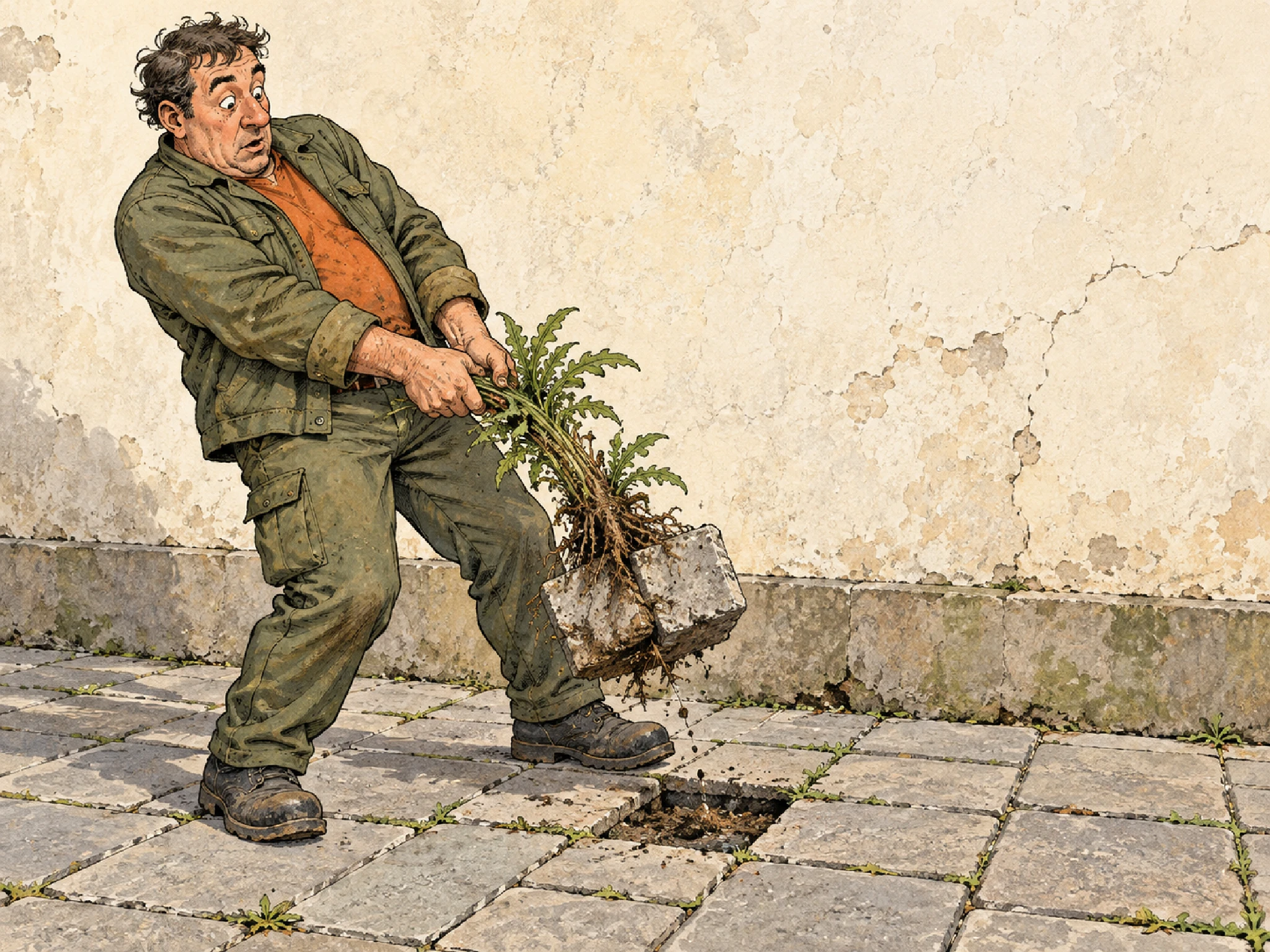
Rough independent-comic pen and wash captures a worker pulling a weed and lifting its paving stone too. An asymmetric figure and tangled root cluster meet a broad reserve of empty wall, giving the small absurdity room to linger.
Remix this referenceA Weed Lifts the Paving Stone
- Form language
- Reduce forms to blunt masses and elastic connecting curves; allow small irregularities within a coherent handmade comic language.
- Contour
- Use scratchy dip-pen contours with abrupt thick-thin changes, occasional broken edges and visible corrective overlaps.
- Mark-making
- Gather short hooked strokes and loose oblique hatching in uneven clusters, letting pen skips and stroke lengths vary naturally.
- Surface rendering
- Lay transparent washes under and across the ink, with pooled rims, uneven dilution and open paper interrupting tonal transitions.
Priority
Rendering medium: rough independent-comic pen-and-wash illustration.
What to avoid & what to check
Exact prompt for this example
MODULE OWNERSHIP
subject: Subject count, type, stable proportions and landmarks, resting face geometry, hair shape, physical materials, garment construction and permanent marks. No emotion, movement, color assignment or rendering recipe.
expression: Facial soft-tissue displacement and pupil direction, muscle coordination, regional intensity, asymmetry and onset/peak/release. No head/body pose, stable appearance, skin color or rendering.
gesture: Head/neck/body/limb orientation, joint movement, support, contact and pose-caused occlusion using existing anatomy. No eye/pupil movement, emotion, identity, props inventory or camera.
props: Prop count, type, construction, physical material and scale relative to the subject. Holding/contact belongs to gesture, position to composition, color to palette.
scene: Environment elements, terrain, backdrop/floor presence and structural detail. No canvas positions, camera, lighting, assigned colors or render texture.
camera: Projection, focal-length impression, camera elevation/yaw/roll, viewing distance and crop. No actor pose, world placement, lighting or canvas aspect ratio.
composition: Normalized 0-100% canvas positions, scale in frame, depth/overlap, focal hierarchy and margins. No joint pose, camera projection, rendering, subject/prop inventory or emotion.
palette: Color anchors, hue/saturation/value ranges, colors assigned to parts and approximate color coverage. No illumination direction, shading algorithm, physical material or layout.
lighting: Light-source direction/softness/intensity, ambient illumination, physical shadow direction/length and highlight position. Absence of directional illumination is allowed. No shading technique, palette or material changes.
style: Reusable form abstraction, contour weight/taper/edge quality, medium and mark scale/density/direction, surface rendering and tonal transition technique. No fixed subject proportions, anatomy, identity, expression, pose, palette, light-source direction, camera or layout.
output: Image count, aspect ratio, size, file/alpha requirements and global lettering/logo/watermark restrictions. No background scenery, crop, style, identity or pose.

SUBJECT
inventory: One original adult municipal maintenance worker, actor A; no additional people.
geometry: A compact, sturdy build with broad hands, a rounded chin and a long, slightly hooked nose.
resting-face: Straight brows, shallow upper-lid folds and a broad mouth with a fuller lower lip define the resting face.
appearance: Short uneven curls; a cotton-twill work jacket over a plain shirt, roomy trousers and rubber work shoes.

PRIORITY


AVOID


CHECK


EXPRESSION — ACTOR A
brows: Both brows rise, with one outer end climbing slightly higher.
lids: Upper lids lift; lower lids remain loose rather than tightening.
cheeks: Cheeks stay relaxed, without a smile-driven upward bunch.
nose: The nose remains unwrinkled, with nostrils at rest.
mouth: Lips part into a small uneven opening; neither corner pulls upward.
jaw: The jaw releases just enough to separate the lips.
gaze: Both pupils turn downward toward the attached paving stone.
coordination: The lifted brows and lids lead the smaller mouth opening.
timing: Catch the onset of surprise, before the mouth opens fully.

PRIORITY


AVOID


CHECK


GESTURE
head: A draws the neck back slightly and tips the chin toward the lifted stone.
torso: The torso leans backward from the hips while the shoulders stay uneven.
limbs: Bent elbows draw the hands toward the waist; one knee bends while the rear leg braces the pull.
contact: Both hands clasp the weed stems; both shoes stay planted, and the attached stone hangs clear of the pavement.

PRIORITY


AVOID


CHECK


PROPS
inventory: One linked assembly: a split paving stone with a wiry weed rooted through it, the stone roughly a shoe-length wide.
construction: A thick concrete block has chipped corners; fibrous roots thread through its split beneath a loose tuft of narrow leaves.

PRIORITY


AVOID


CHECK


SCENE
inventory: A modest sidewalk beside an uninterrupted plaster wall; no street furnishings.
structure: Rectangular paving joints surround one open recess; the wall has a low footing and a few irregular cracks.

PRIORITY


AVOID


CHECK


CAMERA
projection: Use natural perspective with a normal-lens impression and restrained depth convergence.
viewpoint: View from adult chest height at a slight frontal three-quarter yaw, with no roll.
crop: A moderately distant full-figure view includes the shoes and paving recess; the wall continues beyond the crop.

PRIORITY


AVOID


CHECK


COMPOSITION
placement: A occupies the lower-left third; the root-and-stone cluster lies nearer the center, beneath a broad upper-right reserve.
depth: A overlaps the wall; the lifted assembly reads in front of the torso, with the pavement recess on a deeper plane.
spacing: Use one continuous composition without sequential panels. The figure fills about half the image height. Face and stone share focus; clear gaps preserve the root silhouette.

PRIORITY


AVOID


CHECK


PALETTE
colors: Use warm ivory, soot black, muted olive and rusty orange, with restrained saturation and a broad light-value range.
assignment: Ivory anchors the wall, olive the jacket and weed, rusty orange the shirt and warm skin, and grey-black the stone and shoes.
balance: Light ivory dominates; olive forms the main color mass, with orange used sparingly and black in smaller accents.

PRIORITY


AVOID


CHECK


LIGHTING
sources: Broad, soft daylight arrives from upper left, with generous ambient illumination.
shadows: Short soft shadows fall toward lower right; a detached shadow beneath the stone makes its lift visible.
highlights: Gentle highlights favor the upper-left brow, shoulder and stone rim, without sharp glints.

PRIORITY


AVOID


CHECK


STYLE GUIDE
form-language: Reduce forms to blunt masses and elastic connecting curves; allow small irregularities within a coherent handmade comic language.
contour: Use scratchy dip-pen contours with abrupt thick-thin changes, occasional broken edges and visible corrective overlaps.
mark-making: Gather short hooked strokes and loose oblique hatching in uneven clusters, letting pen skips and stroke lengths vary naturally.
surface-rendering: Lay transparent washes under and across the ink, with pooled rims, uneven dilution and open paper interrupting tonal transitions.

PRIORITY
Rendering medium: rough independent-comic pen-and-wash illustration.

AVOID


CHECK


OUTPUT
format: One finished illustration, landscape 4:3, 2048 × 1536 pixels, PNG with an opaque background.
restrictions: No lettering, speech balloons, logos or watermarks.

PRIORITY


AVOID


CHECK


FINAL INTEGRATION
expression + gesture + composition: Let facial acting and the interrupted pull meet at the shared focal area, while their surrounding space carries the comic pause.
style + palette + lighting: Let the pen and wash interpret the chosen colors and light loosely, preserving their roles through natural variation.
Model information comes from image provenance. The same prompt may produce a different result.