Text to imageProductStyle guide
Mint Terrazzo Coaster · Edge-Clipped Chips
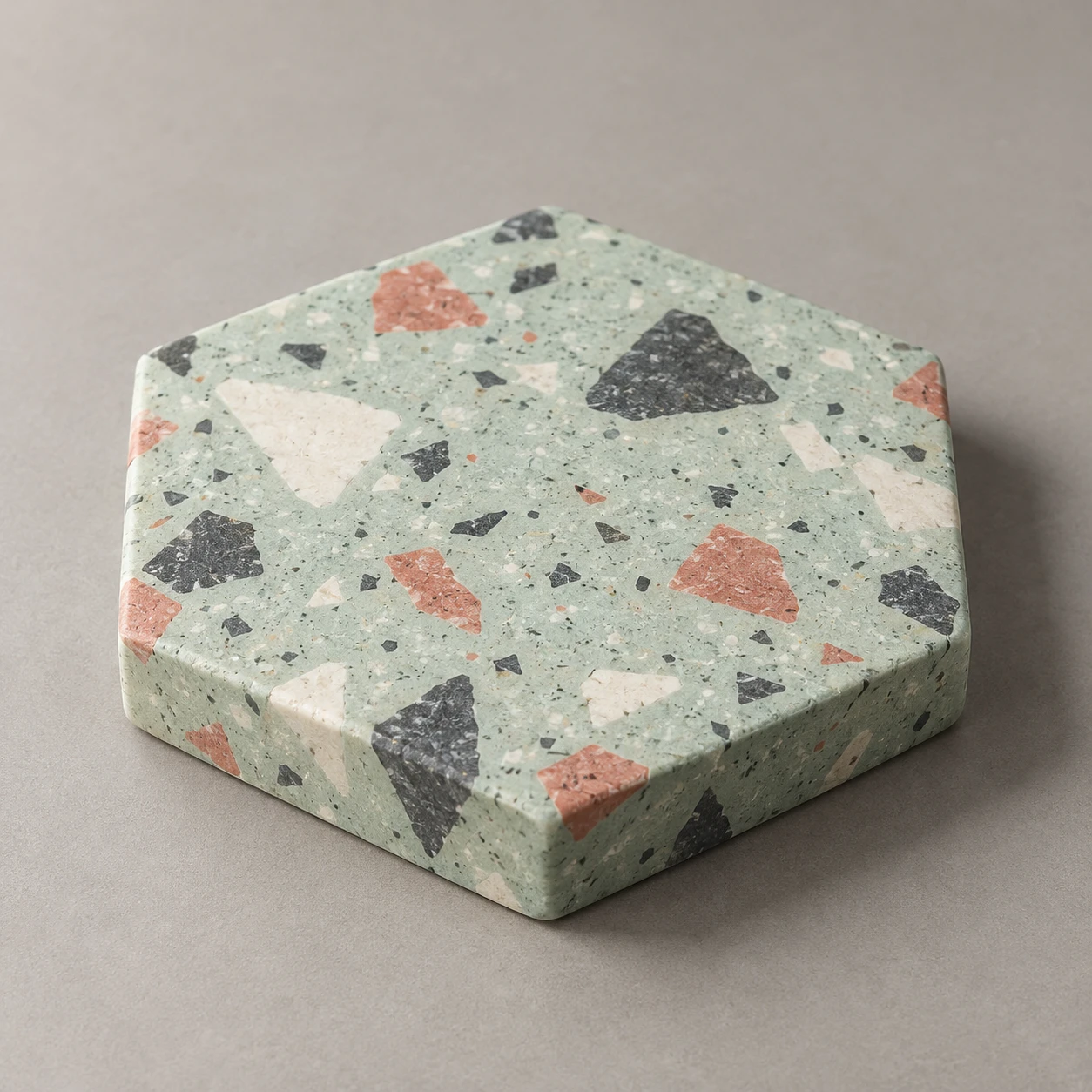
Clip irregular chips at the edges of a mint terrazzo coaster so its pattern reads as aggregate embedded in the material.
Mint Terrazzo Coaster · Edge-Clipped Chips
- Shape & line
- Build a clean hexagonal slab with straight outer edges and subtly softened corners. Draw the embedded chips as varied angular polygons, and let several polygons terminate abruptly at the top perimeter instead of shrinking or leaving a decorative border.
- Color & light
- Use a pale mint base with ivory, charcoal, and muted coral inclusions. Light from the upper-left image side with a broad soft source, making the top brighter than the front side faces and placing a soft cast shadow on the tabletop toward the lower-right image side.
- Texture & material
- Render a smooth honed surface with a restrained broad sheen. Embed chips flush within the base, vary their sizes and spacing, and carry a few edge-crossing inclusions onto the adjoining side face as related cut sections; avoid raised pieces or painted-on speckles.
- Composition
- Keep the complete silhouette and both front side faces visible against an uncluttered tabletop. Make the coaster large enough to read several clipped chips along the nearest edges, and maintain sharp focus across the product so the top-to-side transitions remain legible.
Priority
Prioritize chips visibly cut by the perimeter and embedded across the slab's exposed faces.
What to avoid & what to check
Avoid a repeated confetti pattern, a chip-free border, or raised mosaic tiles.
Check that several chips meet the nearest edges and that their cut sections read as part of one solid material.
Exact prompt for this example
SUBJECT
One thick hexagonal mint terrazzo coaster resting flat on a plain warm-gray tabletop, with irregular ivory, charcoal, and muted coral chips embedded in its top and visible side faces.

COMPOSITION
Use an elevated three-quarter view that clearly reveals the broad top and two shallow front side faces. Center the entire coaster with generous tabletop space around it; keep its nearest corner toward the lower center of the image.

STYLE GUIDE
1. Shape & line
Build a clean hexagonal slab with straight outer edges and subtly softened corners. Draw the embedded chips as varied angular polygons, and let several polygons terminate abruptly at the top perimeter instead of shrinking or leaving a decorative border.

2. Color & light
Use a pale mint base with ivory, charcoal, and muted coral inclusions. Light from the upper-left image side with a broad soft source, making the top brighter than the front side faces and placing a soft cast shadow on the tabletop toward the lower-right image side.

3. Texture & material
Render a smooth honed surface with a restrained broad sheen. Embed chips flush within the base, vary their sizes and spacing, and carry a few edge-crossing inclusions onto the adjoining side face as related cut sections; avoid raised pieces or painted-on speckles.

4. Composition
Keep the complete silhouette and both front side faces visible against an uncluttered tabletop. Make the coaster large enough to read several clipped chips along the nearest edges, and maintain sharp focus across the product so the top-to-side transitions remain legible.

PRIORITY
Preserve the requested identity, count, action, composition and output settings. Apply the style rules within those constraints; a style reference must not replace the subject or layout. Within the style: Prioritize chips visibly cut by the perimeter and embedded across the slab's exposed faces.

AVOID
Avoid a repeated confetti pattern, a chip-free border, or raised mosaic tiles.

OUTPUT
One square image in a realistic studio product-photography medium, with no lettering, labels, logos, or watermark.

SELF-CHECK
Check that several chips meet the nearest edges and that their cut sections read as part of one solid material.
Model information comes from image provenance. The same prompt may produce a different result.