Text to imageProductStyle guide
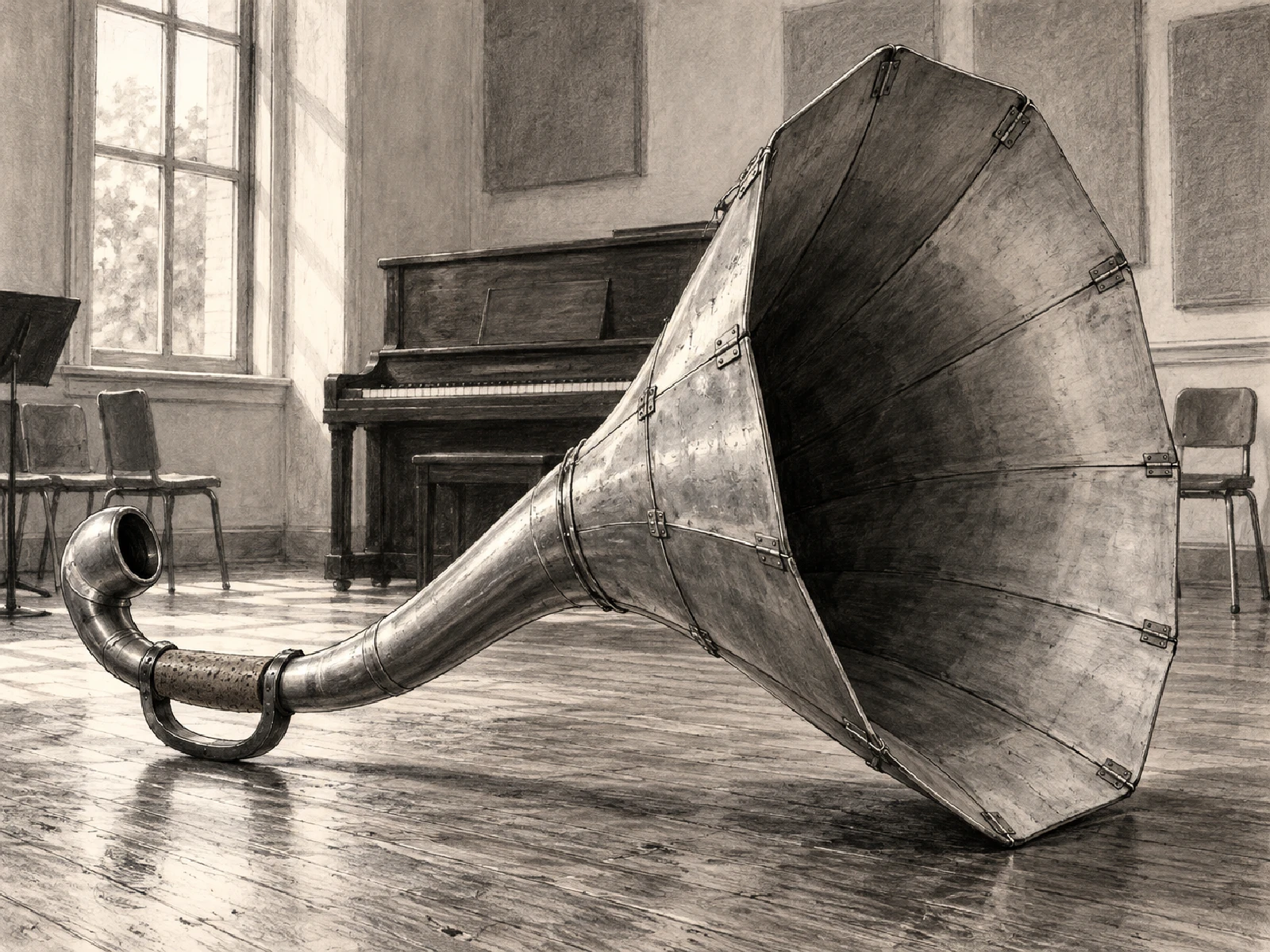
A Giant Folding Listening Horn in a Music Room
A doorway-sized folding listening horn transforms a familiar school music room. Rubbed charcoal and erased light reveal the metal product's construction and unexpected scale.
Remix this referenceA Giant Folding Listening Horn in a Music Room
- Form language
- Use observational charcoal drawing: establish convincing volumes through broad planes, retaining slight searching corrections.
- Contour
- Vary compressed dark edges with rubbed, lost boundaries; keep occasional doubled exploratory lines instead of uniform outlines.
- Mark-making
- Combine broad side-of-stick sweeps, finger smudges and sparse pointed strokes; let pressure and direction change with the planes.
- Surface rendering
- Rub charcoal into continuous middle tones, then lift light with a kneaded eraser; leave irregular paper tooth and soft tonal breaks.
Priority
Make smudged charcoal masses and erased light visibly responsible for the product's volume.
What to avoid & what to check
Exact prompt for this example
MODULE OWNERSHIP
subject: Subject count, type, stable proportions and landmarks, resting face geometry, hair shape, physical materials, garment construction and permanent marks. No emotion, movement, color assignment or rendering recipe.
expression: Facial soft-tissue displacement and pupil direction, muscle coordination, regional intensity, asymmetry and onset/peak/release. No head/body pose, stable appearance, skin color or rendering.
gesture: Head/neck/body/limb orientation, joint movement, support, contact and pose-caused occlusion using existing anatomy. No eye/pupil movement, emotion, identity, props inventory or camera.
props: Prop count, type, construction, physical material and scale relative to the subject. Holding/contact belongs to gesture, position to composition, color to palette.
scene: Environment elements, terrain, backdrop/floor presence and structural detail. No canvas positions, camera, lighting, assigned colors or render texture.
camera: Projection, focal-length impression, camera elevation/yaw/roll, viewing distance and crop. No actor pose, world placement, lighting or canvas aspect ratio.
composition: Normalized 0-100% canvas positions, scale in frame, depth/overlap, focal hierarchy and margins. No joint pose, camera projection, rendering, subject/prop inventory or emotion.
palette: Color anchors, hue/saturation/value ranges, colors assigned to parts and approximate color coverage. No illumination direction, shading algorithm, physical material or layout.
lighting: Light-source direction/softness/intensity, ambient illumination, physical shadow direction/length and highlight position. Absence of directional illumination is allowed. No shading technique, palette or material changes.
style: Reusable form abstraction, contour weight/taper/edge quality, medium and mark scale/density/direction, surface rendering and tonal transition technique. No fixed subject proportions, anatomy, identity, expression, pose, palette, light-source direction, camera or layout.
output: Image count, aspect ratio, size, file/alpha requirements and global lettering/logo/watermark restrictions. No background scenery, crop, style, identity or pose.

SUBJECT
inventory: One original collapsible acoustic listening horn, enlarged to doorway height; no people or animals.
geometry: A broad segmented funnel narrows into a curved tube with a rounded ear tip; an open loop provides the handgrip.
resting-face: No face or facial features are present.
appearance: Thin aluminum bell panels have visible radial hinges; the tube is drawn metal and the grip has a cork sleeve.

PRIORITY


AVOID


CHECK


PROPS
inventory: No separate props.
construction: No prop construction applies.

PRIORITY


AVOID


CHECK


SCENE
inventory: A school music room with an upright piano, ordinary classroom chairs, acoustic wall panels and a tall window.
structure: Scuffed floorboards and a plain skirting board establish the room; the furnishings retain familiar everyday dimensions.

PRIORITY


AVOID


CHECK


CAMERA
projection: Use natural perspective with a moderate wide-lens impression and restrained edge distortion.
viewpoint: Observe from seated eye level, diagonally across the room, with no camera roll.
crop: Include the entire horn and a generous portion of the room; allow peripheral furnishings to leave the frame.

PRIORITY


AVOID


CHECK


COMPOSITION
placement: The horn spans the lower left and middle right; its broad mouth sits around two-thirds across the canvas.
depth: The bell overlaps part of the piano; a small classroom chair remains legible beyond it to establish the scale reversal.
spacing: The bell opening is the primary focus, the folding junction is secondary, and an open floor wedge gives both breathing room.

PRIORITY


AVOID


CHECK


PALETTE
colors: Use warm paper ivory, charcoal black and a broad family of neutral grays; keep saturation negligible.
assignment: The horn ranges from pale gray to black, cork stays mid-gray, and the room remains mostly ivory and quiet gray.
balance: Reserve the deepest blacks for a few bell recesses and structural accents; preserve ample paper-colored areas.

PRIORITY


AVOID


CHECK


LIGHTING
sources: A large window supplies soft light from the left, with weak ambient illumination throughout the room.
shadows: Broad shadows extend rightward over the floor; the bell interior receives a deeper, softly bounded shadow.
highlights: Long soft highlights follow left-facing panel rims and the upper curve of the tube.

PRIORITY


AVOID


CHECK


STYLE GUIDE
form-language: Use observational charcoal drawing: establish convincing volumes through broad planes, retaining slight searching corrections.
contour: Vary compressed dark edges with rubbed, lost boundaries; keep occasional doubled exploratory lines instead of uniform outlines.
mark-making: Combine broad side-of-stick sweeps, finger smudges and sparse pointed strokes; let pressure and direction change with the planes.
surface-rendering: Rub charcoal into continuous middle tones, then lift light with a kneaded eraser; leave irregular paper tooth and soft tonal breaks.

PRIORITY
Make smudged charcoal masses and erased light visibly responsible for the product's volume.

AVOID


CHECK


OUTPUT
format: One finished image, landscape 4:3, 1600 × 1200 pixels, opaque PNG; no lettering, logos or watermarks.
restrictions: Deliver one finished image at 4:3, 1600 × 1200 pixels, as an opaque PNG; no lettering, logos or watermarks.

PRIORITY


AVOID


CHECK


FINAL INTEGRATION
subject + scene + composition: Let familiar room furnishings make the enlargement immediately legible while the product's folding construction remains readable.
lighting + style: Use the observed illumination to guide erased passages, allowing expressive drawing marks within a coherent volume.
Model information comes from image provenance. The same prompt may produce a different result.