Text to imageProductStyle guide
Giant Task Lamp on the Platform
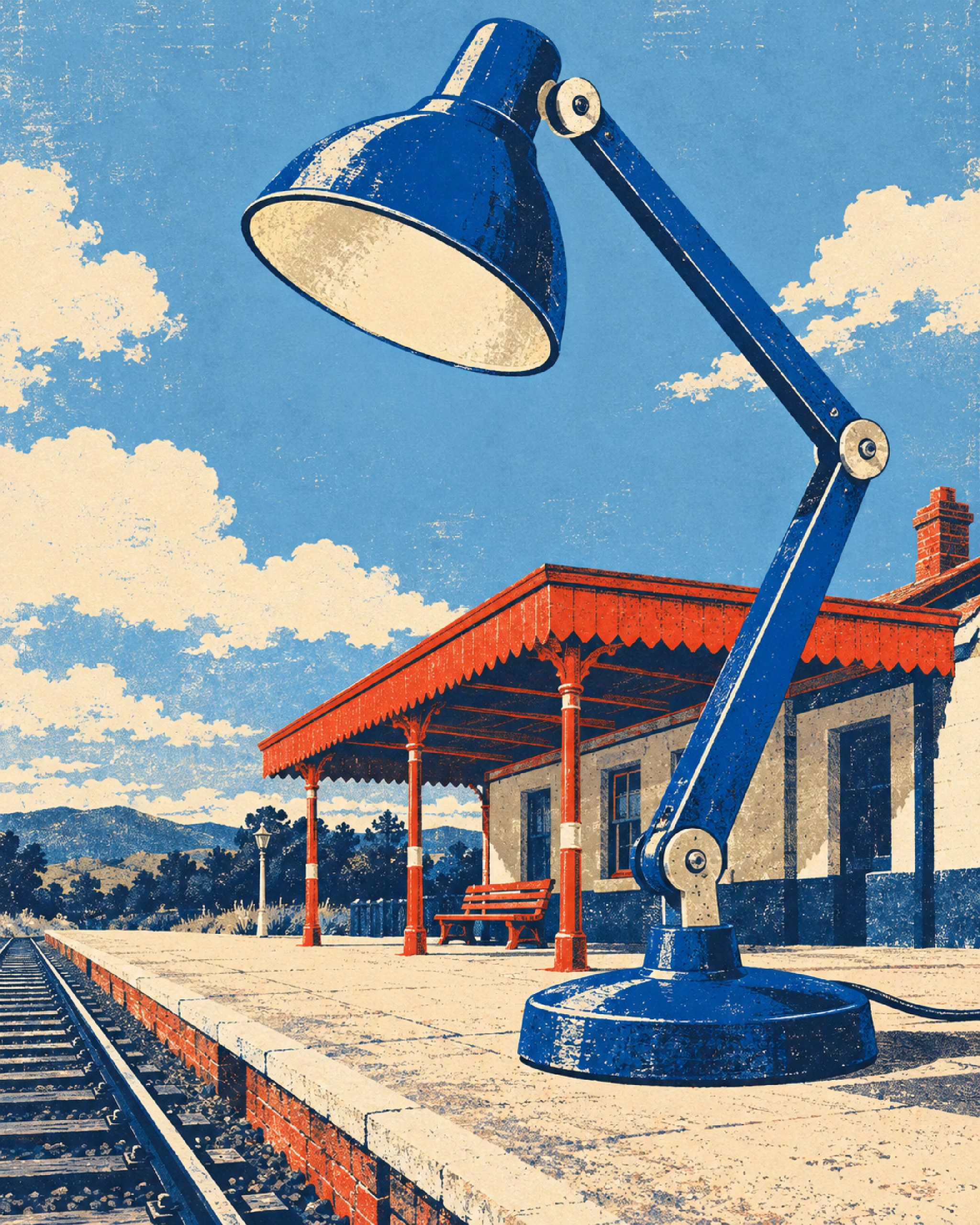
A giant folding task lamp towers over a small station platform, rendered in bold screen-printed shapes and expressive ink overlaps.
Remix this referenceGiant Task Lamp on the Platform
- Form language
- Reduce forms to decisive interlocking silhouettes, alternating broad angular blocks with rounded joins; let minor shapes vary naturally.
- Contour
- Use crisp stencil-like boundaries with occasional small edge bites; separate shapes by ink edges rather than continuous outlines.
- Mark-making
- Add sparse squeegee-drag scuffs and slight plate misregistration at selected overlaps, with naturally uneven marks.
- Surface rendering
- Build tones from opaque spot-ink areas and darker translucent overprints; allow rough paper to show through broken ink patches.
Priority
Preserve the decisive shape rhythms and visible ink layering of graphic screen printing.
What to avoid & what to check
Exact prompt for this example
MODULE OWNERSHIP
subject: Subject count, type, stable proportions and landmarks, resting face geometry, hair shape, physical materials, garment construction and permanent marks. No emotion, movement, color assignment or rendering recipe.
expression: Facial soft-tissue displacement and pupil direction, muscle coordination, regional intensity, asymmetry and onset/peak/release. No head/body pose, stable appearance, skin color or rendering.
gesture: Head/neck/body/limb orientation, joint movement, support, contact and pose-caused occlusion using existing anatomy. No eye/pupil movement, emotion, identity, props inventory or camera.
props: Prop count, type, construction, physical material and scale relative to the subject. Holding/contact belongs to gesture, position to composition, color to palette.
scene: Environment elements, terrain, backdrop/floor presence and structural detail. No canvas positions, camera, lighting, assigned colors or render texture.
camera: Projection, focal-length impression, camera elevation/yaw/roll, viewing distance and crop. No actor pose, world placement, lighting or canvas aspect ratio.
composition: Normalized 0-100% canvas positions, scale in frame, depth/overlap, focal hierarchy and margins. No joint pose, camera projection, rendering, subject/prop inventory or emotion.
palette: Color anchors, hue/saturation/value ranges, colors assigned to parts and approximate color coverage. No illumination direction, shading algorithm, physical material or layout.
lighting: Light-source direction/softness/intensity, ambient illumination, physical shadow direction/length and highlight position. Absence of directional illumination is allowed. No shading technique, palette or material changes.
style: Reusable form abstraction, contour weight/taper/edge quality, medium and mark scale/density/direction, surface rendering and tonal transition technique. No fixed subject proportions, anatomy, identity, expression, pose, palette, light-source direction, camera or layout.
output: Image count, aspect ratio, size, file/alpha requirements and global lettering/logo/watermark restrictions. No background scenery, crop, style, identity or pose.

SUBJECT
inventory: One original folding task lamp is the product subject; no people or animals.
geometry: Two broad hinged arms form a loose zigzag between a round weighted foot and a flared bell shade.
resting-face: The product has no face.
appearance: Use pressed-steel shade and arms, exposed circular hinge caps and a cast-iron base.

PRIORITY


AVOID


CHECK


PROPS
inventory: No separate props.
construction: No prop construction applies.

PRIORITY


AVOID


CHECK


SCENE
inventory: A rural railway platform includes a station wall, shallow canopy, fixed bench and adjoining tracks.
structure: A tiled canopy rests on slender posts; paving and the platform edge establish a recognizable station setting.

PRIORITY


AVOID


CHECK


CAMERA
projection: Use a moderately wide perspective with clear near-to-far scale change.
viewpoint: View from low platform height at a three-quarter angle, looking slightly upward.
crop: Show the complete lamp with a partial station frontage and a short stretch of track.

PRIORITY


AVOID


CHECK


COMPOSITION
placement: The lamp fills the right two-thirds, with its shade high near the middle and its foot at lower right.
depth: The lamp rises far above the canopy; the small bench and station behind it make the scale surprise unmistakable.
spacing: Keep the shade clear of the frame edge and leave open space above the low station mass.

PRIORITY


AVOID


CHECK


PALETTE
colors: Use cobalt blue, vermilion, warm ivory and deep ink blue.
assignment: Make the lamp cobalt with ivory accents, the canopy and bench vermilion, and tracks deep ink blue.
balance: Cobalt dominates the color areas; vermilion stays compact, with ample ivory across sky and paving.

PRIORITY


AVOID


CHECK


LIGHTING
sources: Soft daylight comes from the upper left; the lamp itself is switched off.
shadows: A broad short shadow extends rightward from the base; the canopy casts gentle shade beneath itself.
highlights: Keep broad highlights on the left-facing shade rim and upper faces of the arms.

PRIORITY


AVOID


CHECK


STYLE GUIDE
form-language: Reduce forms to decisive interlocking silhouettes, alternating broad angular blocks with rounded joins; let minor shapes vary naturally.
contour: Use crisp stencil-like boundaries with occasional small edge bites; separate shapes by ink edges rather than continuous outlines.
mark-making: Add sparse squeegee-drag scuffs and slight plate misregistration at selected overlaps, with naturally uneven marks.
surface-rendering: Build tones from opaque spot-ink areas and darker translucent overprints; allow rough paper to show through broken ink patches.

PRIORITY
Preserve the decisive shape rhythms and visible ink layering of graphic screen printing.

AVOID


CHECK


OUTPUT
format: One finished image, portrait 4:5, 2048 × 2560 pixels, opaque PNG.
restrictions: No lettering, logos or watermarks.

PRIORITY


AVOID


CHECK


FINAL INTEGRATION
subject + scene + composition: Recognizable product construction and familiar station architecture make the exaggerated scale immediately readable.
palette + style: The restricted color family supports strong ink separations while overprints enrich the finished print.
Model information comes from image provenance. The same prompt may produce a different result.