Text to imageIllustrationStyle guide
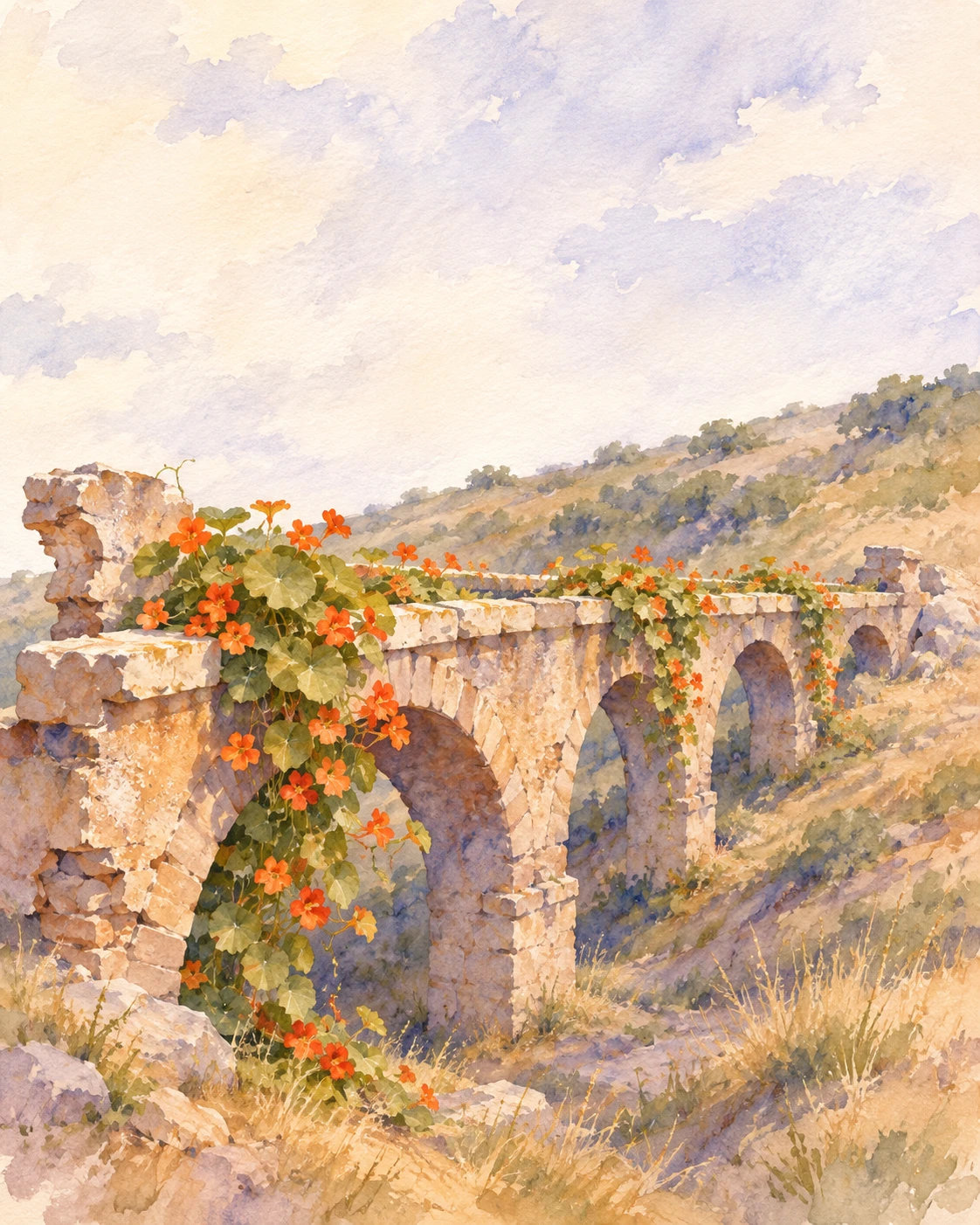
Nasturtiums in the Broken Aqueduct
Nasturtiums spill from an abandoned stone aqueduct. Spacious sky and irregular arches give watercolor blooms and broken edges room to breathe.
Remix this referenceNasturtiums in the Broken Aqueduct
- Form language
- Compress complex forms into broad, slightly irregular interlocking masses; retain only the small shapes needed for recognition.
- Contour
- Let edges alternate between crisp brush turns, feathered diffusion, and complete losses; avoid a continuous enclosing outline.
- Mark-making
- Use loaded watercolor strokes with branching blooms and occasional dry-brush skips; let brush size and pressure vary naturally.
- Surface rendering
- Build transparent overlapping washes with pooled tide marks and selective untouched paper; alternate merged passages with decisive final touches.
Priority
Expressive watercolor blooms and broken edges must remain visibly central to the medium.
What to avoid & what to check
Exact prompt for this example
MODULE OWNERSHIP
subject: Subject count, type, stable proportions and landmarks, resting face geometry, hair shape, physical materials, garment construction and permanent marks. No emotion, movement, color assignment or rendering recipe.
expression: Facial soft-tissue displacement and pupil direction, muscle coordination, regional intensity, asymmetry and onset/peak/release. No head/body pose, stable appearance, skin color or rendering.
gesture: Head/neck/body/limb orientation, joint movement, support, contact and pose-caused occlusion using existing anatomy. No eye/pupil movement, emotion, identity, props inventory or camera.
props: Prop count, type, construction, physical material and scale relative to the subject. Holding/contact belongs to gesture, position to composition, color to palette.
scene: Environment elements, terrain, backdrop/floor presence and structural detail. No canvas positions, camera, lighting, assigned colors or render texture.
camera: Projection, focal-length impression, camera elevation/yaw/roll, viewing distance and crop. No actor pose, world placement, lighting or canvas aspect ratio.
composition: Normalized 0-100% canvas positions, scale in frame, depth/overlap, focal hierarchy and margins. No joint pose, camera projection, rendering, subject/prop inventory or emotion.
palette: Color anchors, hue/saturation/value ranges, colors assigned to parts and approximate color coverage. No illumination direction, shading algorithm, physical material or layout.
lighting: Light-source direction/softness/intensity, ambient illumination, physical shadow direction/length and highlight position. Absence of directional illumination is allowed. No shading technique, palette or material changes.
style: Reusable form abstraction, contour weight/taper/edge quality, medium and mark scale/density/direction, surface rendering and tonal transition technique. No fixed subject proportions, anatomy, identity, expression, pose, palette, light-source direction, camera or layout.
output: Image count, aspect ratio, size, file/alpha requirements and global lettering/logo/watermark restrictions. No background scenery, crop, style, identity or pose.

SUBJECT
inventory: One abandoned stone aqueduct fragment forms the architectural subject; no people or animals.
geometry: Unequal surviving arches support a narrow open trough; fractured ends interrupt its long, recognizable silhouette.
resting-face: No facial geometry applies to the architectural subject.
appearance: Rough masonry and lime mortar retain chipped coping stones and patches of exposed aggregate; small defects may vary.

PRIORITY


AVOID


CHECK


PROPS
inventory: No separate props.
construction: No prop construction applies.

PRIORITY


AVOID


CHECK


SCENE
inventory: A dry grassy ravine, open sky, and abundant nasturtiums establish a reclaimed hillside setting.
structure: Nasturtiums root in accumulated soil inside the trough and trail through gaps; sparse grass follows the ravine banks.

PRIORITY


AVOID


CHECK


CAMERA
projection: Use natural perspective with a moderate focal-length impression and restrained depth convergence.
viewpoint: Look obliquely across the ravine from slightly above the trough, with a level camera and no roll.
crop: Use a medium-wide view that includes the broken ends and enough surrounding terrain to explain the remnant.

PRIORITY


AVOID


CHECK


COMPOSITION
placement: The aqueduct rises diagonally from the lower left toward the middle right, occupying roughly the lower half of the canvas.
depth: A flower cascade overlapping the nearest open arch is the first focal point; receding arches lead into the hillside.
spacing: Keep an expansive upper sky and breathing room around the broken ends; vary the gaps between floral clusters.

PRIORITY


AVOID


CHECK


PALETTE
colors: Anchor the image in warm ivory, muted limestone ochre, blue-violet, olive green, and small bursts of vermilion.
assignment: Give sky the ivory, masonry the ochre, shadow zones blue-violet, foliage olive, and flowers vermilion.
balance: Pale values dominate; stone supplies the broad middle values, while floral accents and arch interiors carry concentrated contrast.

PRIORITY


AVOID


CHECK


LIGHTING
sources: Broad, soft daylight arrives from the upper left with generous ambient light from the open sky.
shadows: Soft cast shadows extend a short distance down and right; arch recesses retain readable shadow depth.
highlights: Gentle highlights catch the upper coping edges and exposed leaf tops without sharp glints.

PRIORITY


AVOID


CHECK


STYLE GUIDE
form-language: Compress complex forms into broad, slightly irregular interlocking masses; retain only the small shapes needed for recognition.
contour: Let edges alternate between crisp brush turns, feathered diffusion, and complete losses; avoid a continuous enclosing outline.
mark-making: Use loaded watercolor strokes with branching blooms and occasional dry-brush skips; let brush size and pressure vary naturally.
surface-rendering: Build transparent overlapping washes with pooled tide marks and selective untouched paper; alternate merged passages with decisive final touches.

PRIORITY
Expressive watercolor blooms and broken edges must remain visibly central to the medium.

AVOID


CHECK


OUTPUT
format: One image.
restrictions: Produce one opaque PNG illustration, portrait 4:5, 2048 × 2560 pixels; no lettering, logos, or watermarks.

PRIORITY


AVOID


CHECK


FINAL INTEGRATION
subject + scene + style: Keep structural recognition clear while allowing vegetation and painterly edges to merge locally.
Model information comes from image provenance. The same prompt may produce a different result.