Text to imageAnimationStyle guide
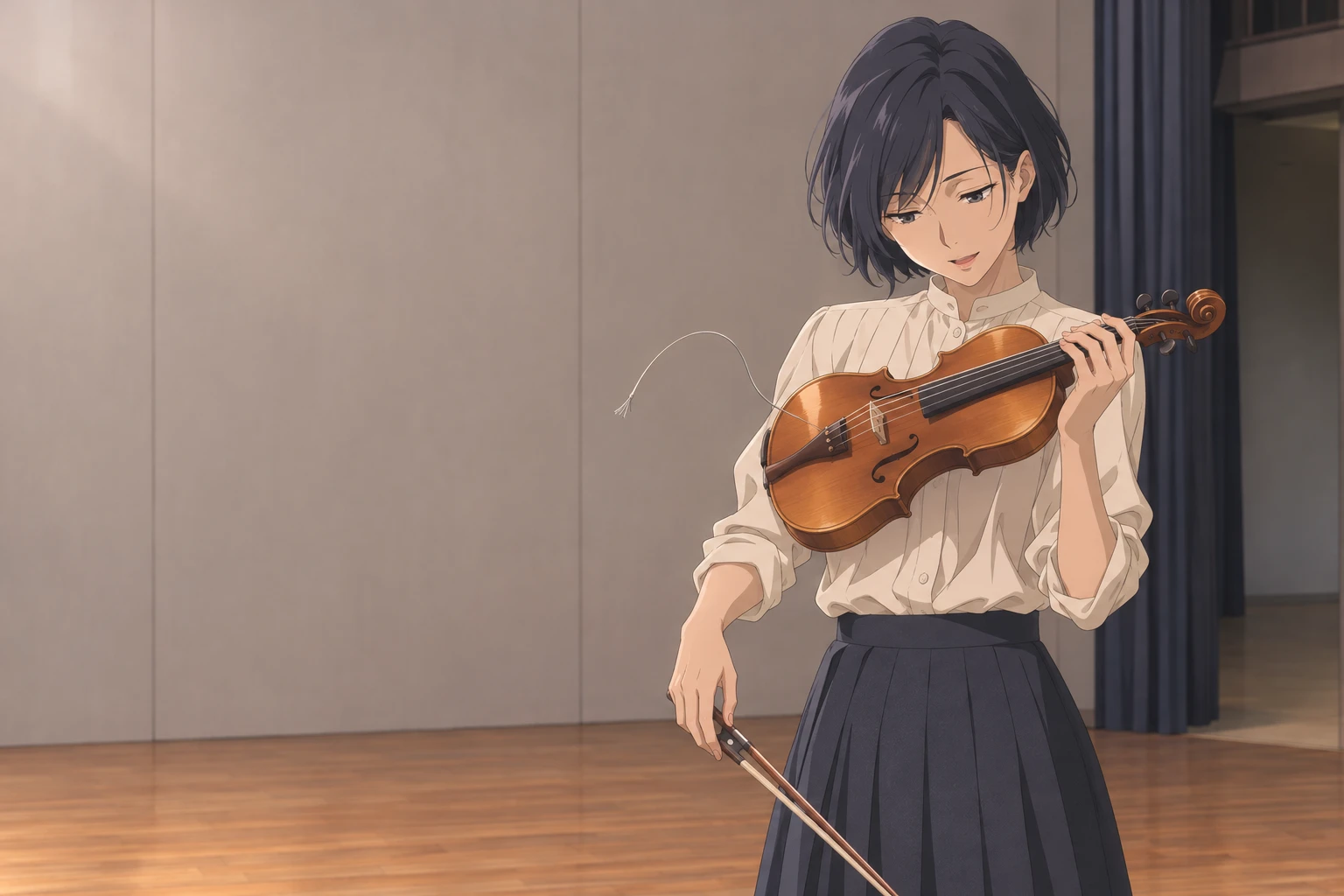
A Violinist After the String Snaps
On an empty rehearsal stage, a violinist lowers her instrument as a small smile begins. The fine curve of a broken string against an expansive bare wall makes the interrupted music almost visible.
Remix this referenceA Violinist After the String Snaps
- Form language
- Preserve broad readable planes, articulating small curvature changes and folds with precise, economical shape divisions.
- Contour
- Use smooth fine cleanup contours with subtly varied weight; taper interior lines to delicate ends and resolve intersections cleanly.
- Mark-making
- Place small restrained strokes only at useful folds and material boundaries; allow minor detail rhythms to vary naturally.
- Surface rendering
- Build crisp cel planes with controlled edges; use limited soft tonal transitions across gently turning surfaces and subtle tonal variation within broad fills.
Priority
Rendering medium: 2D Japanese anime cel illustration with fine cleanup; formal rendering reference: Kyoto Animation · 2020s · Violet Evergarden: The Movie (2020)
What to avoid & what to check
Exact prompt for this example
MODULE OWNERSHIP
subject: Subject count, type, stable proportions and landmarks, resting face geometry, hair shape, physical materials, garment construction and permanent marks. No emotion, movement, color assignment or rendering recipe.
expression: Facial soft-tissue displacement and pupil direction, muscle coordination, regional intensity, asymmetry and onset/peak/release. No head/body pose, stable appearance, skin color or rendering.
gesture: Head/neck/body/limb orientation, joint movement, support, contact and pose-caused occlusion using existing anatomy. No eye/pupil movement, emotion, identity, props inventory or camera.
props: Prop count, type, construction, physical material and scale relative to the subject. Holding/contact belongs to gesture, position to composition, color to palette.
scene: Environment elements, terrain, backdrop/floor presence and structural detail. No canvas positions, camera, lighting, assigned colors or render texture.
camera: Projection, focal-length impression, camera elevation/yaw/roll, viewing distance and crop. No actor pose, world placement, lighting or canvas aspect ratio.
composition: Normalized 0-100% canvas positions, scale in frame, depth/overlap, focal hierarchy and margins. No joint pose, camera projection, rendering, subject/prop inventory or emotion.
palette: Color anchors, hue/saturation/value ranges, colors assigned to parts and approximate color coverage. No illumination direction, shading algorithm, physical material or layout.
lighting: Light-source direction/softness/intensity, ambient illumination, physical shadow direction/length and highlight position. Absence of directional illumination is allowed. No shading technique, palette or material changes.
style: Reusable form abstraction, contour weight/taper/edge quality, medium and mark scale/density/direction, surface rendering and tonal transition technique. No fixed subject proportions, anatomy, identity, expression, pose, palette, light-source direction, camera or layout.
output: Image count, aspect ratio, size, file/alpha requirements and global lettering/logo/watermark restrictions. No background scenery, crop, style, identity or pose.

SUBJECT
inventory: One original adult woman, a violinist; no other people.
geometry: A slender adult build with an oval head, narrow shoulders and naturally long hands.
resting-face: Almond-shaped eyes, a straight nose and a broad, shallow upper-lip bow define her resting face.
appearance: A chin-length bob with a side fringe; a cotton stand-collar blouse with rolled cuffs and a wool pleated skirt.

PRIORITY


AVOID


CHECK


EXPRESSION — ACTOR A
brows: One brow lifts slightly; the other remains loose.
lids: Upper lids open a little; lower lids stay relaxed.
cheeks: One cheek begins to rise with the uneven smile.
nose: The nose remains relaxed, without wrinkling.
mouth: One lip corner curls upward while the lips remain softly parted.
jaw: The jaw releases slightly without a wide opening.
gaze: Pupils turn downward toward the broken string.
coordination: The slight brow lift precedes the smile, leaving the response gently uneven.
timing: Catch the onset of amusement, just before the small smile fully forms.

PRIORITY


AVOID


CHECK


GESTURE
head: A tips her chin down and inclines her head slightly toward the instrument.
torso: Her upright torso softens into a slight forward bend as her shoulders settle.
limbs: The left elbow drops as the violin leaves her jaw; the right arm lowers with a loose wrist.
contact: Her left hand supports the violin neck; her right fingers retain the bow, clear of the strings.

PRIORITY


AVOID


CHECK


PROPS
inventory: One violin with one snapped string, and one bow; the violin body is approximately forearm-length.
construction: An arched wooden violin with a carved scroll and metal strings; one loose string end curls freely. A wooden bow carries a narrow horsehair ribbon.

PRIORITY


AVOID


CHECK


SCENE
inventory: An empty rehearsal stage with a wooden floor, a tall acoustic wall and an open stage wing.
structure: Broad acoustic panels have shallow vertical joints; the wing opens into an unadorned passage.

PRIORITY


AVOID


CHECK


CAMERA
projection: Natural perspective with a normal-lens impression and restrained depth compression.
viewpoint: View from upper-chest height, nearly frontal with a slight view of her left side; keep the camera level.
crop: A medium-long view crops through the lower skirt below the knees, leaving room above the head.

PRIORITY


AVOID


CHECK


COMPOSITION
placement: A occupies the right half, her face near 70% across and 27% down; the violin crosses the middle-right and the bow extends toward the lower middle.
depth: The face leads, followed by the violin and its loose string; the stage wing recedes behind her outer silhouette.
spacing: Leave the left half largely open; give the loose string a clear wall interval and keep panel joints away from the face.

PRIORITY


AVOID


CHECK


PALETTE
colors: Oyster gray, ink navy and warm amber form the anchors, with muted rose and warm ivory as supporting notes.
assignment: Use oyster gray for the wall, navy for hair and skirt, amber for violin and floor, ivory for blouse and warm rose-beige for skin.
balance: Pale restrained neutrals dominate; the violin supplies the richest saturation within a small warm passage.

PRIORITY


AVOID


CHECK


LIGHTING
sources: Broad soft daylight enters from the upper left, supported by gentle ambient fill from the hall.
shadows: Soft shadows fall rightward and slightly backward; the floor shadow stays short and unobtrusive.
highlights: Small highlights rest on the upper-left cheek, violin shoulder and bow stick; keep their intensity modest.

PRIORITY


AVOID


CHECK


STYLE GUIDE
form-language: Preserve broad readable planes, articulating small curvature changes and folds with precise, economical shape divisions.
contour: Use smooth fine cleanup contours with subtly varied weight; taper interior lines to delicate ends and resolve intersections cleanly.
mark-making: Place small restrained strokes only at useful folds and material boundaries; allow minor detail rhythms to vary naturally.
surface-rendering: Build crisp cel planes with controlled edges; use limited soft tonal transitions across gently turning surfaces and subtle tonal variation within broad fills.

PRIORITY
Rendering medium: 2D Japanese anime cel illustration with fine cleanup; formal rendering reference: Kyoto Animation · 2020s · Violet Evergarden: The Movie (2020)

AVOID


CHECK


OUTPUT
format: One finished image, landscape 3:2, 1536 × 1024 pixels, opaque PNG.
restrictions: No lettering, logos or watermarks.

PRIORITY


AVOID


CHECK
Art direction
교토 애니메이션 / Kyoto Animation · 2020s · 바이올렛 에버가든 극장판(2020) / Violet Evergarden: The Movie (2020) ↗- Preserve broad planes while rendering small curvature changes and folds precisely
- Smooth fine cleanup contours and tapered interior lines
- Small restrained detail marks only at necessary folds and material boundaries
- Crisp cel planes with limited soft tonal transitions and controlled edges
Model information comes from image provenance. The same prompt may produce a different result.