Text to imageSpace & architectureStyle guide
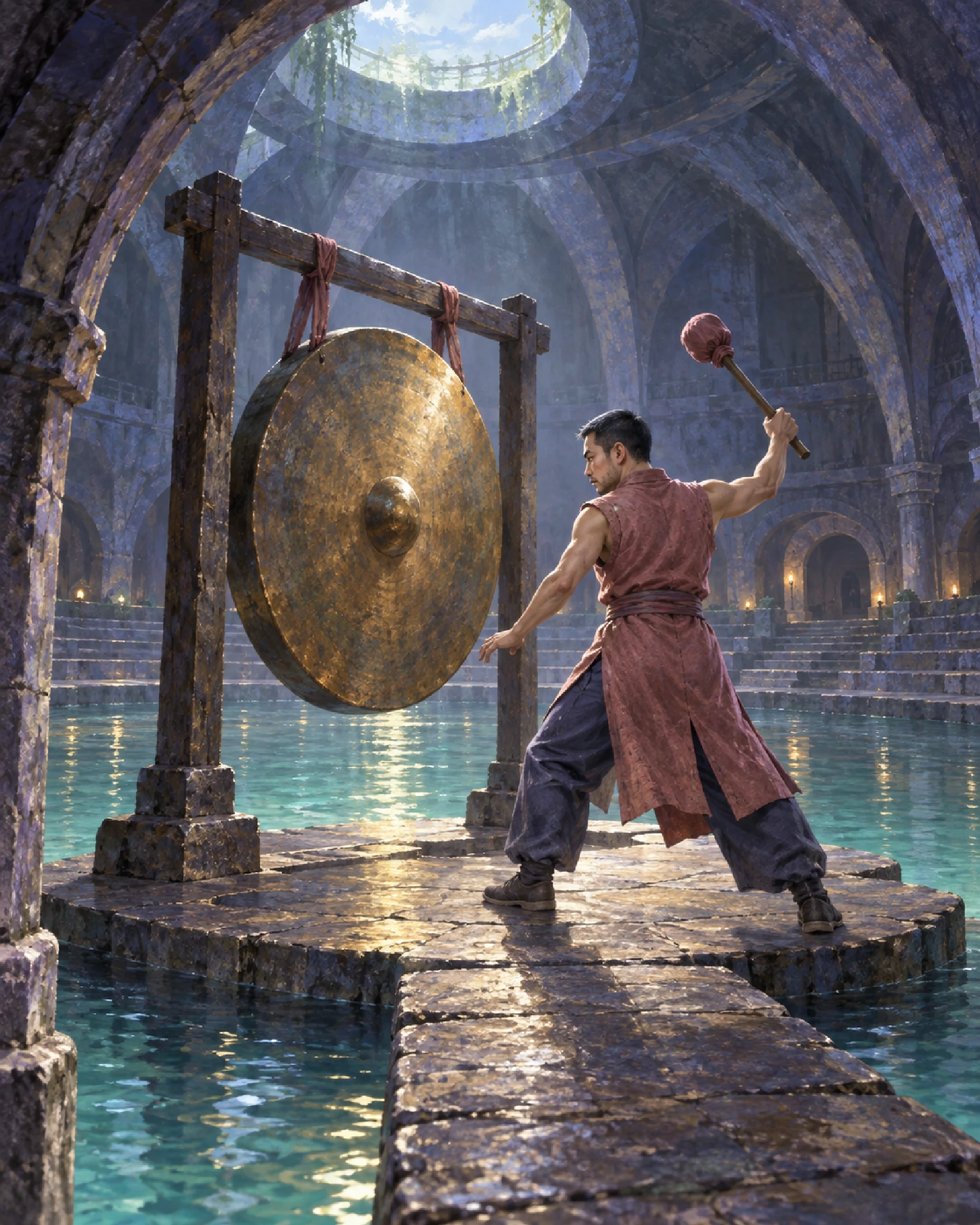
Gong Player in a Flooded Hall
An original underground resonance hall where shallow water surrounds a dry causeway. A rear three-quarter player reveals a concentrated profile just before striking, linking skylight and layered space through luminous continuous-tone painting.
Remix this referenceGong Player in a Flooded Hall
- Form language
- Simplify into broad interlocking curved masses with selective structural breaks; secondary shapes may vary within this fluid abstraction, preserving a coherent language of large connected forms.
- Contour
- Use painted lost-and-found edges, alternating soft merges with sparse firm brush-shaped accents; boundary strength varies naturally, allowing some passages to dissolve while others regain clarity.
- Mark-making
- Broad blended strokes carry the painting, interrupted by sparse dragged traces and loose descending marks with varied pressure and length, keeping the touch visible without an evenly distributed texture.
- Surface rendering
- Build luminous continuous tones with translucent painted veils and blended ramps, retaining occasional opaque scumbles for a visibly painterly finish, with tonal passages that connect gradually rather than stepping abruptly.
Priority
Join luminous tonal continuity with visible brush decisions.
What to avoid & what to check
Avoid uniformly airbrushed smoothness.
Do blended tones and selective brush traces work together?
Exact prompt for this example
MODULE OWNERSHIP
subject: Subject count, type, stable proportions and landmarks, resting face geometry, hair shape, physical materials, garment construction and permanent marks. No emotion, movement, color assignment or rendering recipe.
expression: Facial soft-tissue displacement and pupil direction, muscle coordination, regional intensity, asymmetry and onset/peak/release. No head/body pose, stable appearance, skin color or rendering.
gesture: Head/neck/body/limb orientation, joint movement, support, contact and pose-caused occlusion using existing anatomy. No eye/pupil movement, emotion, identity, props inventory or camera.
props: Prop count, type, construction, physical material and scale relative to the subject. Holding/contact belongs to gesture, position to composition, color to palette.
scene: Environment elements, terrain, backdrop/floor presence and structural detail. No canvas positions, camera, lighting, assigned colors or render texture.
camera: Projection, focal-length impression, camera elevation/yaw/roll, viewing distance and crop. No actor pose, world placement, lighting or canvas aspect ratio.
composition: Normalized 0-100% canvas positions, scale in frame, depth/overlap, focal hierarchy and margins. No joint pose, camera projection, rendering, subject/prop inventory or emotion.
palette: Color anchors, hue/saturation/value ranges, colors assigned to parts and approximate color coverage. No illumination direction, shading algorithm, physical material or layout.
lighting: Light-source direction/softness/intensity, ambient illumination, physical shadow direction/length and highlight position. Absence of directional illumination is allowed. No shading technique, palette or material changes.
style: Reusable form abstraction, contour weight/taper/edge quality, medium and mark scale/density/direction, surface rendering and tonal transition technique. No fixed subject proportions, anatomy, identity, expression, pose, palette, light-source direction, camera or layout.
output: Image count, aspect ratio, size, file/alpha requirements and global lettering/logo/watermark restrictions. No background scenery, crop, style, identity or pose.

SUBJECT
inventory: Actor A is one original adult gong player, the hall's only human subject with a simple, recognizable everyday presence.
geometry: Use ordinary adult proportions, compact shoulders and naturally proportioned hands‚ preserving a believable human scale without exaggerated heroic anatomy.
resting-face: The resting profile has a gently arched brow, straight nose bridge, softly defined cheek and compact rounded chin‚ with uncomplicated landmarks that remain legible in profile.
appearance: Close-cropped hair, a long woven sleeveless tunic, loose trousers and fabric shoes; practical garment details may vary naturally‚ retaining a coherent construction rather than ornamental costume.

PRIORITY
Keep A's practical tunic construction distinctive.

AVOID
Avoid ornate ceremonial costume.

CHECK
Is A a believable adult with a simple working outfit?

EXPRESSION — ACTOR A
brows: The visible brow draws slightly inward and down, gathering concentration without a deep frown, while its outer end remains comparatively relaxed and unforced. Any brow region unavailable in the supplied view remains unprescribed.
lids: The visible upper lid lowers slightly and the lower lid firms, leaving the eye open and attentive, with a small change in the lid aperture rather than a squint. Unavailable eyelid regions remain unprescribed.
cheeks: A small tightening beside the visible mouth corner firms the cheek without lifting it into a smile, retaining a quiet cheek plane and avoiding a conspicuous bulge. Unavailable cheek regions remain unprescribed.
nose: The visible nostril stays relaxed, with no alar flare or bridge wrinkle accompanying the concentration, so the nose channel remains a clearly restful counterpoint to the brow and lid tension.
mouth: Lips meet in a light, even press; the visible corner stays level rather than rising or pulling downward, and the visible lip edges remain softly defined without a conspicuous purse or grimace.
jaw: The jaw is lightly set, without opening or a pronounced clench; the visible jawline remains softly defined, with only enough firmness to support the closed mouth and no bulging jaw-muscle accent.
gaze: Direct the visible pupil toward the gong's intended strike area. Any eye unavailable in the supplied view remains unprescribed; attention is carried by the available pupil direction.
coordination: Brow and lid tension carry the expression; the mouth is quieter, and the visible cheek follows its slight firmness, creating a restrained regional hierarchy rather than equal tension across every visible feature.
timing: Capture concentration gathering at onset: the brow has settled while the lips are only beginning to firm, leaving the facial action at an early, restrained moment rather than a fully intensified peak.

PRIORITY
Make quiet concentration readable through the available facial regions.

AVOID
Avoid turning mild concentration into an angry grimace.

CHECK
Do the visible facial changes suggest restrained attention?

GESTURE
head: A's neck and head turn toward the gong, exposing the near profile while the back of the shoulders remains visible.
torso: The torso turns gently into the impending strike, with a lifted ribcage and small forward inclination‚ retaining a supported, coordinated connection between the shoulders and hips.
limbs: One arm raises the mallet in an open arc; the other extends low for balance above a stable staggered stance‚ with naturally bent joints supporting the movement without theatrical exaggeration.
contact: Both feet bear weight on the dry causeway; one hand grips the shaft, and the padded head remains clear of the gong before impact‚ preserving the visible pause between preparation and contact.

PRIORITY
Make the lifted arc read as the instant before a strike.

AVOID
Avoid a rigid salute-like arm position.

CHECK
Does grounded whole-body movement support the impending strike?

PROPS
inventory: One suspended gong assembly and one padded mallet; the disc is wider than A's torso and approaches adult standing height.
construction: A shallow bronze disc with a modest central boss hangs by textile straps from a two-post timber frame; the mallet has a wooden shaft and cloth-wrapped head.

PRIORITY
Keep the disc and suspension structurally legible.

AVOID
Avoid an elaborate ornamental instrument frame.

CHECK
Does the assembly read as a playable gong?

SCENE
inventory: An underground resonance hall contains a shallow pool, raised dry causeway, curved listening terraces, high vault and open roof oculus.
structure: The causeway reaches a performance platform within the pool; thick masonry ribs span the vault, and a recessed passage suggests adjoining chambers.

PRIORITY
Make the dry route coherent within the flooded chamber.

AVOID
Avoid disconnected platforms.

CHECK
Is the performance platform accessible through the causeway?

CAMERA
projection: Use natural perspective with a moderately wide-lens impression, encompassing the chamber without stretching peripheral forms.
viewpoint: View from standing eye level behind and to one side of A, with a mild upward pitch. Choose sufficient lateral offset to reveal the near profile, including its eye and brow, while the far eye and brow remain outside the visible facial view.
crop: Include A's full figure and the entire gong; crop portions of the nearest vault ribs to suggest enclosure.

PRIORITY
Create an inhabited view with readable action and profile.

AVOID
Avoid a distant architectural elevation.

CHECK
Does the viewpoint retain both the action and visible profile?

COMPOSITION
placement: Place A near 62% canvas width in the lower half, with the gong just left; their focal group is substantial while the vault dominates overall scale.
depth: A cropped near arch frames the foreground, the causeway leads to the focal group, and overlapping terraces recede toward the rear passage.
spacing: Leave open space around the mallet arc and a broad water interval below the platform; architectural layers gather toward the frame edges.

PRIORITY
Anchor the enclosing spatial layers with the focal action.

AVOID
Avoid tangencies between the mallet and vault ribs.

CHECK
Is the focal gesture distinct within the layered enclosure?

PALETTE
colors: Use deep blue-violet, pale celadon, aged amber and dusty rose, with restrained saturation and broad value separation.
assignment: Assign blue-violet to masonry, hair and trousers, celadon to water and upper vault accents, amber to the gong and muted skin tones, and rose to the tunic.
balance: Cool chamber colors occupy most of the image; the gong is the strongest warm area and the tunic a quieter companion.

PRIORITY
Keep the amber gong the principal warm anchor.

AVOID
Avoid equally saturated warmth throughout the architecture.

CHECK
Does the gong remain the strongest warm area?

LIGHTING
sources: Broad skylight enters from above and behind the gong; soft pool-reflected ambient illumination fills the figure and chamber.
shadows: Long softened shadows extend toward the foreground along the causeway; recesses stay dim but readable.
highlights: Light catches the gong's upper rim, raised forearm and platform edges; gentle reflected light reaches the visible cheek, with broad highlights on the pool.

PRIORITY
Connect the focal group and hall through shared illumination.

AVOID
Avoid a separate spotlight on the figure.

CHECK
Do figure, gong and architecture share one light field?

STYLE GUIDE
form-language: Simplify into broad interlocking curved masses with selective structural breaks; secondary shapes may vary within this fluid abstraction, preserving a coherent language of large connected forms.
contour: Use painted lost-and-found edges, alternating soft merges with sparse firm brush-shaped accents; boundary strength varies naturally, allowing some passages to dissolve while others regain clarity.
mark-making: Broad blended strokes carry the painting, interrupted by sparse dragged traces and loose descending marks with varied pressure and length, keeping the touch visible without an evenly distributed texture.
surface-rendering: Build luminous continuous tones with translucent painted veils and blended ramps, retaining occasional opaque scumbles for a visibly painterly finish, with tonal passages that connect gradually rather than stepping abruptly.

PRIORITY
Join luminous tonal continuity with visible brush decisions.

AVOID
Avoid uniformly airbrushed smoothness.

CHECK
Do blended tones and selective brush traces work together?

OUTPUT
format: One finished opaque PNG illustration, 4:5 aspect ratio, 1600 × 2000 pixels‚ delivered as a single standalone spatial artwork with no additional view sheets.
restrictions: No lettering, inscriptions, logos, watermarks, diagram labels or auxiliary views.

PRIORITY
Deliver one complete spatial artwork PNG.

AVOID
Avoid concept-sheet presentation panels.

CHECK
Is the single PNG complete as a standalone artwork?

FINAL INTEGRATION
expression + gesture + camera: Facial attention and bodily preparation reinforce each other through a viewing relationship that makes both readable.
gesture + props + composition: Instrument construction supports the action while focal separation preserves its clarity.
scene + camera + composition: Architectural continuity and viewing relationships cooperate to establish inhabited depth.
lighting + style + palette + scene: Illumination informs tonal transitions while color hierarchy sustains the focal group. Broad, softly blended pool reflections connect illuminated architecture to the water through the painterly tonal treatment.
Model information comes from image provenance. The same prompt may produce a different result.