Text to imageArt stylesStyle guide
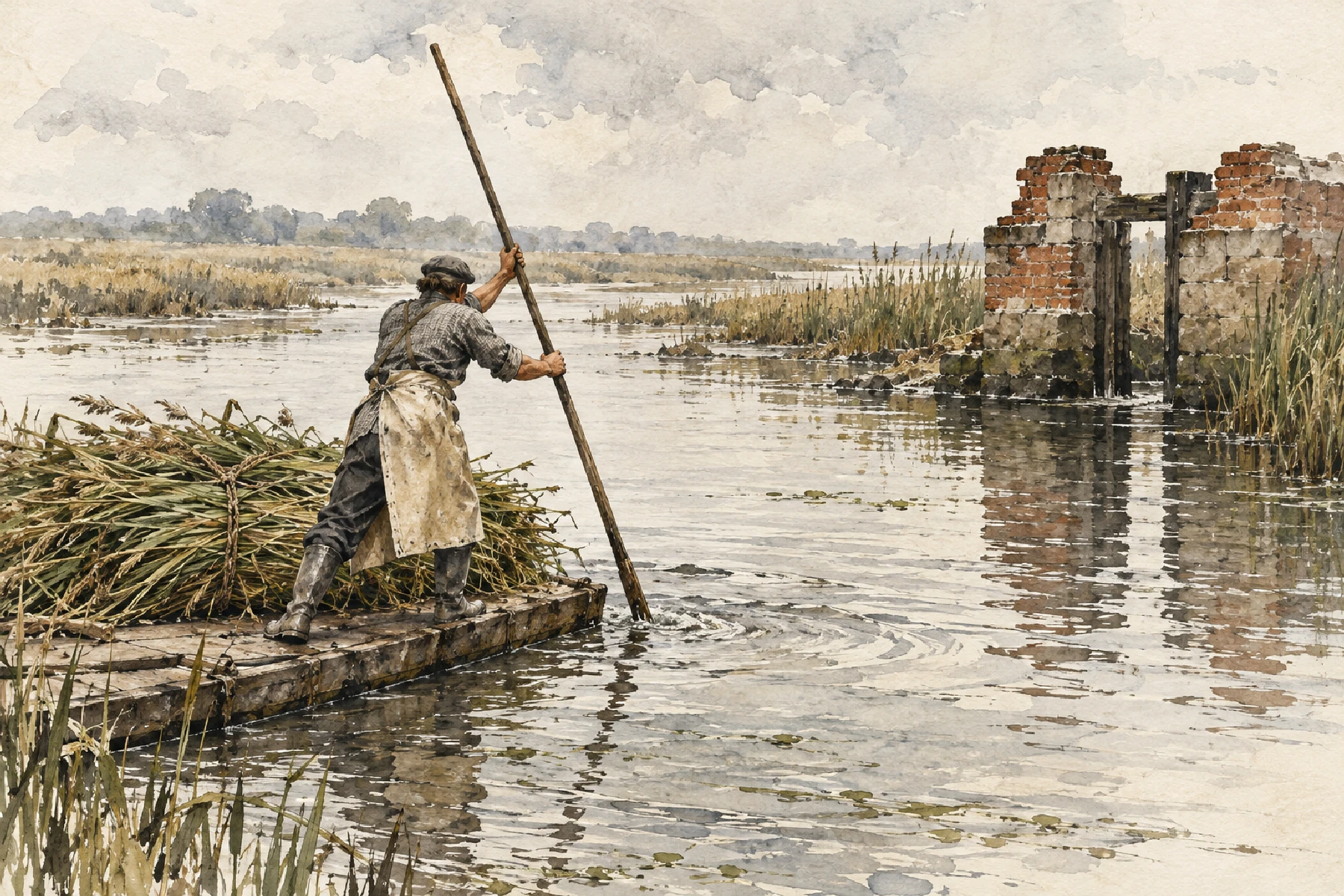
Reed Raft Beside the Broken Sluice
A reed cutter guides a laden raft past a broken sluice. Splintered ink lines and spreading washes meet across spacious, largely untouched water.
Remix this referenceReed Raft Beside the Broken Sluice
- Form language
- Reduce forms to uneven interlocking masses with a few precise structural notches; incidental details may vary within this spare language.
- Contour
- Use pressure-sensitive brush contours that swell, split, and disappear; alternate decisive edges with unfinished breaks.
- Mark-making
- Drag a drying brush into wiry streaks, then answer with a few wet lateral strokes; vary bristle gaps and stroke lengths naturally.
- Surface rendering
- Transparent ink washes pool at selected edges and bloom into damp paper; exposed paper and overlapping stains carry tonal transitions.
Priority
Make editorial ink wash visible through the contrast between splintered brushwork and freely pooling
What to avoid & what to check
Exact prompt for this example
MODULE OWNERSHIP
subject: Subject count, type, stable proportions and landmarks, resting face geometry, hair shape, physical materials, garment construction and permanent marks. No emotion, movement, color assignment or rendering recipe.
expression: Facial soft-tissue displacement and pupil direction, muscle coordination, regional intensity, asymmetry and onset/peak/release. No head/body pose, stable appearance, skin color or rendering.
gesture: Head/neck/body/limb orientation, joint movement, support, contact and pose-caused occlusion using existing anatomy. No eye/pupil movement, emotion, identity, props inventory or camera.
props: Prop count, type, construction, physical material and scale relative to the subject. Holding/contact belongs to gesture, position to composition, color to palette.
scene: Environment elements, terrain, backdrop/floor presence and structural detail. No canvas positions, camera, lighting, assigned colors or render texture.
camera: Projection, focal-length impression, camera elevation/yaw/roll, viewing distance and crop. No actor pose, world placement, lighting or canvas aspect ratio.
composition: Normalized 0-100% canvas positions, scale in frame, depth/overlap, focal hierarchy and margins. No joint pose, camera projection, rendering, subject/prop inventory or emotion.
palette: Color anchors, hue/saturation/value ranges, colors assigned to parts and approximate color coverage. No illumination direction, shading algorithm, physical material or layout.
lighting: Light-source direction/softness/intensity, ambient illumination, physical shadow direction/length and highlight position. Absence of directional illumination is allowed. No shading technique, palette or material changes.
style: Reusable form abstraction, contour weight/taper/edge quality, medium and mark scale/density/direction, surface rendering and tonal transition technique. No fixed subject proportions, anatomy, identity, expression, pose, palette, light-source direction, camera or layout.
output: Image count, aspect ratio, size, file/alpha requirements and global lettering/logo/watermark restrictions. No background scenery, crop, style, identity or pose.

SUBJECT
inventory: A is one adult human reed cutter.
geometry: An ordinary adult build with a sturdy frame and broad hands.
resting-face: Resting facial landmarks remain unspecified.
appearance: A woven work shirt, waterproof canvas apron, rubber boots, and a soft cap enclosing a low hair bun.

PRIORITY


AVOID


CHECK


EXPRESSION — ACTOR A
brows: Brow displacement remains unspecified.
lids: Lid tension remains unspecified.
cheeks: Cheek movement remains unspecified.
nose: Nasal tension remains unspecified.
mouth: Lip displacement remains unspecified.
jaw: Jaw opening remains unspecified.
gaze: Pupil direction remains unspecified.
coordination: No visible facial muscle coordination is prescribed.
timing: The neutral apex has no visible facial change.

PRIORITY


AVOID


CHECK


GESTURE
head: A faces away, with the neck inclined slightly toward the pole; the face stays concealed.
torso: A leans into a measured push, with a small twist through the torso.
limbs: Both arms press along the pole, one elbow bent; separated feet provide a steady stance.
contact: Both hands grip the pole, boots bear on the raft, and the pole tip braces against the shallow bed.

PRIORITY


AVOID


CHECK


PROPS
inventory: One working raft, one punting pole, and one substantial bundle of harvested reeds.
construction: A low timber platform several adult body widths across, a pole taller than A, and cut reeds bound with rough cord.

PRIORITY


AVOID


CHECK


SCENE
inventory: A shallow wetland channel, a broken brick sluice pier, an eroded bank, and a fringe of standing reeds.
structure: The surviving pier has a jagged crown and an empty gate groove; small ripples interrupt otherwise quiet water.

PRIORITY


AVOID


CHECK


CAMERA
projection: Natural perspective with a moderately long focal-length impression and gentle depth compression.
viewpoint: A slightly elevated, oblique view with a level horizon and no camera roll.
crop: A wide environmental view includes the complete cutter, raft, pole, and surviving pier.

PRIORITY


AVOID


CHECK


COMPOSITION
placement: A and the raft occupy the lower-left third; the pier sits farther right, with broad open water above and between.
depth: The raft is the foreground focus; A overlaps the reed bundle; the pier, distant bank, and distant reed fringe form quieter depth steps.
spacing: Leave a generous water interval between raft and pier, and breathing room around the pole tip and reed ends.

PRIORITY


AVOID


CHECK


PALETTE
colors: Warm paper ivory, soot gray, muted olive, and restrained rusty red.
assignment: Ivory carries water and apron; soot gray belongs to shirt, cap, boots, and timber; olive to reeds; rusty red to brick.
balance: Pale values dominate, with concentrated darks and small subdued color passages.

PRIORITY


AVOID


CHECK


LIGHTING
sources: Broad overcast daylight arrives softly from the upper left, supported by diffuse ambient light.
shadows: Short, faint shadows fall toward the lower right; contact shadows remain strongest beneath the load.
highlights: Soft highlights touch upper-left-facing surfaces; water glints remain sparse and broad.

PRIORITY


AVOID


CHECK


STYLE GUIDE
form-language: Reduce forms to uneven interlocking masses with a few precise structural notches; incidental details may vary within this spare language.
contour: Use pressure-sensitive brush contours that swell, split, and disappear; alternate decisive edges with unfinished breaks.
mark-making: Drag a drying brush into wiry streaks, then answer with a few wet lateral strokes; vary bristle gaps and stroke lengths naturally.
surface-rendering: Transparent ink washes pool at selected edges and bloom into damp paper; exposed paper and overlapping stains carry tonal transitions.

PRIORITY
Make editorial ink wash visible through the contrast between splintered brushwork and freely pooling

AVOID


CHECK


OUTPUT
format: One finished illustration, landscape 3:2, 1800 × 1200 pixels, opaque PNG; no lettering, logos, or watermark.
restrictions: One finished illustration, landscape 3:2, 1800 × 1200 pixels, opaque PNG; no lettering, logos, or watermark.

PRIORITY


AVOID


CHECK


FINAL INTEGRATION
style + composition + palette: Let spacious intervals and restrained color support the changing density of brushwork and washes.
gesture + props + scene: Let equipment and channel structure make the pushing action physically legible.
Model information comes from image provenance. The same prompt may produce a different result.