Text to imageCharacterStyle guide
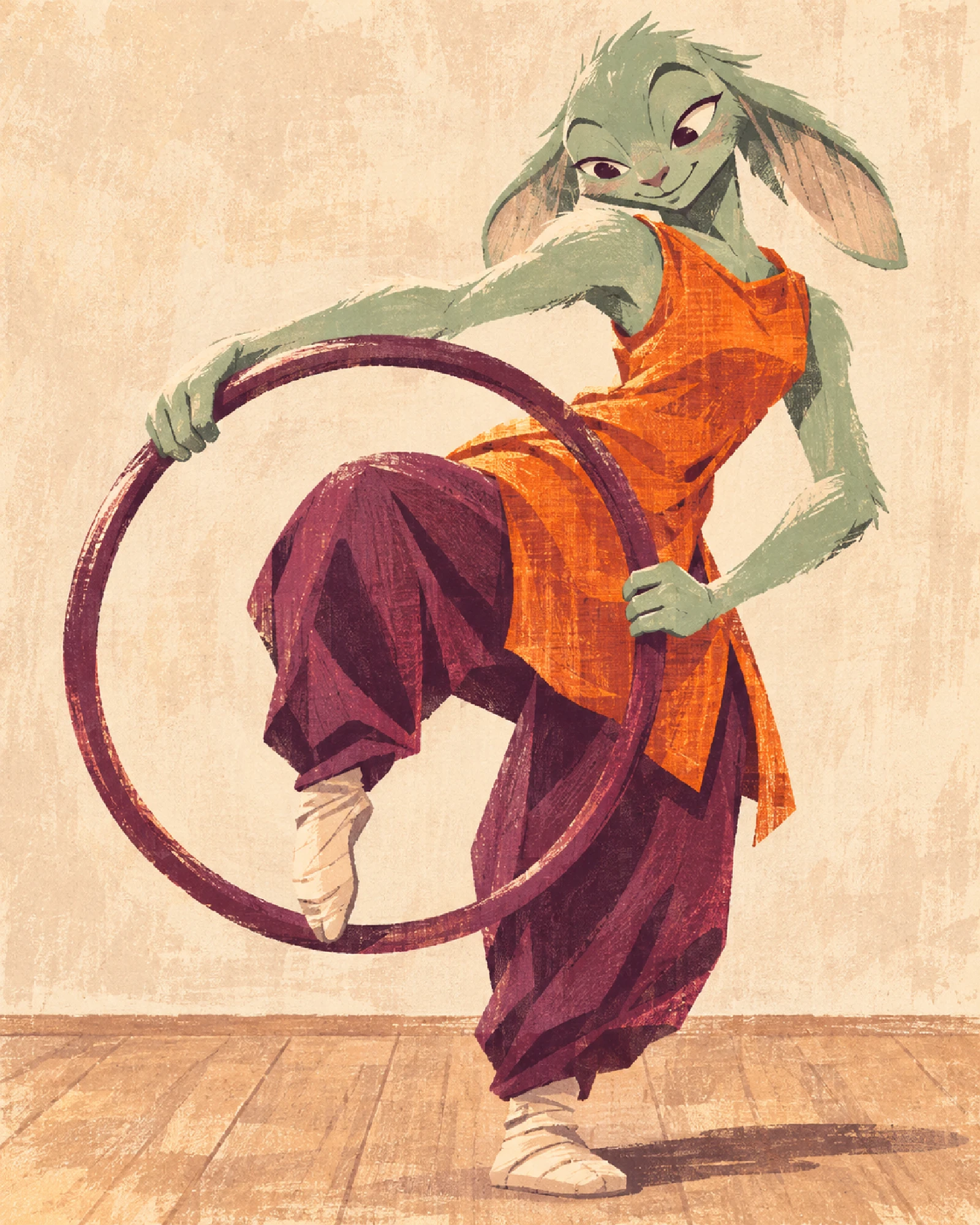
A Dancer Stepping Through a Hoop
A broad-hipped dancer with drooping fin ears smiles while threading one knee through a hoop. An offset silhouette and open spaces between body and hoop give this screen print its rhythm, with bold shapes and imperfect ink overlaps.
Remix this referenceA Dancer Stepping Through a Hoop
- Form language
- Reduce forms to interlocking wedges, swollen arcs and generous cutout gaps; vary minor shapes within this vocabulary.
- Contour
- Let ink-mass edges define most boundaries; occasional thick, blunt contour fragments should stop before completing an outline.
- Mark-making
- Use broad pulled-ink streaks and sparse broken hatch clusters, with naturally uneven pressure and small registration slips.
- Surface rendering
- Build tone from overlapping screen-printed plates, allowing translucent overprints and ragged dry edges beside dense ink passages.
Priority
Make decisive shape rhythms and visibly layered screen-print ink the defining treatment.
What to avoid & what to check
Exact prompt for this example
MODULE OWNERSHIP
subject: Subject count, type, stable proportions and landmarks, resting face geometry, hair shape, physical materials, garment construction and permanent marks. No emotion, movement, color assignment or rendering recipe.
expression: Facial soft-tissue displacement and pupil direction, muscle coordination, regional intensity, asymmetry and onset/peak/release. No head/body pose, stable appearance, skin color or rendering.
gesture: Head/neck/body/limb orientation, joint movement, support, contact and pose-caused occlusion using existing anatomy. No eye/pupil movement, emotion, identity, props inventory or camera.
props: Prop count, type, construction, physical material and scale relative to the subject. Holding/contact belongs to gesture, position to composition, color to palette.
scene: Environment elements, terrain, backdrop/floor presence and structural detail. No canvas positions, camera, lighting, assigned colors or render texture.
camera: Projection, focal-length impression, camera elevation/yaw/roll, viewing distance and crop. No actor pose, world placement, lighting or canvas aspect ratio.
composition: Normalized 0-100% canvas positions, scale in frame, depth/overlap, focal hierarchy and margins. No joint pose, camera projection, rendering, subject/prop inventory or emotion.
palette: Color anchors, hue/saturation/value ranges, colors assigned to parts and approximate color coverage. No illumination direction, shading algorithm, physical material or layout.
lighting: Light-source direction/softness/intensity, ambient illumination, physical shadow direction/length and highlight position. Absence of directional illumination is allowed. No shading technique, palette or material changes.
style: Reusable form abstraction, contour weight/taper/edge quality, medium and mark scale/density/direction, surface rendering and tonal transition technique. No fixed subject proportions, anatomy, identity, expression, pose, palette, light-source direction, camera or layout.
output: Image count, aspect ratio, size, file/alpha requirements and global lettering/logo/watermark restrictions. No background scenery, crop, style, identity or pose.

SUBJECT
inventory: One original adult humanoid creature, a dancer with short dense fur and no tail.
geometry: A small diamond-shaped head, long drooping fin ears, narrow shoulders, broad hips and compact feet.
resting-face: Widely spaced oval eyes, low brow ridges, a short wedge nose and a broad mouth with a shallow upper lip.
appearance: A sleeveless woven tunic with side slits over loose high-waisted trousers; simple cloth wraps cover the feet.

PRIORITY


AVOID


CHECK


EXPRESSION — ACTOR A
brows: One brow lifts slightly while the other stays relaxed.
lids: Lower lids rise gently; upper lids remain comfortably open.
cheeks: Cheeks lift unevenly, stronger beside the raised mouth corner.
nose: Nostrils and nose bridge remain relaxed.
mouth: A small closed smile pulls one corner higher.
jaw: The jaw stays loose without dropping open.
gaze: Both pupils look downward toward the knee.
coordination: The uneven cheek lift and mouth corner carry quiet amusement beneath restrained brows.
timing: Hold the apex of a brief private smile before it relaxes.

PRIORITY


AVOID


CHECK


GESTURE
head: The neck bends gently and the head tips toward the raised knee.
torso: The torso bends sideways as the hips shift over the supporting leg.
limbs: One foot remains planted while the other knee passes through the hoop; elbows open outward.
contact: Both hands brace opposite sides of the rim; the raised thigh partly hides its lower arc.

PRIORITY


AVOID


CHECK


PROPS
inventory: One rigid dance hoop, large enough for the dancer's hips to pass through.
construction: A continuous bent-wood ring with a rounded section and an unadorned surface.

PRIORITY


AVOID


CHECK


SCENE
inventory: A bare rehearsal room with a plaster wall and a timber floor.
structure: A simple wall-floor junction and a few broad floorboard divisions establish the room.

PRIORITY


AVOID


CHECK


CAMERA
projection: Use a mild long-lens perspective with little apparent depth distortion.
viewpoint: View from waist height in a shallow three-quarter view, with no camera roll.
crop: A full-figure view includes the complete hoop and a little floor beneath the feet.

PRIORITY


AVOID


CHECK


COMPOSITION
placement: Place the large figure right of center, with the hoop extending left and generous open space above-left.
depth: The face leads, followed by the knee within the hoop; the room remains a quiet rear plane.
spacing: Keep the hoop's open crescent legible beside the torso and allow comfortable margins around its rim.

PRIORITY


AVOID


CHECK


PALETTE
colors: Use aubergine, persimmon orange, muted mint and warm ivory; keep the dark anchor deep and restrained.
assignment: Mint fur, an orange tunic, aubergine trousers and hoop, with ivory surroundings and foot wraps.
balance: Ivory occupies the largest area; orange and mint form the main chromatic exchange, punctuated by dark accents.

PRIORITY


AVOID


CHECK


LIGHTING
sources: Broad soft light enters from upper left, supported by gentle room ambience.
shadows: A short soft cast shadow falls rightward across the floor.
highlights: Broad highlights touch the upper-left cheek, shoulder and hoop rim.

PRIORITY


AVOID


CHECK


STYLE GUIDE
form-language: Reduce forms to interlocking wedges, swollen arcs and generous cutout gaps; vary minor shapes within this vocabulary.
contour: Let ink-mass edges define most boundaries; occasional thick, blunt contour fragments should stop before completing an outline.
mark-making: Use broad pulled-ink streaks and sparse broken hatch clusters, with naturally uneven pressure and small registration slips.
surface-rendering: Build tone from overlapping screen-printed plates, allowing translucent overprints and ragged dry edges beside dense ink passages.

PRIORITY
Make decisive shape rhythms and visibly layered screen-print ink the defining treatment.

AVOID


CHECK


OUTPUT
format: One portrait image, 4:5 aspect ratio, 1600 × 2000 pixels, opaque PNG.
restrictions: No lettering, logos, signatures or watermarks.

PRIORITY


AVOID


CHECK


FINAL INTEGRATION
gesture + composition + style: Let the action create open intervals that the arrangement preserves and the print shapes articulate.
Model information comes from image provenance. The same prompt may produce a different result.