Text to imageSpace & architectureStyle guide
Reed Blind in the Brick Passage
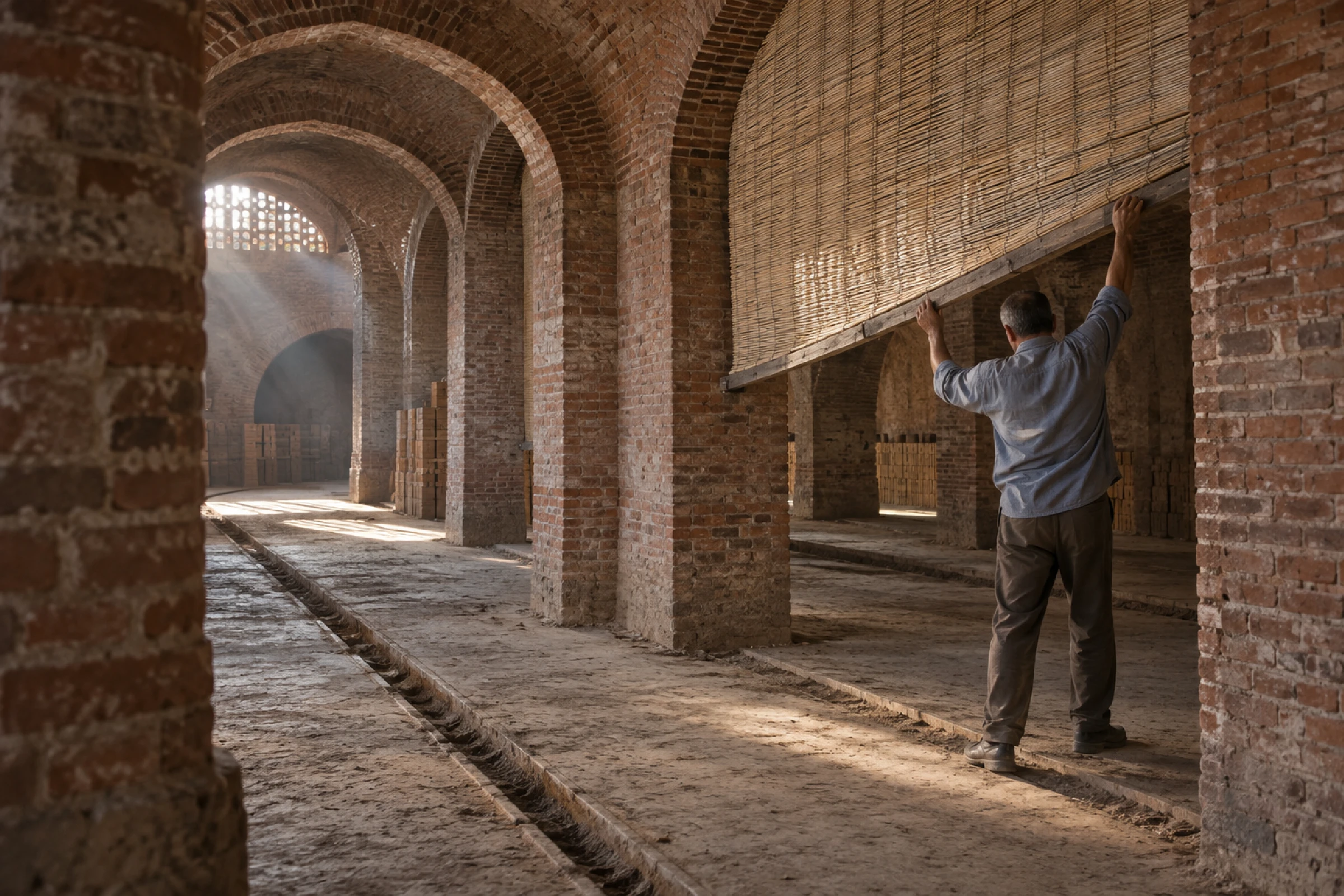
A caretaker lifts a great reed blind, revealing arches and shallow channels inside a former brick drying hall. Analog architectural photography gives the layered passage expressive depth.
Remix this referenceReed Blind in the Brick Passage
- Form language
- Use observational photographic forms with natural irregularities in volumes and edges.
- Contour
- Define boundaries optically without drawn outlines; let fine edges soften naturally beyond the focus plane.
- Mark-making
- Fine irregular film grain remains visible in quiet tones, with sparse incidental dust rather than a repeated distress pattern.
- Surface rendering
- Use silver-halide print tonality: open midtones, gently compressed highlights and gradual optical softness through depth.
Priority
The finished image reads as an analog photograph with expressive depth.
What to avoid & what to check
Exact prompt for this example
MODULE OWNERSHIP
subject: Subject count, type, stable proportions and landmarks, resting face geometry, hair shape, physical materials, garment construction and permanent marks. No emotion, movement, color assignment or rendering recipe.
expression: Facial soft-tissue displacement and pupil direction, muscle coordination, regional intensity, asymmetry and onset/peak/release. No head/body pose, stable appearance, skin color or rendering.
gesture: Head/neck/body/limb orientation, joint movement, support, contact and pose-caused occlusion using existing anatomy. No eye/pupil movement, emotion, identity, props inventory or camera.
props: Prop count, type, construction, physical material and scale relative to the subject. Holding/contact belongs to gesture, position to composition, color to palette.
scene: Environment elements, terrain, backdrop/floor presence and structural detail. No canvas positions, camera, lighting, assigned colors or render texture.
camera: Projection, focal-length impression, camera elevation/yaw/roll, viewing distance and crop. No actor pose, world placement, lighting or canvas aspect ratio.
composition: Normalized 0-100% canvas positions, scale in frame, depth/overlap, focal hierarchy and margins. No joint pose, camera projection, rendering, subject/prop inventory or emotion.
palette: Color anchors, hue/saturation/value ranges, colors assigned to parts and approximate color coverage. No illumination direction, shading algorithm, physical material or layout.
lighting: Light-source direction/softness/intensity, ambient illumination, physical shadow direction/length and highlight position. Absence of directional illumination is allowed. No shading technique, palette or material changes.
style: Reusable form abstraction, contour weight/taper/edge quality, medium and mark scale/density/direction, surface rendering and tonal transition technique. No fixed subject proportions, anatomy, identity, expression, pose, palette, light-source direction, camera or layout.
output: Image count, aspect ratio, size, file/alpha requirements and global lettering/logo/watermark restrictions. No background scenery, crop, style, identity or pose.

SUBJECT
inventory: One adult caretaker, actor A; no other people.
geometry: An ordinary adult build with broad shoulders and a compact silhouette.
resting-face: Resting facial landmarks remain unspecified because the face is unseen.
appearance: Close-cropped hair, a loose cotton work shirt, straight trousers and sturdy leather boots.

PRIORITY


AVOID


CHECK


EXPRESSION — ACTOR A
brows: Brow displacement is unseen and remains unprescribed.
lids: Eyelid movement is unseen and remains unprescribed.
cheeks: Cheek displacement is unseen and remains unprescribed.
nose: Nasal soft-tissue movement is unseen and remains unprescribed.
mouth: Lip movement is unseen and remains unprescribed.
jaw: Jaw tension and opening are unseen and remain unprescribed.
gaze: Pupil direction is unseen and remains unprescribed.
coordination: No visible facial coordination is required; leave hidden acting unspecified.
timing: The neutral release has no visible facial cue; do not invent a hidden transition.

PRIORITY


AVOID


CHECK


GESTURE
head: A faces away, neck extended slightly toward the opening.
torso: The torso leans into the lift with a gentle twist through the shoulders.
limbs: One arm reaches overhead while the other stays bent; staggered feet support the effort.
contact: Both hands grip the blind's lower rail, lifting one end higher to open a wedge beneath it.

PRIORITY


AVOID


CHECK


PROPS
inventory: No separate props; the reed blind is an architectural fitting.
construction: No separate prop construction applies.

PRIORITY


AVOID


CHECK


SCENE
inventory: A former brick drying hall with transverse vaults, shallow floor channels and a suspended reed blind.
structure: Thick piers divide linked chambers; tied reeds form a flexible blind with a wooden lower rail.

PRIORITY


AVOID


CHECK


CAMERA
projection: Rectilinear perspective with a moderately wide architectural lens impression.
viewpoint: View diagonally along the passage from standing eye level, with a level horizon.
crop: A wide interior view retains the caretaker's full figure and cuts through the nearest vault.

PRIORITY


AVOID


CHECK


COMPOSITION
placement: Place A near the right third beneath the blind; the opening is the primary spatial focus.
depth: A cropped foreground pier, the blind and successive chambers establish overlapping depths.
spacing: Keep the figure small against the hall; let a generous floor interval lead toward the opening.

PRIORITY


AVOID


CHECK


PALETTE
colors: Kiln red, tobacco brown, pale straw and subdued blue-gray.
assignment: Brickwork carries kiln red, reeds pale straw, floor tobacco brown and A's shirt blue-gray.
balance: Earth hues dominate, with the restrained shirt color providing a small cool counterpoint.

PRIORITY


AVOID


CHECK


LIGHTING
sources: Broad daylight enters from a high opening at rear left; weak ambient light reaches the near chamber.
shadows: Piers cast long, soft-edged shadows toward the foreground right.
highlights: The raised rail and A's upper sleeve catch the clearest highlights.

PRIORITY


AVOID


CHECK


STYLE GUIDE
form-language: Use observational photographic forms with natural irregularities in volumes and edges.
contour: Define boundaries optically without drawn outlines; let fine edges soften naturally beyond the focus plane.
mark-making: Fine irregular film grain remains visible in quiet tones, with sparse incidental dust rather than a repeated distress pattern.
surface-rendering: Use silver-halide print tonality: open midtones, gently compressed highlights and gradual optical softness through depth.

PRIORITY
The finished image reads as an analog photograph with expressive depth.

AVOID


CHECK


OUTPUT
format: One image, landscape 3:2, 2400 × 1600 pixels, opaque PNG.
restrictions: No lettering, logos or watermarks.

PRIORITY


AVOID


CHECK
Model information comes from image provenance. The same prompt may produce a different result.