Text to imageArt stylesStyle guide
Antlers in the Clothesline
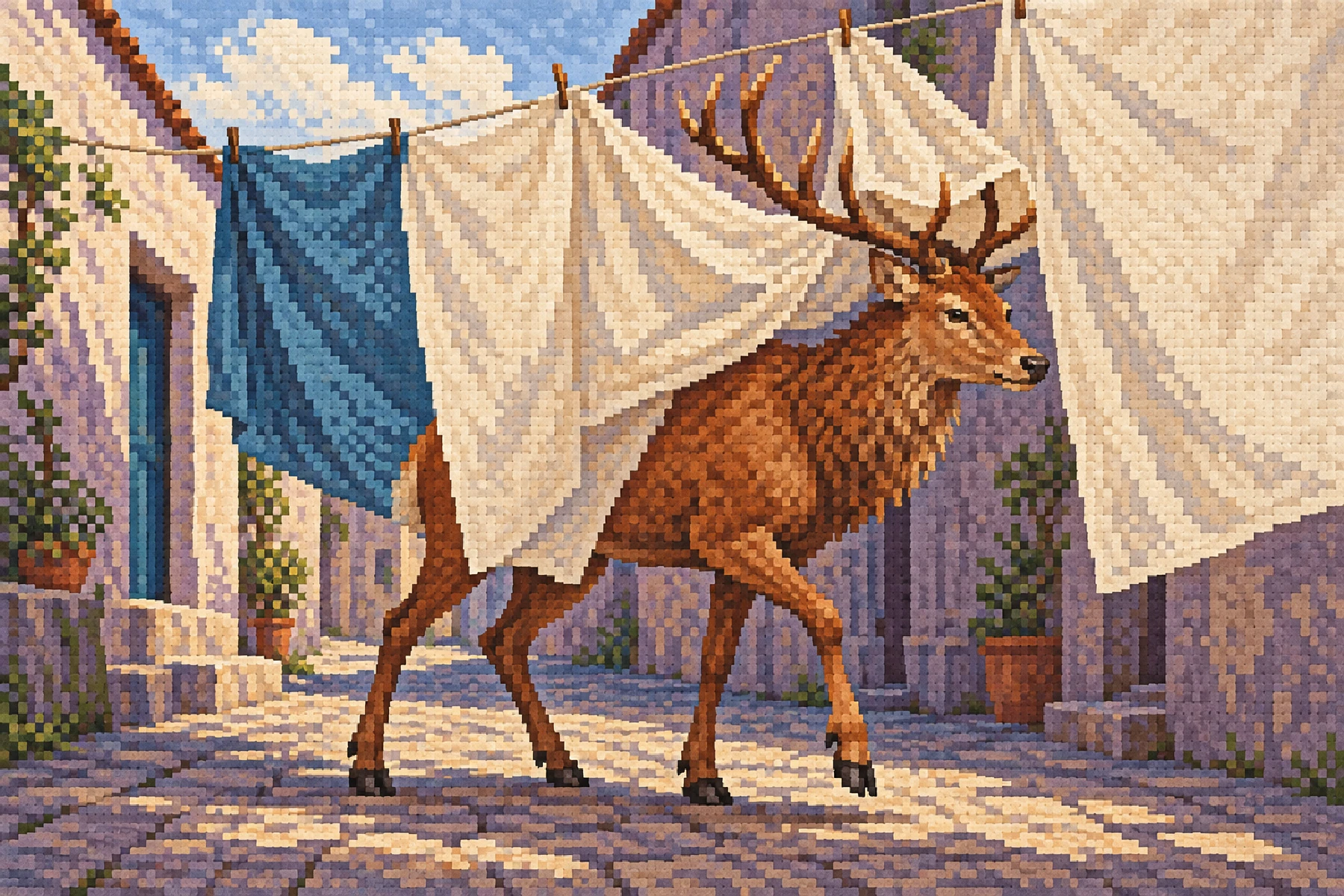
A stag catches a hanging sheet on its antlers while crossing a narrow courtyard. Overlapping cloth and stepped silhouettes become a lively weave of coarse pixels.
Remix this referenceAntlers in the Clothesline
- Form language
- Build broad shapes from interlocking square blocks; turn curves through purposeful stair-step runs on a visibly coarse grid.
- Contour
- Use hard stepped silhouettes with occasional cell-sized gaps; retain uneven runs instead of smoothing every edge.
- Mark-making
- Interlace short horizontal and vertical pixel bars like hand-set threads, letting their spacing and rhythm vary naturally.
- Surface rendering
- Build midtones from mingled neighboring cells and broken block clusters; let patchy densities create a woven surface.
Priority
The defining treatment is woven pixel art with deliberate low-resolution edges.
What to avoid & what to check
Exact prompt for this example
MODULE OWNERSHIP
subject: Subject count, type, stable proportions and landmarks, resting face geometry, hair shape, physical materials, garment construction and permanent marks. No emotion, movement, color assignment or rendering recipe.
expression: Facial soft-tissue displacement and pupil direction, muscle coordination, regional intensity, asymmetry and onset/peak/release. No head/body pose, stable appearance, skin color or rendering.
gesture: Head/neck/body/limb orientation, joint movement, support, contact and pose-caused occlusion using existing anatomy. No eye/pupil movement, emotion, identity, props inventory or camera.
props: Prop count, type, construction, physical material and scale relative to the subject. Holding/contact belongs to gesture, position to composition, color to palette.
scene: Environment elements, terrain, backdrop/floor presence and structural detail. No canvas positions, camera, lighting, assigned colors or render texture.
camera: Projection, focal-length impression, camera elevation/yaw/roll, viewing distance and crop. No actor pose, world placement, lighting or canvas aspect ratio.
composition: Normalized 0-100% canvas positions, scale in frame, depth/overlap, focal hierarchy and margins. No joint pose, camera projection, rendering, subject/prop inventory or emotion.
palette: Color anchors, hue/saturation/value ranges, colors assigned to parts and approximate color coverage. No illumination direction, shading algorithm, physical material or layout.
lighting: Light-source direction/softness/intensity, ambient illumination, physical shadow direction/length and highlight position. Absence of directional illumination is allowed. No shading technique, palette or material changes.
style: Reusable form abstraction, contour weight/taper/edge quality, medium and mark scale/density/direction, surface rendering and tonal transition technique. No fixed subject proportions, anatomy, identity, expression, pose, palette, light-source direction, camera or layout.
output: Image count, aspect ratio, size, file/alpha requirements and global lettering/logo/watermark restrictions. No background scenery, crop, style, identity or pose.

SUBJECT
inventory: One adult stag, actor A; no other animals or people.
geometry: A deep chest, slender legs, narrow muzzle and two spreading antlers with branching tines.
resting-face: Side-set eyes beneath shallow brow ridges; a broad nose ends the tapered muzzle above a short mouth seam.
appearance: Short fur, a coarse neck ruff, exposed antler bone and cloven keratin hooves; no garments or permanent marks.

PRIORITY


AVOID


CHECK


EXPRESSION — ACTOR A
brows: The visible brow rests without lifting or drawing inward.
lids: The near-side eyelids remain naturally open without widening or squeezing.
cheeks: The visible cheek stays slack, without bunching toward the eye.
nose: The visible nostril rests without flare or wrinkling.
mouth: The lips meet softly, with no corner pull or exposed teeth.
jaw: The jaw remains gently closed without clenching.
gaze: The visible pupil looks ahead along the passage; the far eye remains unprescribed.
coordination: The visible eye and muzzle share an unstrained resting state; hidden facial regions need no control.
timing: At the apex, this quiet resting expression remains steady.

PRIORITY


AVOID


CHECK


GESTURE
head: A reaches its neck forward beneath the line, tipping the antlers into the cloth; the muzzle shows in partial profile.
torso: The torso turns through the passage, with the shoulders advancing ahead of the hindquarters.
limbs: One foreleg lifts into the next step while the other foreleg and hind legs support the stride.
contact: One sheet catches across an antler fork while remaining on the line; planted hooves bear weight on the paving.

PRIORITY


AVOID


CHECK


PROPS
inventory: Three rectangular laundry sheets, each broad enough to conceal much of the stag's torso.
construction: Woven cotton sheets with simple turned hems; minor edge and fold differences may vary naturally.

PRIORITY


AVOID


CHECK


SCENE
inventory: A narrow domestic courtyard with paving, opposing plaster walls, shallow doorsteps and an installed clothesline.
structure: The walls form a passage open to the sky, with a small doorway recess interrupting one wall.

PRIORITY


AVOID


CHECK


CAMERA
projection: Moderate perspective with a natural short-normal lens impression.
viewpoint: View from just above paving level, looking slightly upward along the passage without camera roll.
crop: Include the full stag and lifted sheet; allow the enclosing walls to continue beyond the crop.

PRIORITY


AVOID


CHECK


COMPOSITION
placement: The stag crosses the lower half diagonally; the lifted sheet above its shoulders is the first focal shape.
depth: The nearest sheet overlaps the antlers; the others partly screen the body and reveal the passage through gaps.
spacing: Keep a spacious opening at upper left and tighter overlaps around the snag; preserve a gap beneath the belly.

PRIORITY


AVOID


CHECK


PALETTE
colors: Pale flax, muted violet, rusty copper and restrained peacock blue.
assignment: Flax colors two sheets and the sky, violet the courtyard, copper the stag and blue the third sheet.
balance: Broad pale cloth fields interrupt the quieter violet surroundings; copper and blue provide concentrated accents.

PRIORITY


AVOID


CHECK


LIGHTING
sources: Broad daylight enters from upper left with soft ambient fill throughout the passage.
shadows: Soft-edged shadows fall a short distance toward lower right beneath the stag and hanging cloth.
highlights: Gentle highlights touch upper antler ridges and the crest of the lifted sheet.

PRIORITY


AVOID


CHECK


STYLE GUIDE
form-language: Build broad shapes from interlocking square blocks; turn curves through purposeful stair-step runs on a visibly coarse grid.
contour: Use hard stepped silhouettes with occasional cell-sized gaps; retain uneven runs instead of smoothing every edge.
mark-making: Interlace short horizontal and vertical pixel bars like hand-set threads, letting their spacing and rhythm vary naturally.
surface-rendering: Build midtones from mingled neighboring cells and broken block clusters; let patchy densities create a woven surface.

PRIORITY
The defining treatment is woven pixel art with deliberate low-resolution edges.

AVOID


CHECK


OUTPUT
format: One finished image, landscape 3:2, 1800 × 1200 pixels, opaque PNG.
restrictions: No lettering, logos or watermarks.

PRIORITY


AVOID


CHECK


FINAL INTEGRATION
gesture + composition + style: Let the action remain legible through the overlaps as the woven treatment unifies the image.
Model information comes from image provenance. The same prompt may produce a different result.