Text to imageAnimationStyle guide
Snowdrift in the Mountain Gallery
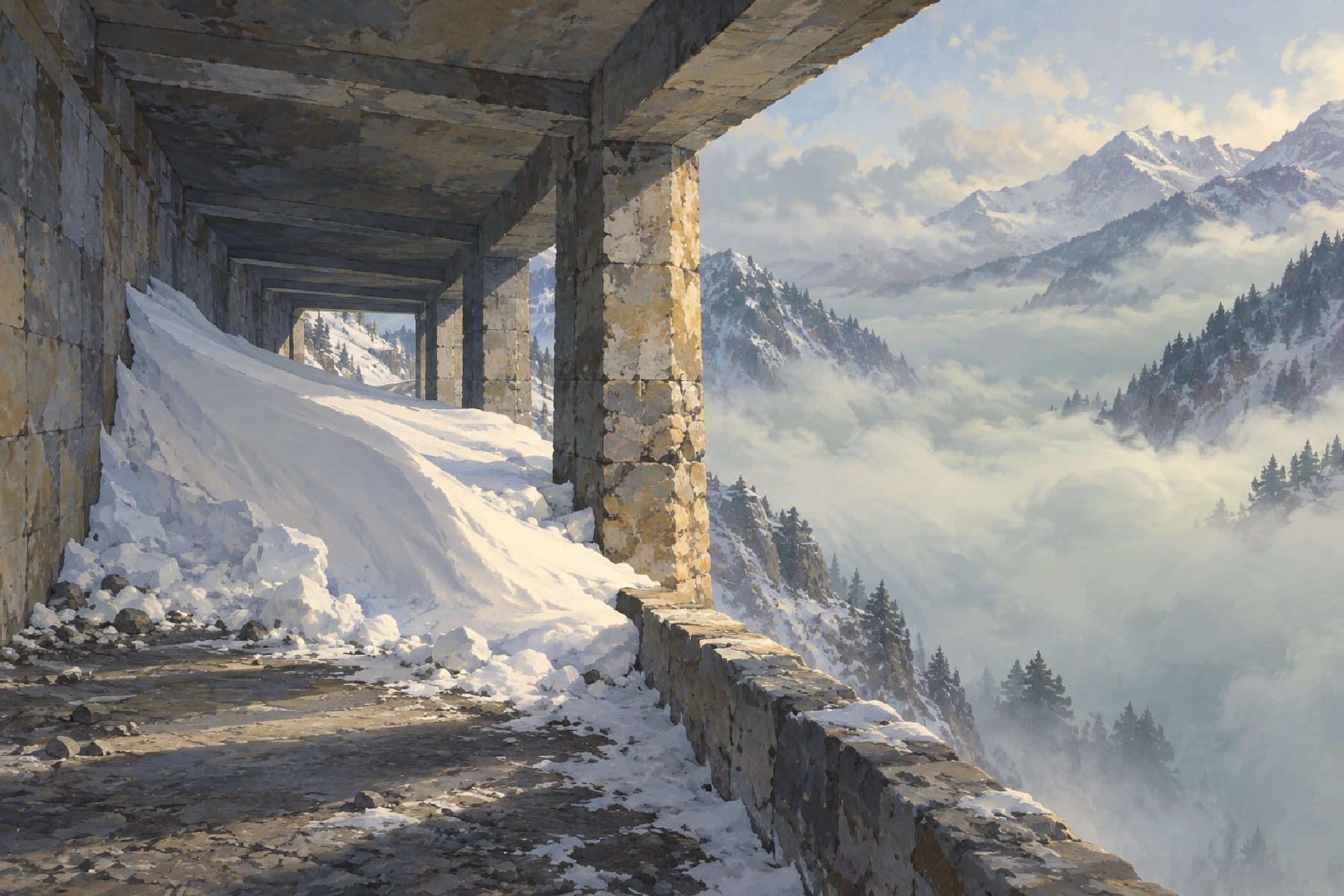
A snowdrift spills into a mountainside avalanche gallery. Sunlit snow curves beneath the heavy roof, while an immense opening onto fog holds the stillness after a storm.
Remix this referenceSnowdrift in the Mountain Gallery
- Form language
- Establish broad interlocking form planes first, then describe smaller variations with unequal painted patches; simplify without making every shape regular.
- Contour
- Alternate firm opaque boundaries with feathered and lost edges; painted transitions replace strong continuous outlines.
- Mark-making
- Overlap brush traces along the direction of each plane, interrupted by sparse dragged dry-brush marks; allow natural changes in stroke width and pressure.
- Surface rendering
- Let shallow paper-and-pigment tooth show through uneven painted planes; combine broken opaque patches with gently blended tonal transitions.
Priority
Rendering medium: 2D hand-painted animated-film background illustration; formal rendering reference: Studio Ghibli · 2020s · The Boy and the Heron (2023), background art
What to avoid & what to check
Exact prompt for this example
MODULE OWNERSHIP
subject: Subject count, type, stable proportions and landmarks, resting face geometry, hair shape, physical materials, garment construction and permanent marks. No emotion, movement, color assignment or rendering recipe.
expression: Facial soft-tissue displacement and pupil direction, muscle coordination, regional intensity, asymmetry and onset/peak/release. No head/body pose, stable appearance, skin color or rendering.
gesture: Head/neck/body/limb orientation, joint movement, support, contact and pose-caused occlusion using existing anatomy. No eye/pupil movement, emotion, identity, props inventory or camera.
props: Prop count, type, construction, physical material and scale relative to the subject. Holding/contact belongs to gesture, position to composition, color to palette.
scene: Environment elements, terrain, backdrop/floor presence and structural detail. No canvas positions, camera, lighting, assigned colors or render texture.
camera: Projection, focal-length impression, camera elevation/yaw/roll, viewing distance and crop. No actor pose, world placement, lighting or canvas aspect ratio.
composition: Normalized 0-100% canvas positions, scale in frame, depth/overlap, focal hierarchy and margins. No joint pose, camera projection, rendering, subject/prop inventory or emotion.
palette: Color anchors, hue/saturation/value ranges, colors assigned to parts and approximate color coverage. No illumination direction, shading algorithm, physical material or layout.
lighting: Light-source direction/softness/intensity, ambient illumination, physical shadow direction/length and highlight position. Absence of directional illumination is allowed. No shading technique, palette or material changes.
style: Reusable form abstraction, contour weight/taper/edge quality, medium and mark scale/density/direction, surface rendering and tonal transition technique. No fixed subject proportions, anatomy, identity, expression, pose, palette, light-source direction, camera or layout.
output: Image count, aspect ratio, size, file/alpha requirements and global lettering/logo/watermark restrictions. No background scenery, crop, style, identity or pose.

SUBJECT
inventory: No characters or separate object subjects.
geometry: No character proportions or anatomical landmarks apply.
resting-face: No faces are present.
appearance: No character appearance, garments or permanent marks apply.

PRIORITY


AVOID


CHECK


PROPS
inventory: No separate props.
construction: No prop construction applies.

PRIORITY


AVOID


CHECK


SCENE
inventory: An avalanche gallery follows a mountain ledge, with a deep snowdrift, exposed scree and a fog-filled valley.
structure: A heavy concrete roof rests on square stone piers beside a retaining wall. Snow bulges through an open bay onto the rough floor; worn joints and chipped edges may vary naturally.

PRIORITY


AVOID


CHECK


CAMERA
projection: Use natural perspective with a moderately wide, approximately 28 mm lens impression.
viewpoint: View from standing eye level inside the gallery, looking obliquely along its open side with a level horizon.
crop: Use a wide environmental view, cropping through the nearest roof and wall while retaining the drift's full leading edge.

PRIORITY


AVOID


CHECK


COMPOSITION
placement: The roof forms a weighty upper-left wedge. The drift below it is the focal point; open fog occupies most of the right half.
depth: Overlapping piers lead from the foreground into a small distant bend; the valley remains an expansive, nearly uninterrupted interval.
spacing: Keep the snow crest clear of the pier silhouettes and let generous empty space counterbalance the compressed architecture.

PRIORITY


AVOID


CHECK


PALETTE
colors: Use ivory, faded ochre, muted blue-violet and pale celadon, with restrained saturation.
assignment: Assign ivory to snow, faded ochre to stone and concrete, blue-violet to recesses, and pale celadon to valley fog.
balance: Pale values dominate; ochre provides a muted middle range, with only a few deep blue-violet accents.

PRIORITY


AVOID


CHECK


LIGHTING
sources: Low sunlight enters from the open right side with softly defined edges; fog supplies broad ambient fill.
shadows: Pier shadows stretch leftward across the floor, beneath the broad shade cast by the roof.
highlights: Sunlight catches the exposed snow crests and outward-facing lips of the piers, creating the strongest highlights.

PRIORITY


AVOID


CHECK


STYLE GUIDE
form-language: Establish broad interlocking form planes first, then describe smaller variations with unequal painted patches; simplify without making every shape regular.
contour: Alternate firm opaque boundaries with feathered and lost edges; painted transitions replace strong continuous outlines.
mark-making: Overlap brush traces along the direction of each plane, interrupted by sparse dragged dry-brush marks; allow natural changes in stroke width and pressure.
surface-rendering: Let shallow paper-and-pigment tooth show through uneven painted planes; combine broken opaque patches with gently blended tonal transitions.

PRIORITY
Rendering medium: 2D hand-painted animated-film background illustration; formal rendering reference: Studio Ghibli · 2020s · The Boy and the Heron (2023), background art

AVOID


CHECK


OUTPUT
format: One finished image, landscape 3:2, 1800 × 1200 pixels, opaque PNG.
restrictions: No lettering, logos or watermarks.

PRIORITY


AVOID


CHECK


FINAL INTEGRATION
scene + composition + lighting: Let the architecture, open interval and illumination cooperate to make the aftermath of the storm legible without characters.
style + palette: Keep the restrained color relationships coherent as painted patches vary naturally in shape and opacity.
Art direction
스튜디오 지브리 / Studio Ghibli · 2020s · 그대들은 어떻게 살 것인가(2023)의 배경 미술 / The Boy and the Heron (2023), background art ↗- Establish broad form planes before describing smaller surface variations with painted patches
- Use hard and soft painted boundaries rather than strong continuous outlines
- Overlapping brush traces following the plane direction with sparse dry-brush marks
- Shallow paper-and-pigment texture, uneven painted planes and blended tonal transitions
Model information comes from image provenance. The same prompt may produce a different result.